UNITED STATES
SECURITIES AND EXCHANGE COMMISSION
Washington, D.C. 20549
FORM 10-K
| [X] | Annual report under Section 13 or 15(d) of the Securities Exchange Act of 1934 |
For the fiscal year ended December 31, 2020
| [ ] | Transition report under Section 13 or 15(d) of the Securities Exchange Act of 1934 |
For the transition period from _____________ to _____________
COMMISSION FILE NO. 1-11602
Nano Magic Holdings Inc.
(Exact name of registrant as specified in its charter)
| Delaware | 47-1598792 | |
| (State of Incorporation) | (IRS Employer Identification Number) |
31601 Research Park Drive, Madison Heights, MI 48071
(Address of principal executive office, including Zip Code)
Registrant’s telephone number, including area code: (844) 273-6462
Securities registered pursuant to Section 12(b) of the Exchange Act:
| Title of each class | Trading Symbol | Name of Each Exchange on Which Registered | ||
| Common Stock, $0.0001 par value | NMGX | OTC Markets |
Securities registered pursuant to Section 12(g) of the Exchange Act: None
Indicate by check mark if the registrant is a well-known seasoned issuer as defined in Rule 405 of the Securities Act. Yes [ ] No [X]
Indicate by check mark if the registrant is not required to file reports pursuant to Section 13 or Section 15(d) of the Act. Yes [ ] No [X]
Indicate by check mark whether the registrant: (1) has filed all reports required to be filed by Section 13 or 15(d) of the Securities Exchange Act of 1934 during the past 12 months (or for such shorter period that the registrant was required to file such reports), and (2) has been subject to such filing requirements for the past 90 days. Yes [X] No [ ]
Indicate by check mark whether the registrant has submitted electronically and posted on its corporate website, if any, every Interactive Data File required to be submitted and posted pursuant to Rule 405 of Regulation S-T (232.405 of this chapter) during the preceding 12 months (or for such shorter period that the registrant was required to submit and post such files). Yes [X] No [ ]
Indicate by check mark whether the registrant is a large accelerated filer, an accelerated filer, a non-accelerated filer, a smaller reporting company, or an emerging growth company. See the definitions of “large accelerated filer,” “accelerated filer,” “smaller reporting company,” and “emerging growth company” in Rule 12b-2 of the Exchange Act.
| Large Accelerated Filer [ ] | Accelerated Filer [ ] |
| Non-accelerated Filer [X] | Smaller Reporting Company [X] |
| Emerging Growth Company [ ] |
If an emerging growth company, indicate by check mark if the registrant has elected not to use the extended transition period for complying with any new or revised financial accounting standards provided pursuant to Section 13(a) of the Exchange Act. [ ]
Indicate by check mark whether the registrant has filed a report on and attestation to its management’s assessment of the effectiveness of its internal control over financial reporting under Section 404(b) of the Sarbanes-Oxley Act (15 U.S.C. 7262(b)) by the registered public accounting firm that prepared or issued its audit report. [ ]
Indicate by check mark whether the registrant is a shell company (as defined in Rule 12b-2 of the Exchange Act). Yes [ ] No [X]
The aggregate market value of the Common Stock held by non-affiliates of the Registrant, based upon the closing price of the Common Stock on the OTCQB system on June 30, 2020 of $1.25, was approximately $1,125,970.
As of May 20, 2021, the registrant had 9,657,347 shares of common stock issued and outstanding.
Documents Incorporated by Reference: No documents are incorporated by reference into this annual report on Form 10-K.
NANO MAGIC HOLDINGS INC.
FORM 10-K
TABLE OF CONTENTS
| 2 |
CAUTIONARY NOTE REGARDING FORWARD-LOOKING STATEMENTS
This Annual Report on Form 10-K (this “Report”) contains “forward-looking statements” within the meaning of Section 27A of the Securities Act of 1933 and Section 21E of the Securities Exchange Act of 1934, which includes information about us and our industry that involve substantial risks and uncertainties. All statements, other than statements of historical facts, included in this Report regarding our strategy, future operations, future financial position, future net sales, projected expenses, prospects and plans and objectives of management are forward-looking statements. These statements involve known and unknown risks, uncertainties and other factors that may cause our actual results, levels of activity, performance or achievement to be materially different from those expressed or implied by the forward-looking statements.
In some cases, you can identify forward-looking statements by terms such as “anticipate,” “believe,” “estimate,” “expect,” “intend,” “may,” “might,” “plan,” “project,” “will,” “would,” “should,” “could,” “can,” “potential,” “continue,” or the negative of these terms, and similar expressions intended to identify forward-looking statements. However, not all forward-looking statements contain these identifying words. These forward-looking statements reflect our current views about future events and are based on assumptions and subject to risks and uncertainties. Given these uncertainties, you should not place undue reliance on these forward-looking statements. Actual events or results could differ materially from those expressed or implied by these forward-looking statements as a result of various factors. There may be other factors that cause our actual results to differ materially from the forward-looking statements.
These forward-looking statements represent our estimates and assumptions only as of the date of this report. Unless required by U.S. federal securities laws, we do not intend to update any of these forward-looking statements to reflect circumstances or events that occur after the statement is made or to conform these statements to actual results.
| 3 |
Nano Magic Holdings Inc., a Delaware corporation (“we”, “us”, “our”, “Nano Magic” or the “Company”), formerly Nano Magic Inc., develops, commercializes and markets consumer and industrial products powered by nanotechnology. Our nanotechnology powered solutions are formulated in the Unites States. We are recognized for the products manufactured and sold by our wholly-owned subsidiary Nano Magic LLC (formerly PEN Brands LLC). These include the NANO MAGIC and ULTRA CLARITY brand eyeglass cleaner. Our consumer products include electronic device hygiene & protection, anti-fog solutions, household cleaning and automobile cleaning and protection in addition to lens care. Our focus for consumer products is to sell Nano Magic-branded consumer products in big box retail and direct-to-consumer sales on our website and other on-line marketplaces. We historically sold our consumer products directly to opticians, ophthalmologists and small optical retailers and we will continue to do so. Institutional and industrial applications include cleaning and defogging and other coatings for glass and ceramics. We also develop and sell printable inks and pastes, thermal management materials, and graphene foils and windows through our other wholly-owned subsidiary, Applied Nanotech, Inc. (“Applied Nanotech”). Applied Nanotech also functions as our Innovation and Technology Center in Austin, Texas, and, in addition to performing product development work for our business, engages in contract research and development work for government and private customers.
Our principal operating segments coincide with our different business activities. Our two reportable segments for the years ended December 31, 2020 and 2019 were (i) the Product segment and (ii) the Contract Services segment.
Product Segment
In our Product segment, revenue is based on the retail and institutional sale of specialty products utilizing nanotechnology to deliver unique performance attributes. We have a strong focus on understanding surfaces and our products for surfaces can be used on a wide variety of substrates. Our consumer products are sold as liquids, gels, foam and as wet and dry towelettes. Institutional coating products are typically sold in liquid form enabling application by a variety of common commercial techniques We rely on intellectual property including trade secret formulations to protect our proprietary technology.
We have multiple product technology platforms that offer solutions to common surface problems such as ease of cleaning, preventing fogging, preventing accumulation of dirt or grime, improving resistance to scuffing and wear and surface protection. All our products have some “nano” characteristic about them – whether it is being active at the molecular level, incorporation of submicron-particles, or creating very thin, self-assembling coatings that are 20 nanometers or less in thickness.
Our consumer products are primarily customized cleaning and de-fogging treatments. With respect to our consumer products, we strive to create segment leading brands that are sustainable, of high quality, and that are both easy and safe to apply. Our products can be used on eyeglasses, extreme sport and safety glasses and goggles, electronic screens, windshields, windows, mirrors, shower doors, and other similar clear surfaces along with the cleaning of everyday household surfaces.
Industrial surface treatment products include a family of coating liquids that create nano-thin, strongly-bound, invisible, “forcefield”-like coatings on surfaces used for glass and ceramic surfaces and a series of clear coatings for plastics incorporating submicron sized particles to improve abrasion resistance and wear resistance without sacrificing transparency. We manufacture our formulations internally to protect our technology and strive to maintain the highest quality for the products that we and our commercial partners bring to the marketplace.
Our surface treating products include:
| ● | Liquid and towelette formulations packaged for retail sale to consumers for cleaning and protecting clear surfaces – such as electronic touchscreens, windshields, windows, mirrors, shower doors, eyeglass and sunglass lenses. | |
| ● | Liquid formulation packaged for retail and industrial sale for cleaning surfaces. |
| 4 |
| ● | Anti-fogging liquid and towelette formulations packaged for retail sale to consumers for safety glasses, protective eye wear including face shields, and sporting goggles. | |
| ● | Anti-fogging towelettes for sale to the military and first responders for safety, anti-fogging and conditioning of lenses, masks, head gear and other applications such as head’s up displays, | |
| ● | Mar-resistant and stain-resistant coatings for high end vitreous china tableware used for heavy duty, usage situations such as restaurants, cruise ships, casinos. | |
| ● | Clear protective coatings used on display panels and touch screens to make it easy to remove fingerprints. Applications include automotive and hand-held devices. | |
| ● | Protective and water-repelling coatings on interior and exterior glass and ceramic surfaces to make it easy to clean and prevent scale and grime encrustation. | |
| ● | Coatings for ceramic insulators used in transit and underground subways systems to prevent caking of metal dust and greases on surfaces to reduce maintenance and current leakage losses. |
In addition to our surface treatment products, we sell metallic inks and pastes to a variety of customers around the world. The submicron particles in our formulations are compatible with the nozzles used in digital printing, including 3D printing. Certain of our products based on nano-copper are available only outside Asia under agreements with our former research partner Ishihara Chemical Company, Ltd., that has exclusive rights in Asia to patents developed under research contracts with them. Other copper products that we sell are available worldwide.
In the medical field, our thin carbon foil made of layers of graphene is sold for use in cyclotron accelerators that produce nuclear pharmaceuticals used by the medical field in Positron Emission Tomography (PET) imaging.
Our vision is to harness the power of nanotechnology to create a safer, more socially conscious, and higher performing world. We have three primary areas of focus:
| 1. | Surface cleaning for safety, time and cost savings: Treating surfaces at the nano-scale for easy clean performance – to clean better and to stay cleaner longer; | |
| 2. | Preventing fogging: Surface treatments at the nano-scale to prevent fogging for safety and improved performance, especially on lenses, sportwear and protective eyewear; and | |
| 3. | Sustainability: Creating nano-scale devices and formulas using safe, natural ingredients and manufacturing methods while avoiding the use of harsh chemicals and pesticides, whenever possible. |
Marketing and Distribution
We sell our consumer products directly to consumers and retailers in the United States. Direct-to-consumer sales are through our website, nanomagic.com, on Amazon and other online marketplaces. We also have products in pharmacies, and big box retailers. Sales to big box retailers include private label products under the retailers’ names. Some of our products are used on our customer’s branded products. Historically we have relied heavily on outside agents and distributors and focused on leading optical retailers. We lost many of those customers in 2018 due to delays in shipping customer orders, but we have continued direct sales to opticians and ophthalmologists.
Our industrial coating products, inks and pastes, and graphene foil products are sold directly to institutional and industrial customers.
Manufacturing Operations
We manufacture, pack and label liquids and towelettes as well as specialty surface coatings at our 29,220-square foot facility in Madison Heights, Michigan. Metallic inks and pastes and the graphene windows are made at our Innovation and Technology Center in Austin, Texas. Health and safety protocols related to the COVID-19 pandemic are in effect at our facilities, but both our facilities are operating.
| 5 |
Intellectual Property and Proprietary Rights
Our nanotechnology expertise and the related intellectual property used in our current products is specialized in the areas of surface science, molecular self-assembly, transparent composites, surfactants, sub-micron metallic inks and pastes and graphene foils. The intellectual property developed from this work is protected with a combination of selective patents and primarily by trade secrets. This intellectual property strategy is like that used by leading companies in the fragrance and flavors industry. No single patent is significant to any of our commercial products. Please refer to the section entitled “Intellectual Property Rights” in this Item 1 for a more detailed discussion of these matters.
Competition
Products sold into the optical segment, which has historically been our core sales channel, have a small number of significant competitors. Our products are known to be the “benchmark” products in these segments and generally outperform those of our competitors. Some of our products in these segments do compete for certain customers or certain applications against lower-priced, traditional materials. Most of the companies selling products into these market segments are privately-held, U.S. packaging or catalog companies. Examples in the U.S. include Hilco Accessories, California Accessories, and Amcon Laboratories. Internationally, the catalog company, Prosben, Inc., from the Peoples Republic of China is a competitor. These companies are not selling direct to consumer or in big box retail and pharmacies. Optical company, Carl Zeiss, sells its branded optical products in bog box retail in those chains where it has optical stores.
In the nano-coating products area or the anti-fog product line we are not aware of any competitive products that we believe match our product performance or processing characteristics. With the COVID-19 pandemic and fogging caused by increased use of masks, other companies have made more of an effort to sell anti-fog products, but no company has a significant portion of the market.
Most inks and pastes sold in commercial quantities today are manufactured and sold by large multinational chemical companies. For example, the two largest suppliers of silver inks and pastes for solar cell production are DuPont and Ferro. We are unable to compete directly with companies of that size in established silver ink markets. The use of metallic inks in 2D and 3D printing is just developing. Because silver is expensive, other metals are preferred for these applications. Numerous other companies are working with other technologies for the commercial use of conductive inks and pastes.
Backlog
Sales are primarily made under purchase orders for delivery of products. We do not believe that a backlog as of any date is indicative of future results. Some agreements give customers the right to purchase a specific quantity of products during a specified period, but these agreements do not obligate the customers to purchase any minimum quantity. Private label customers are required to commit either to minimums or to repurchase unique inventory items related to their product(s). The quantities purchased by the customer, as well as the shipment schedules, are frequently revised during the agreement term to reflect changes in the customer’s needs. Because of our relatively small size, a customer’s delay of a product shipment can make a difference in the results for an accounting period.
Geographical Information
All long-lived assets are in the United States.
Sources and availability of raw materials and the names of principal suppliers
We use third-party suppliers in the United States to obtain substantially all raw materials, components and packaging products. As is customary in our industry, historically we have not had long-term or exclusive agreements with third-party suppliers and have generally made purchases through purchase orders. In the last quarter of 2018 and first quarter of 2019 we terminated most of our outside contract and toll manufacturing, bringing our manufacturing back in house. We believe that we have good relationships with our suppliers.
| 6 |
Apart from the disruption affecting all manufacturing businesses as a result of the COVID-19 pandemic, some of the raw materials and bottles used to produce our liquid products are used to produce hand sanitizer and other cleaning product that were in high demand during the pandemic and some of our raw materials and packaging become harder to find due to the COVID-19 pandemic, but we were able to obtain what we needed for our operations. With some suppliers we have moved to blanket purchase orders and have seen some price increases, but this has not disrupted operations.
Key Customers
A limited number of key customers historically accounted for a majority of our commercial revenue in the product segment. The company re-built its customer base in 2019 and 2020 with the addition of new sales channels. In 2019, no customer represented greater than 10% of total product revenue in 2019 as a result of these changes. In 2020, three customers each represented a total of 10% of total product revenue.
Impact of COVID-19
In December 2019, COVID-19 was first reported in Wuhan, China. Less than four months later, on March 11, 2020, the World Health Organization declared COVID-19 a pandemic. During the rest of 2020, restrictions imposed by Federal, state and local governments affected operations of our business and those of our vendors and customers as well as logistics for shipping and receiving supplies and shipping our products. We experienced longer lead-times to receive supplies and price increases on some items, but did not suffer any major disruption and these changes have been incorporated into our operating procedures and business.
The increased use of face masks and other personal protective equipment as a result of the pandemic created additional demand for our antifog product. Whether this will continue as government restrictions are lifted and COVID-19 related recommendations for mask wearing become less restrictive is unknown.
Whether the effects of COVID-19 restrictions on businesses and our customers generally, and on our business in particular, will continue, and how this will change with changes in government restrictions over time, or from other effects of the COVID-19 pandemic is unknown.
Contract Services Segment
Our Contract services segment functions as the Innovation and Technology Center for our new products as well as performing work for government agencies and private strategic partners. Formerly called the research and development segment, this segment has moved away from areas of research that do not involve product development, especially government contracts that required us to fund part of the research cost. This segment is involved in development work under contract for government and private entities. The Center is also a resource for proof of concepts and prototypes for proposed Nano Magic products. Our work generally falls under one of three technology platforms:
| ● | Nanosensor technology; | |
| ● | Nanoelectronics; and | |
| ● | Submicron particle formulations and materials for health and safety products. |
Much of our contract product development work is done under government contracts. Government contracts frequently limit profit on work done. With private development contracts, there is a relationship between revenues received under the contract and rights granted to the licensee under the contract. Our short-term goal when we work for others is to cover all out-of-pocket costs and contribute to our overall overhead. Our long-term goal is to become a trusted supplier of products to our development partners.
| 7 |
Nanoelectronics Applications – Inks and Pastes
Metallic Inks & Pastes
Copper Inks - As flexible electronics grow, soldering is disappearing. New digital and additive manufacturing processes allow industries to move from the design process directly to the production line. We believe that only submicron particles are capable of producing inks that are compatible with the nozzles used in digital printing.
Other metallic inks – Our technology and development work in conductive inks also resulted in conductive inks and pastes using nickel, silver, and aluminum rather than copper. Research partners who funded some of our work using silver and aluminum have exclusive rights to certain products for solar applications. We are not restricted in using products for other applications, and we can sell into the solar field our products that do not infringe those specific patents.
Technical Inks Printing Solution (TIPS)
Conductive inks have the potential to revolutionize many types of electronics manufacturing. Our strategy is to provide a comprehensive solution for end users not just by developing inks, but assisting in the process from start to finish. We call this our Technical Inks Printing Solution. We have also formed relationships with hardware manufacturers with the goal of providing seamless integration into high volume manufacturing for companies wishing to use conductive inks in their manufacturing processes. In addition to traditional 2D printing applications, we developed multifunctional inks for 3D printing applications, the fastest growing segment of printed electronics.
We also build on our expertise in inks and pastes to work with potential customers to develop inks to their specifications for their products in development. Product sales typically come from repeat business or from customer inquiries in our areas of expertise.
Sensors
Our approach to sensor technology offers the unique advantage of recognizing and sometimes measuring materials at the molecular level. Our competition in the sensor area will come from a variety of technologies and companies depending on the purpose and use of the sensor. The areas where we are currently active are described below.
Hydrogen and Methane Sensors. Hydrogen sensors were initially targeted for use in fuel cells for automobiles and for remote monitoring of large power transformers. We developed a hydrogen sensor for use in the measurement of hydrogen in power transformer products. Currently, we are not aware of commercial interest in hydrogen sensors.
Methane gas detectors that we developed for use in the natural gas industry under funding from the Northeast Gas Association have achieved UL 1484 certification for Residential Gas Detectors. In 2018, the Northeast Gas Association completed a field test and reliability study of these sensors. The results have led to further work to improve the performance of these detectors beyond the UL 1484 standards. Northeast Gas Association has told us that they have a commercialization partner. Following that, in 2020 we reached agreement with the Northeast Gas Association to license to our background intellectual property pursuant to which we will be entitled to a percentage of revenue from any commercial sales through March 31, 2028.
Submicron Particle Formulations and Materials for Health and Safety Applications
Using our experience with metallic inks and our prior work with carbon nanotube composites we developed a new graphene foil that is used by institutional customers who make nuclear pharmaceuticals. We have developed mountings for the foil and have developed foils that include both carbon nanotubes and graphene for longer life in cyclotron applications. We are also working to develop targets to be used by customers in this industry.
Related to the Company’s contract services revenue, three customers accounted for 92% and 99% of contract services revenue in 2020 and 2019, respectively. All three of those customers were government entities in 2020, while two of those key customers were government entities in 2019.
| 8 |
Intellectual Property Rights
An important part of our overall business and product development strategy is to protect our intellectual property and, when appropriate, we seek patent protection for our products and proprietary technology. Trade secret protection is most important to our products. Our patent portfolio consists of approximately a dozen issued patents.
The patenting of technology-related products and processes involves uncertain and complex legal and factual questions. The legal standards change from time to time, and administrative and court interpretations are not always consistent in one jurisdiction, or across different jurisdictions. Therefore, there is no assurance what scope of protection any issued patents will provide, or whether any such patents ultimately will be upheld as valid by a court of competent jurisdiction in the event of a legal challenge. The costs of such proceedings would be significant and an unfavorable outcome could result in the loss of rights to the invention at issue in the proceedings.
If we fail to obtain patents or elect not to file for patent protection, there can be no assurance that we can protect our rights in the technology, or that others will not independently develop substantially equivalent proprietary products and techniques, or otherwise gain access to our technology.
Competitors have filed applications for, or have been issued, patents, and may obtain additional patents and proprietary rights relating to products or processes used in, necessary to, competitive with, or otherwise related to, our patents. The scope and validity of these patents, and the extent to which we may be required to obtain licenses under these patents or under other proprietary rights and the cost and availability of licenses is unknown. This may limit our ability to use and to license our technology. Litigation concerning these or other patents could be protracted and expensive. If suit were brought against us for patent infringement, we could potentially challenge the validity of the other patent but would need to overcome a presumption of validity. If we were found to infringe and the patent was held valid (or was unchallenged), there could be no assurance that the prevailing party would grant us a license. Even if a license were available, the payments that would be required would be unknown and could materially reduce the value of our interest in the affected products.
We require our employees, directors, consultants, outside scientific collaborators, sponsored researchers, and other advisors to execute confidentiality agreements upon the commencement of employment or consulting relationships with us. These agreements provide that all confidential information developed or made known to the individual through the relationship is to be kept confidential and not disclosed to third parties except in specific circumstances. In the case of employees and some consultants, the agreements provide that all inventions conceived by the individual while working for us will be our property. There is no assurance, however, that these agreements will provide sufficient protection for our trade secrets in the event of unauthorized use or disclosure of such information.
Government Contracts
A portion of our revenue in the Contract services segment consists of reimbursement of expenditures under U.S. government contracts. Our revenue from government contracts was $628,950 and $743,665 for the years ended December 31, 2020 and 2019, respectively. These reimbursements represented all or a portion of the costs associated with such contracts. As of December 31, 2020, we had several government contracts in process that had approximately $265,000 of revenue yet to be recognized. Government contracts are subject to delays and risk of cancellation. Also, in the ordinary course of business, government contractors generally are subject to audits and reviews by government agencies. These audits and reviews involve review of a contractor’s performance on its contracts, as well as its pricing practices, the costs incurred and compliance with all laws, regulations and standards. We have been audited by the government, with no material changes, and we do not expect the results of any government audit to have a significant effect on our operations or our financial statements.
Research and Development
Research and development drive our new products and improvement of existing products. Research and development costs incurred in the development of the Company’s products was $56,816 for the year ended December 31, 2020. Research and development costs were $68,539 for 2019. This represented approximately 2.3% and 5.1% of our total operating costs in each of those years. The ability to engineer product performance using nanotechnology is one of the ways we distinguish our products in marketing and sales of our products. Product research and development work includes branding and packaging, development and refinement of formulas, engineering of liquid formulas that can be applied both by hand and by machine, optimization for a variety of performance characteristics, testing and characterization, and work on manufacturing processes and techniques both for producing the product, and for a customer’s use of the product.
| 9 |
Compliance with Laws and Regulations
Our operations must satisfy governmental safety standards. Applicable safety standards are established by the U.S. Occupational Safety and Health Administration (“OSHA”), pollution control standards by the U.S. Environmental Protection Agency (“EPA”) and other state and local regulations, including foreign regulation for products manufactured or shipped outside the U.S. We take these requirements into account in product development. Cost of compliance with these regulations has not been significant in the past and we do not expect it to be material in the future.
OSHA, the EPA, the CDRH and other governmental agencies, both in the United States, the states where we or our customers sell products, and foreign countries, may adopt additional rules and regulations that may affect us and products using our technology. The cost of compliance with these regulations has not been significant to us in the past and is not expected to be material in the future. Changing regulations can affect our customers, and we have in the past, and may be required in the future, to reformulate or change packaging to address regulatory issues. This can affect timing of sales which may be significant in an accounting period.
Our commercial products do not require any government approvals.
Employees
As of December 31, 2020, we had 21 full-time employees. We have hired additional personnel in sales and marketing in 2021 and expect to make additional hires to support our growth. Our employees are valued team members and are important to our growth and success. This is especially true given our relatively small size. By cross-training so that individuals can master a number of different tasks, we try to create a more challenging work environment and minimize disruption in the case of absence or employee departures. We strive to provide a positive work environment emphasizing a positive attitude, team work and ethical behavior. We are not subject to any collective bargaining agreements, and we consider our relations with our employees to be good.
Available Information
General information about the Company can be found on our website, www.nanomagic.com
| 10 |
COVID-19 has disrupted the global economy and Nano Magic’s supply chain and the long-term effects of the pandemic cannot be predicted.
The COVID-19 pandemic and government orders have imposed restrictions and disrupted the U.S. and global economies. The duration of the disruption and the short and long-term effects of new requirements and facilities and business closures are impossible to predict. Similarly, the recommendations for personal health and safety have evolved and are evolving, and it is unknown what new requirements or recommendations will be adopted.
Nano Magic has seen increased demand for its anti-fog product as a result of the pandemic and is increasing production capacity and increasing raw material purchases to meet demand. It is unknown whether demand will remain high once the effects of the pandemic are blunted by the availability of new vaccines and the long-term demand for this and other products is uncertain. This may leave Nano Magic with unused capacity or slow-moving or obsolete inventory.
Many retail stores have been adversely affected and numerous bankruptcies have been filed apparently as a result of the pandemic, but drug stores and many big box retailers remain in business. The long-term effect of the pandemic on distribution of Nano Magic products, and changes in consumer behavior as a result of the pandemic experience cannot be foreseen.
Supply chain disruption and sales growth can put additional strain on its need for working capital.
Disruption in the supply chain from COVID-19 has caused us to see some higher prices and longer lead times. To assure supply, Nano Magic must order materials with longer lead times, increasing the time between its down payments to vendors and the time when Nano Magic can realize a sale. Increased order volume and increased sales require that Nano Magic buy larger quantities of raw material inventory and packaging materials. Sales growth also increases its need for working capital, as Nano Magic must pay for the materials before Nano Magic can see the increased revenue from customers. Similarly, labor must be paid for before the revenue is realized. This can create a greater need for growth capital when funds are already curtailed by Nano Magic’s operating losses.
Nano Magic has limited resources which can hamper its ability to execute its business plan.
Nano Magic is a small company with limited human and financial resources. This limits the resources Nano Magic can devote to the sale and promotion of its products, and may limit its ability to tackle issues that arise in manufacturing and distribution. Nano Magic’s size curtails the resources Nano Magic can devote to promoting its existing products and developing brand recognition. Nano Magic’s limited resources can constrain its ability to take advantage of opportunities, may limit its growth and may give competitors time to challenge its products in the marketplace. These factors will make it harder for Nano Magic to be successful.
Nano Magic is dependent on key executives and loss of its President and CEO or other key personnel could adversely affect its results of operations and financial condition.
Nano Magic’s President and CEO, Tom Berman, is under contract through the end of 2023. His vision and leadership are very important to the execution of the Nano Magic business plan, and loss of his services would adversely affect Nano Magic’s results of operations and the value of its stock. Other executives and employees are at-will employees, so they may terminate their employment relationship at any time. Loss of experienced personnel and their knowledge of Nano Magic’s business and industry would be extremely difficult to replace. Moreover, because of Nano Magic’s small size, it would be very difficult for remaining personnel to perform the duties fulfilled by the loss of personnel.
| 11 |
Increased sales under the Nano Magic brand name and building a strong brand with consumer brand loyalty will take time.
Nano Magic’s marketing, sales and distribution capabilities are limited. Product performance and word-of-mouth are effective sales tools but developing customer loyalty and increasing sales by this method takes time. The time frame could be shortened if Nano Magic had greater resources for marketing and advertising.
Consumer confidence and spending habits have been affected by the COVID-19 pandemic, but what that means and how this will affect sales of Nano Magic products remains unknown.
Nano Magic is a small company and the marketplace for consumer cleaning products is competitive.
Nano Magic has a limited line of products; retail chains and big-box stores may only want suppliers that offer a more extensive product line. Once its products are in retail chains and other consumer outlets, Nano Magic may face pressure to introduce new or improved products to compete with the products offered by competitors. Nano Magic has fewer resources than many of its competitors to devote to extending product lines, and to new products and packaging. Its inability to devote the required resources to adapt to the demands of consumers or to meet competitive product offerings may limit Nano Magic’s ability to execute on its business plan and hurt its revenue.
If we or our third-party service providers experience a security breach, data loss or other compromise, including if unauthorized access to our data, our business operations may be interrupted, our reputation and business relationships may be harmed, and we may incur other costs.
We use cloud-based computer systems for our communications (e-mail, voice, data exchange, etc.), for other aspects of our operations and for our business and financial records. Any security breach, data loss, or other compromise, including those resulting from a cybersecurity attack, phishing attack, or any unauthorized access, unauthorized usage, virus or similar breach or disruption could result in the loss or destruction of or unauthorized access to, or use, alteration, disclosure, or acquisition of, data, business disruptions and delays as well as damage to our reputation, litigation, regulatory investigations, or other liabilities. Our website and technology infrastructure also may experience performance issues due to a variety of factors, including infrastructure changes, human or software errors, hosting disruptions, capacity constraints, technical failures, natural disasters, or fraud.
We also rely on cloud technologies from third parties in order to operate critical functions of our business, including financial management services, relationship management services, and aspects of our manufacturing and sales functions. If our service agreements are terminated, or there is a lapse of service, elimination of services or features that we utilize, interruption of internet service provider connectivity or damage to our providers’ facilities, we could experience business interruptions as well as significant delays and additional expense in arranging or creating new facilities and services and/or re-architecting our cloud-based offerings for deployment on a different cloud infrastructure service provider, which could adversely affect our business, financial condition and results of operations. Our vendors and service providers may also be the targets of cyberattacks, malicious software, phishing schemes, and fraud. Any of the foregoing could have a material adverse effect on our business, including our financial condition, results of operations and reputation.
Our facilities, as well as the facilities of third-parties that provide or maintain, or have access to our data or network infrastructure, are vulnerable to damage or interruption from earthquakes, hurricanes, floods, fires, cyber security attacks, terrorist attacks, power losses, telecommunications failures and similar events. In the event that our or any third-party provider’s systems or service abilities are hindered by any of the events discussed above, our ability to operate may be impaired. A third party’s decision to close facilities or terminate services without adequate notice, or other unanticipated problems, could adversely impact our operations. If business continuity and disaster recovery plans of ours or of a third-party provider prove to be inadequate in preventing the loss of data, service interruptions, this could cause further disruptions to our operations or damages to important systems or facilities. in our operations or damage to our computer hardware or systems or those of our employees, or customers. Our systems have been the target of cyber-attacks. Although we have taken and continue to take steps to enhance our cybersecurity posture, we cannot assure that future cyber incidents will not occur or that our systems will not be targeted or breached in the future.
| 12 |
Drug stores and big-box retail chains that Nano Magic has targeted as a distribution channel to increase its sales volume have their own specific product requirements and demand a high level of support from vendors which will be challenging for Nano Magic, due to its size and limited resources.
To supply a large number of stores and maintain their brand quality, drug stores and big-box retail chains often require, among other things, that their vendors comply with scheduling and packaging requirements, maintain back-up inventory in reserves and impose other standards and restrictions on their vendors. If Nano Magic, because of its limited resources, cannot meet these requirements, then it will not be able to service these distribution channels, and Nano Magic’s potential for revenue growth will be harmed. Moreover, losing a customer may leave Nano Magic with significant obsolete inventory.
Sales of specialized coatings to industrial customers that incorporate Nano Magic products into their own product offerings make us dependent on Nano Magic’s industrial customers’ commitment to the product and dependent on the success of Nano Magic’s customers.
Some of Nano Magic’s existing products are sold to institutional customers that incorporate Nano Magic’s product into their own product or service offering to their customers. This means the success of Nano Magic’s product is dependent on the level of support, marketing and customer assistance provided by the institutional customers. Also, Nano Magic cannot control timing, marketing or introduction of its products or improved products, the timing or methods used to address customer concerns, and Nano Magic cannot affect directly marketing or distribution of the products or services that incorporate its products. If Nano Magic’s industrial customer has other priorities or is unsuccessful in its marketing or provides poor customer service, then the sales of Nano Magic’s products and Nano Magic’s results of operations will be adversely affected. To the extent that Nano Magic’s customers feel the effects of an economic downturn from the COVID-19 pandemic, that may lessen their interest in introducing products or services incorporating Nano Magic products.
Revenue in the contract research segment is dependent on government funding for technology development that is subject to a number of risks that could adversely impact Nano Magic.
Research contracts funded by the U.S. government are awarded through multiple agencies. Agency priorities and focus can change over time, and government funding overall is affected by political considerations affecting priorities and budgets. Government funding and priorities will also be impacted by the COVID-19 pandemic. Many of Nano Magic’s projects originate with the SBIR program. The initial grant is small, but if Nano Magic establishes proof of concept, then it will be eligible for larger, follow-on grants. However, eligibility for such additional grants also require approval and grant award funding. If funding priorities change, then new grants may not be made in areas that are a focus for Nano Magic’s research, and Nano Magic may need to refocus its funding proposals or apply to different agencies. Moreover, some parts of most projects are the responsibility of subcontractors, and a failure of performance by a subcontractor may adversely affect performance under the contract and may affect follow-on funding or Nano Magic’s reputation as a government contractor or subcontractor. Failure to receive awards of new research funding will adversely affect revenue and margin in Nano Magic’s Contract research segment.
Risks relating to the Introduction of New Products
Other cleaning product companies are much larger, with more money for advertising and marketing and staff dedicated to regulatory regimes related to selling disinfectants into the consumer market.
Nano Magic is working to accomplish a commercial launch of a new cleaning product based on its patented technology. Other Nano Magic products have not been subject to regulations administered by the EPA. Compliance with EPA requirements may involve significant product testing and qualification — and take time and money — and new and changed regulations require monitoring on an ongoing basis. In additional, other government regulations apply to consumer sales. Nano Magic does not presently have staff responsible for regulatory approvals and compliance and will need to build that capacity or hire it from outside consultants. How this will impact time to commercial launch and the cost of compliance, both to accomplish launch and on an ongoing basis, are unknown.
| 13 |
Sales to new industrial or institutional customers typically have a long-lead time, as much as two years between customer interest and the first commercial sale, which makes it difficult to capitalize on opportunities and limits Nano Magic’s ability to grow revenue.
To become a supplier to a new institutional customer Nano Magic must complete the customer’s internal approval process and be set up as a new vendor. This process is outside of Nano Magic’s control and puts a strain on its limited resources. When the product is a coating product, Nano Magic’s technology may need to be incorporated into the customer’s manufacturing or the production processes of its customers. This can require an initial small-scale pilot project before the process with Nano Magic’s coating or technology is expanded to full-scale commercial production. If that occurs, even if no problems are encountered, then commercial sales will be delayed, and Nano Magic must allocate the technical resources to support the customer as it scales-up production. The time and resources required make the effort more risky for Nano Magic, as the customer could stop the project at any point. The process also requires a significant commitment from the customer, and recognizing the limits of Nano Magic’s resources, potential customers may choose not to work with a small supplier.
Nano Magic has limited resources which could hamper its ability to launch new products.
Nano Magic’s small size and limited resources reduce the number of potential new product ideas that Nano Magic can pursue and the number of potential products that Nano Magic works on at any time. These constraints can also limit Nano Magic’s ability to bring new product ideas through development stage and commercial-scale manufacturing. Its limited resources can inhibit Nano Magic’s ability to take advantage of opportunities, and may give competitors time to challenge its products in the marketplace. These factors may hinder Nano Magic’s ability to expand its product line and grow its revenue.
Some of Nano Magic’s technology development is in its early stages and the viability of commercial products is uncertain.
Some applications of Nano Magic’s intellectual property, and certain products that use these technologies, will require significant additional development, engineering, testing and investment prior to commercialization. Nano Magic has developed proof of concepts of potential products based on some of its technologies, others are not that far in the process. It is uncertain whether commercially viable products can be developed from a number of Nano Magic’s technologies, the size of the potential customer base, and the resources that will be required to develop, test, standardize, manufacture, market, distribute and sell these potential products. Evaluating the potential commercial uses of a product under development is a matter of judgment, and errors in judgment relating to products Nano Magic is developing would reduce the resources available for other potential products and delay commercialization which would adversely affect Nano Magic’s results of operations and may require Nano Magic to seek additional capital that may not be available on acceptable terms, if at all. Development partners face the same challenges and may elect not to continue funding development work based on Nano Magic’s technologies.
Risks Relating to Nano Magic’s Technology and Commercialization
Nano Magic’s strategy to commercialize new products from its intellectual property may be more difficult, costly or time-consuming than expected, any of which could adversely affect Nano Magic’s results and negatively affect the value of its common stock.
Though few companies have successfully developed commercial products based on nanotechnology, Nano Magic plans to create new products using its intellectual property. To implement this plan, Nano Magic must identify product opportunities, take the products from concept to prototype, and make and sell the new product commercially. Many factors affect a customer’s acceptance of new products and many new product ideas are never realized. Many others never achieve commercial success. If Nano Magic cannot successfully develop and sell products enhanced by nanotechnology, or if the process drags on, then the value of Nano Magic’s common stock may continue to be adversely affected.
Nano Magic’s products may infringe the intellectual property rights of others, which may subject it to claims, or prevent or delay its product development efforts and stop it from selling or increase the costs of its products.
Nano Magic’s commercial success depends in part on its ability to operate without infringing the patents and other intellectual property rights of third parties. If claims are made that Nano Magic is using third party technology without authorization or that any third-party patents cover Nano Magic’s products or their use, then the holders of any of these patents or other intellectual property may be able to block the sale of Nano Magic’s products unless Nano Magic obtains a license or changes the products so as not to use the third-party’s intellectual property. Nano Magic could incur significant costs defending against any claim; and, if Nano Magic is liable, then Nano Magic may not be able to enter licensing arrangements or to redesign the products at a reasonable cost or on reasonable terms.
| 14 |
Nano Magic may be unable to adequately prevent disclosure of trade secrets and other proprietary information.
Nano Magic relies on trade secrets to protect its proprietary know-how and technology, especially where Nano Magic does not believe patent protection is appropriate or obtainable. Others independently may develop the same or similar technology, or otherwise obtain access to Nano Magic’s proprietary technology. Nano Magic relies in part on confidentiality agreements with its employees and consultants to protect its trade secrets and other proprietary information. These agreements may not effectively prevent disclosure of confidential information and may not provide an adequate remedy in the event of unauthorized disclosure. Costly and time-consuming litigation could be necessary to enforce and determine the scope of Nano Magic’s proprietary rights. Failure to obtain or maintain trade secret protection could enable competitors to use Nano Magic’s proprietary information and to develop products that better compete with its products.
Any lawsuits relating to infringement of intellectual property rights necessary to defend Nano Magic or enforce its rights will be costly and time consuming.
Nano Magic’s ability to defend its intellectual property may require litigation to enforce its rights or to defend litigation brought by a third-party. Any of these lawsuits, regardless of their success, could be time consuming and expensive to defend and resolve and may require delay or suspension of commercial sales while they are pending. The cost could cause Nano Magic to forego litigation or to settle on terms that are disadvantageous. If litigation is undertaken or defended, that attendant cost or delay could have a material, adverse impact on Nano Magic’s results of operations.
Some health effects of nanotechnology are unknown.
There has been scientific debate on the health effects of nanomaterials. The science of nanotechnology is engineering at the molecular level to modify or build materials. Many nano-materials are found in nature; others are not naturally occurring. Some scientists believe that certain nanomaterials may be hazardous to human health or the environment. The health effect of new materials is unknown, and can be affected by how they are incorporated and bonded to other materials. Nano Magic focuses on materials larger than 100 nanometers so that they are not regulated as nanoparticles, and Nano Magic carefully evaluates potential health effects of its products on its customers and the effects of handling materials on Nano Magic’s employees. Nano Magic is very mindful of the risks of materials Nano Magic uses and focuses on health and safety. However, debate about the health effects of nanoparticles and nanotechnology may adversely affect market acceptance of Nano Magic’s products and adversely affect its financial performance.
Risks Related to Ownership of Nano Magic’s Common Stock
Nano Magic common stock has not resumed trading on the OCTQB since the SEC issued an order suspending trading for a period of 10 days. Very few companies resume trading following a trading suspension, and failure of Nano Magic stock to resume trading will likely depress Nano Magic’s stock price and will also make it more difficult to sell Nano Magic stock.
On April 30, 2020, the Commission issued an Order of Suspension of Trading (the “Order”) with respect to Nano Magic’s Common Stock. The trading suspension associated with the Order expired after ten (10) business days, at 11:59 PM on Thursday, May 14, 2020. Nano Magic has not resumed trading on the OTCQB since entry of the trading suspension and the resumption of trading eligibility. One effect of the Order is Nano Magic lost eligibility for the “piggyback exception” under Rule 15c2-11(f)(3) promulgated under the Exchange Act. Even if the Commission were to rule in favor of Nano Magic and restore the “piggyback exception,” then there still is no assurance that a broker-dealer will resume publishing quotations for Nano Magic.
| 15 |
Concentration of stock ownership with affiliates could make a management change or an acquisition of Nano Magic more difficult.
Approximately 71% of the outstanding common stock is owned or controlled by Nano Magic’s present officers and directors. Certain provisions of Nano Magic’s organizational documents could discourage potential acquisition proposals, delay or prevent a change in control of us or limit the price that investors may be willing to pay in the future for shares of Nano Magic’s common stock. For example, the amended and restated certificate of incorporation and amended and restated by-laws will:
| ● | authorize the issuance of preferred stock that can be created and issued by Nano Magic’s board of directors without prior stockholder approval, commonly referred to as “blank check” preferred stock, with rights senior to those of its common stock; | |
| ● | limit the persons who can call special stockholder meetings; | |
| ● | permit written action by voting stockholders, permitting affiliates acting alone to accomplish most stockholder actions; | |
| ● | establish advance notice requirements to nominate persons for election to Nano Magic’s board of directors or to propose matters that can be acted on by stockholders at stockholder meetings; | |
| ● | not provide for cumulative voting in the election of directors; and | |
| ● | provide for the filling of vacancies on Nano Magic’s Board of Directors by action of a majority of the directors and not by the stockholders. |
These provisions could also limit the price that investors would be willing to pay in the future for shares of Nano Magic common stock.
Nano Magic’s common stock is thinly traded, and the number of free trading shares is small, thereby contributing to price volatility.
In 2019 Nano Magic caught up with and became current in its periodic filings with the Commission, sought quotation on the OTCQB, and successfully obtained trading for Nano Magic common stock on the OTCQB. Even before the trading suspension (described above), there was little trading of Nano Magic common stock. At present, Nano Magic stock trades in the grey market. As a result, even if investors receive a distribution of Nano Magic stock and hold the shares directly, investors may not be able to sell Nano Magic common stock at the time that the investors would like to sell. Furthermore, if a stock is thinly traded, then any sale may depress the market price.
The limited number of Nano Magic’s free trading shares may limit its ability to raise capital through private placements forcing Nano Magic to offer its stock using more costly qualification or registration procedures.
To remain eligible for the OTCQB, Nano Magic must have a minimum float of 10% of the outstanding stock. Shares sold in a private placement are restricted, and issuing too many restricted shares will take Nano Magic below the float required to remain on the OTCQB. This may force Nano Magic to use available qualification and registration procedures for any capital raise. This in turn would require additional time and resources before Nano Magic would have additional funds for operations or other purposes.
The market price of Nano Magic’s common stock is subject to potential significant price fluctuation because the common stock is thinly traded, and that could result in substantial losses for investors and subject Nano Magic to securities class action litigation.
Among the factors that may cause the market price of Nano Magic’s common stock to fluctuate are the risks described in this “Risk Factors” section and other factors, including:
| ● | The trading volume of Nano Magic’s common stock; | |
| ● | Changes in Nano Magic’s capital structure, such as future issuances of securities or the incurrence of debt; | |
| ● | Actual or expected sales of Nano Magic’s common stock by its stockholders; | |
| ● | Failure of Nano Magic’s products to achieve or maintain market acceptance or commercial success; | |
| ● | Changes in the estimation of the future size and growth rate of Nano Magic’s markets; |
| 16 |
| ● | Fluctuation in Nano Magic’s quarterly operating results; | |
| ● | Recruitment or departure of key personnel; | |
| ● | The commencement or outcome of litigation involving Nano Magic, its industry segments, or some combination; and | |
| ● | Changes in legislation or regulatory policies, practices, or actions. |
In addition, the stock market in general, the OTCQB and the market for nanotechnology companies in particular, may experience a loss of investor confidence. Such loss of investor confidence may result in extreme price and volume fluctuations in Nano Magic common stock that are unrelated or disproportionate to the operating performance of Nano Magic’s business, financial condition or results of operations. These broad market and industry factors may materially harm the market price of Nano Magic’s common stock and expose Nano Magic to securities class action litigation. Such litigation, even if unsuccessful, could be costly to defend and divert management’s attention and resources, which could further materially harm Nano Magic’s financial condition and results of operations.
Nano Magic does not intend to pay dividends for the foreseeable future.
Nano Magic intends to retain earnings for the foreseeable future to finance the operation and expansion of its business, and Nano Magic does not anticipate paying cash dividends. Stockholders can expect to receive a return on common stock only if the market price of the stock increases.
Future sales of Nano Magic’s common stock may depress its share price.
Sales of substantial number of shares of Nano Magic’s common stock in the public market following a capital raise, or the perception that these sales may occur, could cause the market price of Nano Magic’s common stock to decline.
Nano Magic’s common stock is a “penny stock” under SEC rules, and it may be more difficult to resell securities classified as “penny stock.”
Nano Magic’s common stock is a “penny stock” under applicable SEC rules (generally defined as non-exchange traded stock with a per-share price below $5.00). Unless Nano Magic maintains a per-share price above $5.00, these rules impose additional sales practice and disclosure requirements on broker-dealers that recommend the purchase or sale of penny stocks to persons other than those who qualify as “established customers” or “accredited investors.” The additional burdens imposed upon broker-dealers by such requirements may discourage broker-dealers from effecting transactions in Nano Magic’s securities, which could severely limit the market price and liquidity of Nano Magic’s securities. These requirements may also affect your ability to resell Nano Magic’s common stock.
Nano Magic has reported material weaknesses in its internal controls over financial reporting, and if not remedied, at some point Nano Magic may determine that these internal controls may not be effective.
In order to remedy the identified deficiencies in its internal controls over financial reporting, Nano Magic may be required to add additional staff. Nano Magic may not be able to remediate any future material weaknesses, or to complete its evaluation, testing and any required remediation in a timely fashion. During the annual evaluation process, if Nano Magic identifies one or more material weaknesses in its internal controls over financial reporting, then Nano Magic may be unable to assert that its internal controls are effective. If Nano Magic is unable to assert that its internal controls over financial reporting are effective, investors then could lose confidence in the accuracy and completeness of its financial reports, which could harm Nano Magic’s stock price.
Nano Magic’s obligations associated with being a public company require significant resources and management attention, and carry significant cost.
As a public company, Nano Magic has legal, accounting, administrative and other costs and expenses that burden its profit As a reporting company under the Exchange Act, , Nano Magic is required to file annual, quarterly and current reports with respect to its business and financial condition, and proxy and other information statements, and is subject to the rules and regulations implemented by the Commission, the Sarbanes-Oxley Act, and the Dodd-Frank Wall Street Reform and Consumer Protection Act of 2010, and accounting pronouncements and standards of the Public Company Accounting Oversight Board, each of which imposes additional reporting and other obligations on public companies.
| 17 |
Moreover, Nano Magic must monitor changes and comply with any changes to these rules and regulations, and with any future changes in laws, regulations and standards relating to corporate governance and public disclosure. Changes can create uncertainty for public companies, increase legal and financial compliance costs and make some activities more time consuming and costly. Laws, regulations and standards are subject to varying interpretations, in many cases, due to their lack of specificity, and, as a result, their application in practice may evolve over time as new guidance is provided by regulatory and governing bodies. This could result in uncertainty regarding compliance matters and higher costs necessitated by ongoing revisions to disclosure and governance practices. Nano Magic’s need to comply with existing and evolving regulatory requirements imposes administrative expense and also diverts management’s time and attention from revenue-generating activities to compliance activities, which could have a material adverse effect on its business, financial condition and results of operations.
Item 1B. Unresolved Staff Comments
Not applicable.
We lease facilities in two locations. Our headquarters and the office, warehouse, manufacturing and laboratory space of our subsidiary Nano Magic LLC are in leased space in Madison Heights, Michigan. Our leased space in Austin, Texas is used primarily by our Contract services segment and to produce our printable inks and pastes, thermal management materials, and graphene foils and window. These facilities are adequate for our current needs.
None.
Item 4. Mine Safety Disclosures.
Not applicable.
Item 5. Market for Registrant’s Common Equity, Related Stockholder Matters and Issuer Purchases of Equity Securities.
Our common stock, $0.0001 par value, trades on the OTC system under the symbol “NMGX”. The following table sets forth, on a per share basis for the periods indicated, the high and low sale prices for the common stock as reported by that system. These quotations reflect inter-dealer prices, without retail mark-up, mark-down or commission and may not represent actual transactions.
| High | Low | |||||||||
| 2019 | First Quarter | $ | 0.70 | $ | 0.24 | |||||
| Second Quarter | $ | 0.70 | $ | 0.42 | ||||||
| Third Quarter | $ | 0.70 | $ | 0.51 | ||||||
| Fourth Quarter | $ | 0.83 | $ | 0.47 | ||||||
| 2020 | First Quarter | $ | 2.25 | $ | 0.57 | |||||
| Second Quarter | $ | 2.40 | $ | 0.85 | ||||||
| Third Quarter | $ | 2.00 | $ | 0.50 | ||||||
| Fourth Quarter | $ | 1.00 | $ | 0.30 | ||||||
As of May 18, 2020, the closing sale price for our common stock as reported on the OTCQB system was $0.25 per share. As of that date, there were approximately 357 shareholders of record for our common stock. This does not include beneficial owners holding common stock in street name in brokerage accounts. As of our last record of total shareholders, including those holding stock in street name, there were approximately 3,460 shareholders.
| 18 |
Trading Suspension
On April 30, 2020, the SEC issued an Order of Suspension of Trading (the “Order”) of our common stock for the 10-day period from May 1, 2020 to May 14, 2020. A trading suspension is not an enforcement action and is not a finding of wrongdoing by the SEC. In the Order, the SEC raised questions regarding the accuracy and adequacy of publicly available information in the marketplace concerning the Company since at least February 24, 2020, including (a) information in the marketplace claiming that the Company has a patent for a disinfectant that kills “coronavirus”; and (b) a statement made by the Company on April 7, 2020 regarding the Company’s involvement in the fight against COVID-19. With the assistance of outside counsel, Dickinson Wright, we have notified the SEC that we do not believe the SEC should have ordered a trading suspension and we believe that all disclosures by the Company in the marketplace are accurate and adequate.
On May 6, 2020, we, through Dickinson Wright, filed with the SEC a Petition to Terminate Trading Suspension (“Petition”). On May 7, 2020, Dickinson Wright filed with the SEC a Motion for Expedited Consideration of Petition to Terminate Trading Suspension. In our Petition, we informed the SEC that neither the Company, nor its officers or directors were the source of the “information in the marketplace” cited by the SEC. The Company believes that the “information” to which the SEC refers is information that may have been posted by third parties on internet message boards. The Company cautions investors to rely only on information released by the Company in its current and periodic reports filed with the SEC, and in press releases that the Company, from time to time, may issue. The Company has a policy of not communicating on internet message boards and a policy of not communicating with persons seeking to obtain information from the Company outside of the Company’s public filings and official statements. The Company at no time and in no medium has communicated or published information claiming that “the Company has a patent for a disinfectant that kills ‘coronavirus.’” The Company has no knowledge of the source of such information entering the marketplace. The Company’s practice is to cooperate with non-public inquiries conducted by regulators. The Company does have four issued patents – two issued in April 2017, one issued in November 2018, and one issued in October 2019 – relating to the Company’s work in disinfectants. The testing on the Company’s formulations for the four patents all occurred prior to the filing in 2015 of the patent applications.
Cash Dividends
We have never paid cash dividends on our common stock, have no plans to pay any dividends, and it is unlikely that we will pay any dividends in the foreseeable future. We currently intend to invest future earnings, if any, to finance expansion of our business. Any payment of cash dividends in the future will be dependent upon our earnings, financial condition, capital requirements, and other factors determined by our board of directors.
Recent Sales of Unregistered Securities
On October 15, 2018, we sold 590,847 shares of common stock for a purchase price of $0.50 per share in a private placement for aggregate proceeds of $295,423. Purchasers were PEN Comeback, LLC (“PEN Comeback”) and the Rickert family, Limited Partnership. Ronald Berman, one of our directors, and his son, Tom Berman have reported that they each have 50% control of PEN Comeback. On October 15, 2018, in connection with the sale of shares of our common stock to PEN Comeback the Company also sold at a price of $0.03 per option, options that would allow PEN Comeback to acquire up to an additional 550,847 shares at an option exercise price of $1.00 per share. Those options were not exercised and expired, by their terms, on June 30, 2019.
On January 31, 2019, we sold 325,581 shares of common stock in a private placement to PEN Comeback, LLC (“PEN Comeback”) at a per share price of $0.40 for aggregate proceeds of $130,232. At the same time PEN Comeback bought warrants to purchase up to 325,581 additional shares at a warrant exercise price of $1.50. The right to purchase warrant shares expires on the earlier of (1) 45 days after the day that Nano Magic shares have been trading at or above 120% of the exercise price for a period of 90 days, or (2) four years from date of issue. Aggregate proceeds from the sales of the warrants were $9,768.
| 19 |
On March 22, 2019, we sold 232,558 shares of common stock in a private placement to PEN Comeback at a per share price of $0.40 for aggregate proceeds of $93,023. At the same time the investor bought warrants to purchase up to 325,581 additional shares at a warrant exercise price of $1.50. The right to purchase warrant shares expires on the earlier of (1) 45 days after the day that Nano Magic shares have been trading at or above 120% of the exercise price for a period of 90 days, or (2) four years from date of issue. Aggregate proceeds from the sales of the warrants were $6,977.
On April 3, 2019, we issued an aggregate of 18,180 shares of our common stock to five of our directors as compensation to them for service on our Board. The shares were valued at $0.55 per share based on the quoted price of the stock for a total value of $10,000. On that date the Board also granted to our President an option to purchase up to 550,000 shares of our common stock at a price of $0.55 per share. Under that option, the right to purchase 50,000 shares vested on the date of grant, the right to purchase up to 75,000 shares vested on December 31, 2019, the right to purchase 100,000 shares will vest on June 30, 2020, and the right to purchase up to 125,000 shares will vest on December 31, 2020. In addition, two tranches entitling him to purchase 100,000 shares vest only if he reaches the cap for cash payments under the bonus program created under his employment agreement. The bonus cap under Mr. Berman’s employment agreement was not reached in 2019 and that tranche will never vest, but the tranche for 2020 may vest in the future. All rights to purchase have a term of 5 years from date of vesting.
On April 24, 2019, we issued an aggregate of 19,998 shares of common stock to our directors as compensation to them for service on our Board. These shares were valued on that date at $0.60 per share based on the quoted price of the stock for a total value of $12,000.
On May 10, 2019, we sold 523,266 shares of common stock in a private placement to PEN Comeback at a per share price of $0.40 for aggregate proceeds of $209,302. At the same time the investor bought warrants to purchase up to 523,266 additional shares at a warrant exercise price of $1.50. The right to purchase warrant shares expires on the earlier of (1) 45 days after the day that Nano Magic shares have been trading at or above 120% of the exercise price for a period of 90 days, or (2) four years from date of issue. Aggregate proceeds from the sales of the warrants were $15,698.
On June 27, 2019, we sold 441,860 shares of common stock in a private placement to PEN Comeback at a per share price of $0.40 for aggregate proceeds of $176,744. At the same time the investor bought warrants to purchase up to 441,860 additional shares at a warrant exercise price of $1.50. The right to purchase warrant shares expires on the earlier of (1) 45 days after the day that Nano Magic shares have been trading at or above 120% of the exercise price for a period of 90 days, or (2) four years from date of issue. Aggregate proceeds from the sales of the warrants were $13,256.
On July 24, 2019, we issued an aggregate of 18,750 shares of common stock to our directors as compensation to them for service on our Board. These shares were valued on that date at $0.64 per share based on the quoted price of the stock for a total value of $12,000.
On September 6, 2019, we sold 216,912 shares of common stock in a private placement to PEN Comeback 2, LLC (“PEN Comeback 2”) at a per share price of $0.65 for aggregate proceeds of $140,993. At the same time the investor bought 216,906 warrants to purchase up to 216,906 additional shares at a warrant exercise price of $1.50. The right to purchase warrant shares expires four years from date of issue. Aggregate proceeds from the sales of the warrants were $6,507.
On October 9, 2019, we sold an additional 88,235 shares of common stock in a private placement to PEN Comeback 2 at a per share price of $0.65 for aggregate proceeds of $57,353. At the same time the investor bought 88,235 warrants to purchase up to 88,235 additional shares at a warrant exercise price of $1.50. The right to purchase warrant shares expires four years from date of issue. Aggregate proceeds from the sales of the warrants were $2,647.
On October 23, 2019, we issued an aggregate of 23,331 shares of common stock to our directors as compensation to them for service on our Board and its committees. These shares were valued on that date at $0.60 per share based on the quoted price of the stock for a total value of $14,000.
| 20 |
On October 31, 2019, we sold an additional 165,441 shares of common stock in a private placement to PEN Comeback 2 and 15,384 shares of common stock to the Rickert Family, Limited Partnership, all at a per share price of $0.65 for aggregate proceeds of $117,537. At the same time PEN Comeback 2 bought 165,441 warrants to purchase up to 165,441 additional shares and the partnership bought 13 warrants to purchase up to 13 additional shares, all at a warrant exercise price of $1.50. The right to purchase warrant shares expires four years from date of issue. Aggregate proceeds from the sales of the warrants were $4,963.
On December 10, 2019, we sold an additional 272,059 shares of common stock in a private placement to PEN Comeback 2 at a per share price of $0.65 for aggregate proceeds of $176,838. At the same time the investor bought 272,055 warrants to purchase up to 272,055 additional shares at a warrant exercise price of $1.50. The right to purchase warrant shares expires four years from date of issue. Aggregate proceeds from the sales of the warrants were $0.03 per warrant for an aggregate of $8,162.
On December 18, 2019, we issued an aggregate of 20,688 shares of common stock to our directors as compensation to them for service on our Board. These shares were valued on that date at $0.58 per share based on the quoted price of the stock for a total value of $12,000.
On January 22, 2020, we sold 198,530 shares of common stock in a private placement to PEN Comeback 2 at a per share price of $0.65 for aggregate proceeds of $129,044. At the same time the investor bought 198,516 warrants to purchase up to 198,516 additional shares at a warrant exercise price of $1.50. The right to purchase warrant shares expires four years from date of issue. Aggregate proceeds from the sales of the warrants were $5,955.
On February 12, 2020, we issued an aggregate of 21,048 shares of common stock to our directors as compensation to them for service on our Board. These shares were valued on that date at $0.57 per share based on the quoted price of the stock for a total value of $12,000.
On February 24, 2020, we sold 205,883 shares of common stock in a private placement to PEN Comeback 2 at a per share price of $0.65 for aggregate proceeds of $133,824. At the same time the investor bought 205,868 warrants to purchase up to 205,868 additional shares at a warrant exercise price of $1.50. The right to purchase warrant shares expires four years from date of issue. Aggregate proceeds from the sales of the warrants were $6,176.
On March 24, 2020, in a private placement to PEN Comeback 2, we sold 551,600 shares of common stock and committed to issue an additional 242,518 shares when we have additional authorized shares. That occurred on July 2, 2020, and the shares were issued. Proceeds, at a per share price of $0.65, were $516,177. At the same time the investor bought 794,110 warrants to purchase up to 794,110 additional shares at a warrant exercise price of $1.50. The right to purchase warrant shares expires four years from date of issue. Aggregate proceeds from the sale of the warrants were $23,823.
On March 26, 2020, in a private placement to the same investor we committed to issue 36,765 shares when we have additional authorized shares and accepted $.65 per share for proceeds of $23,897. The additional shares were authorized on July 2, 2020 and the shares were issued. Also on March 26, 2020 the investor bought 36,758 warrants to purchase up to 36,780 additional shares at a warrant exercise price of $1.50. The right to purchase warrant shares expires four years from date of issue. Aggregate proceeds from the sale of the warrants were $1,103.
In connection with the lease for the facility in Michigan effective May 31, 2020, we issued the landlord warrants to purchase up to 410,000 shares of our common stock at a warrant exercise price of $1.50 per share. The warrants are exercisable after we have additional authorized shares of stock until the fourth anniversary of the date of the lease. The fair value of the warrants at the date of issuance was $311,718 and is included in the calculation of right-of-use assets.
On July 13, 2020, Nano Magic Inc. sold to Magic Growth, LLC 388,462 shares of common stock for proceeds of $485,578 and warrants to purchase up to 388,450 shares of common stock for proceeds of $19,422. The warrants are exercisable at any time during the four years after date of issue at a warrant exercise price of $2.00 per share. The stock and warrants were sold in a private placement exempt from registration under Section 4(a)(2) of the Securities Act of 1933, as amended. PEN Comeback Management, LLC, owned by Tom J. Berman and Ronald J. Berman, is the sole voting member of Magic Growth, LLC.
| 21 |
On August 12, 2020, Nano Magic Inc. sold to Magic Growth, LLC 461,538 shares of common stock for proceeds of $576,923 and warrants to purchase up to 461,525 shares of common stock for proceeds of $23,079. The warrants are exercisable at any time during the four years after date of issue at a warrant exercise price of $2.00 per share. The stock and warrants were sold in a private placement exempt from registration under Section 4(a)(2) of the Securities Act of 1933, as amended.
On September 14, 2020, Nano Magic Inc. sold to Magic Growth, LLC 130,770 shares of common stock for proceeds of $163,463 and warrants to purchase up to 130,750 shares of common stock for proceeds of $6,537. The warrants are exercisable at any time during the four years after date of issue at a warrant exercise price of $2.00 per share. The stock and warrants were sold in a private placement exempt from registration under Section 4(a)(2) of the Securities Act of 1933, as amended.
The issuances of all shares described in this section were exempt from registration under the Securities Act of 1933, as amended, in reliance on Section 4(a)(2).
Issuer Purchases of Equity Securities
Neither we nor any of our affiliates have engaged in any purchases of our equity securities during the periods discussed in this Report.
Equity Compensation Plan Information
The table below sets out as of December 31, 2020 the number of securities to be issued upon the exercise of outstanding options, warrants and rights (column (a)), the weighted average exercise price of those options, warrants and rights (column (b)), and the number of securities remaining available for future issuance under the plan (other than the securities to be issued upon the exercise of the outstanding options, warrants and rights) (column (c)).
| Plan
(none of which have been approved by security holders) | Number of securities to be issued upon exercise of outstanding options, warrants and rights | Weighted-average exercise price of outstanding options, warrants and rights ($) | Number of securities remaining available for future issuance under equity compensation plans | |||||||||
| (a) | (b) | (c) | ||||||||||
| 2002 and 2012 Equity Compensation Plans (1) | 2,892 | 57.43 | - | |||||||||
| 2015 Equity Incentive Plan (2) | 50,000 | 0.65 | - | |||||||||
| Option granted to Tom J. Berman | 450,000 | 0.55 | - | |||||||||
| Total | 502,892 | 0.89 | - | |||||||||
| (1) | The 2002 Equity Compensation Plan was approved by a majority of the shareholders casting votes at each of the 2010, 2008, and 2007 annual meetings of shareholders. However, since less than 50% of the shares eligible to vote cast votes at each meeting, the plan does not fall into the category of plans approved by shareholders under SEC rules. The 2002 Equity Compensation Plan expired in March 2012 and no future options can be granted under the plan. In April 2012, the Company’s Board of Directors established the 2012 Equity Compensation Plan. The Board has terminated the 2012 Equity Compensation Plan and no new grants can be made under this Plan. | |
| (2) | The 2015 Equity Incentive Plan was adopted by the Board on November 30, 2015. During 2020, 50,000 options were granted under the Plan. In 2021, the Board terminated the 2015 Equity Plan and no new grants can be made under this Plan. |
| 22 |
Item 6. Selected Financial Data
As a smaller reporting company, we are not required to provide disclosure under this item.
Item 7. Management’s Discussion and Analysis of Financial Condition and Results of Operation.
The following is management’s discussion and analysis of certain significant factors that have affected our financial position and operating results during the periods included in the accompanying consolidated financial statements.
OVERVIEW
Nano Magic develops, commercializes and markets consumer and industrial products powered by nanotechnology that solve everyday problems for customers in the optical, transportation, military, sports and safety industries. Our primary business is the formulation, marketing and sale of products powered by nanotechnology including the ULTRA CLARITY brand eyeglass cleaner, our defogging products and nanocoating products for glass and ceramics. We have historically sold our consumer products directly to opticians and ophthalmologists and small optical retailers and we will continue to do so, even as we are now working to expand our consumer sales by sales to big box retailers and e-commerce. We also develop and sell printable inks and pastes, thermal management materials, and graphene foils and windows. Our Innovation and Technology Center conducts development services for us and for government and private customers.
In December 2019, a novel strain of coronavirus disease (“COVID-19”) was first reported in Wuhan, China. Less than four months later, on March 11, 2020, the World Health Organization declared COVID-19 a pandemic. Restrictions imposed by Federal, state and local governments during the pandemic affected operations of our business and those of our vendors and customers as well as logistics for shipping and receiving supplies and shipping our products.
Apart from the disruption affecting all manufacturing businesses, some of the raw materials and bottles used to produce our liquid products are used to produce hand sanitizer and other cleaning product that are in high demand and some of our raw materials and packaging were harder to find at several points during 2020 due to the COVID-19 pandemic. However, shortages did not continue, and we have been able to obtain adequate supply. The increased use of face masks and other personal protective equipment as a result of the pandemic has created additional demand for our antifog product. We cannot know whether, or for how long, this will continue.
Our principal operating segments coincide with the types of products to be sold. The Company’s two reportable segments for the years ended December 31, 2020 and 2019 were (i) the Product segment and (ii) the Contract services segment.
RESULTS OF OPERATIONS
The following comparative analysis on results of operations was based primarily on the comparative consolidated financial statements, footnotes and related information for the periods identified below and should be read in conjunction with the consolidated financial statements and the notes to those statements that are included elsewhere in this report. The results discussed below are for the years ended December 31, 2020 and 2019.
| 23 |
Comparison of Results of Operations for the Year Ended December 31, 2020 and 2019
Revenues
For the years ended December 31, 2020 and 2019, revenues consisted of the following:
| Year Ended December 31, | ||||||||
| 2020 | 2019 | |||||||
| Revenues: | ||||||||
| Product segment | $ | 4,075,818 | $ | 1,539,191 | ||||
| Contract services segment | 683,422 | 896,819 | ||||||
| Total segment and consolidated sales | $ | 4,759,240 | $ | 2,436,010 | ||||
For the year ended December 31, 2020, sales from the Product segment increased by $2,536,627, or 165%, as compared to the year ended December 31, 2019. Sales of all product categories were higher, but the largest increase was for anti-fog products that are in high demand as the COVID pandemic has had many more people wearing face masks and shields in many more places and for longer periods. How long this will continue is unknown. We continue to work to increase direct sales to consumers, especially using the internet, and to expand by placing products with pharmacies, big box stores and other retailer outlets.
For the year ended December 31, 2020, revenues of our Contract services segment decreased by $213,397 or 24% as compared to the year ended December 31, 2019. This reflects completion of work under government contracts without new contracts to replace them. We have submitted proposals for funding of other projects and expect, in the ordinary course of business, that some of those proposals will be funded and new contracts will replace those that have been concluded.
Cost of revenues
Cost of revenues includes inventory costs, materials and supplies costs, internal labor and related benefits, subcontractor costs, depreciation, overhead and shipping and handling costs incurred including costs related to government and private contracts in our Contract services segment.
For the year ended December 31, 2020, cost of revenues increased by $1,008,306, or 48%. These consisted of the following:
| Year Ended December 31, | ||||||||
| 2020 | 2019 | |||||||
| Cost of revenues: | ||||||||
| Product segment | $ | 2,533,497 | $ | 1,200,168 | ||||
| Contract services segment | 586,917 | 911,941 | ||||||
| Total segment and consolidated cost of revenues | $ | 3,120,414 | $ | 2,112,109 | ||||
Gross profit and gross margin
For the year ended December 31, 2020, gross profit amounted to $1,638,826 as compared to $323,901 for the year ended December 31, 2019, an increase of $1,314,924, or 406%. The increase was due primarily to the sales increase as well as the product mix. For the years ended December 31, 2020 and 2019, gross margins were 34.4% and 13.3%, respectively.
Gross profit and gross margin by segment and totals are as follows:
| Year Ended December 31, | ||||||||||||||||
| 2020 | % | 2019 | % | |||||||||||||
| Gross profit: | ||||||||||||||||
| Product segment * | $ | 1,542,320 | 37.8 | % | $ | 339,023 | 22.0 | % | ||||||||
| Contract services segment * | 96,506 | 14.1 | % | (15,122 | ) | -1.7 | % | |||||||||
| Total gross profit | $ | 1,638,826 | 34.4 | % | $ | 323,901 | 13.3 | % | ||||||||
| * | Gross margin is based on respective segments sales. |
| 24 |
Operating expenses
For the year ended December 31, 2020, operating expenses increased by $1,076,488, or 79%. For the years ended December 31, 2020 and 2019, respectively, operating expenses consisted of the following:
| Year Ended December 31, | ||||||||
| 2020 | 2019 | |||||||
| Selling and marketing expenses | $ | 29,218 | $ | 66,892 | ||||
| Salaries, wages and related benefits | 906,236 | 361,188 | ||||||
| Research and development | 56,816 | 68,539 | ||||||
| Professional fees | 806,488 | 310,141 | ||||||
| General and administrative expenses | 766,214 | 548,224 | ||||||
| Other expense (income), net | (133,950 | ) | - | |||||
| Total | $ | 2,431,022 | $ | 1,354,984 | ||||
| ● | For the year ended December 31, 2020, selling and marketing expenses decreased by $37,674, or 56%, as compared to the year ended December 31, 2019. The decrease was primarily attributable to a decrease in marketing consultants as we increased our internal capacity, as reflected in the increase in salaries, wages and related benefits. | |
| ● | For the year ended December 31, 2020, salaries, wages and related benefits increased by $545,048 or 151%, as compared to the year ended December 31, 2019. The change from 2019 reflects the increase in the number of employees to support increased product sales and the growth in the marketing and sales function. | |
| ● | For the year ended December 31, 2020, research and development costs decreased by $11,723, or 17%, as compared to the year ended December 31, 2019. This is attributable to our focus on the move of our facilities to Michigan and the demand for anti-fog that left fewer resources and less time for research and development work. | |
| ● | For the year ended December 31, 2020, professional fees increased by $496,347, or 160%, as compared to the year ended December 31, 2019. This was due, primarily, an increase in accounting fees, software consulting fees, and an increase in outside counsel costs related to the petition the Company filed to challenge the trading suspension. | |
| ● | For the year ended December 31, 2020, general and administrative expenses increased by $217,990, or 40%, as compared to the year ended December 31, 2019 primarily due to an across-the-board increase in support costs associated with increased personnel and resources. | |
| ● | For the year ended December 31, 2020, other expense (income) increased by ($133,500) as a result of the settlement of a dispute with a former employee. |
Loss from operations
As a result of the factors described above, for the year ended December 31, 2020, loss from operations amounted to $792,196 as compared to a loss from operations of $1,031,083 for the year ended December 31, 2019, a decrease of $238,887 or 23%.
Other income
For the year ended December 31, 2020, total other income amounted to $10,691 as compared to other income of $66,096 for the year ended December 31, 2019, a decrease of $55,405, or 84%. Interest expense was relatively flat. Other income was down by $57,151 or 76% mostly due to one-time miscellaneous income in 2019.
Net loss
As a result of the foregoing, for the year ended December 31, 2020, our net (loss) amounted to ($781,055) as compared to a net loss of ($964,987) for the year ended December 31, 2019, a change of $183,931 or 19%.
| 25 |
For the years ended December 31, 2020 and 2019, net loss amounted to $(0.10) per common share (basic and diluted), and a net loss of $(0.22) per common share (basic and diluted), respectively.
LIQUIDITY AND CAPITAL RESOURCES
Liquidity is the ability of an enterprise to generate adequate amounts of cash to meet its needs for cash requirements. We had a working capital balance of $628,572 and unrestricted cash of $288,134 as of December 31, 2020.
The following table sets forth a summary of changes in our working capital from December 31, 2019 to December 31, 2020:
| December
31, 2020 | December
31, 2019 | Dollar
Change | Percentage Change | |||||||||||||
| Working capital (deficit): | ||||||||||||||||
| Total current assets | $ | 2,653,831 | $ | 835,109 | $ | 1,818,722 | 217.78 | % | ||||||||
| Total current liabilities | 2,025,259 | 1,508,149 | 517,110 | 34.29 | % | |||||||||||
| Working capital (deficit): | $ | 628,572 | $ | (673,040 | ) | $ | 1,301,612 | 193.39 | % | |||||||
The increase in current assets reflects higher pre-paid expenses and contract assets. The largest part of that increase was increased accounts receivable. The increase in current liabilities includes significant increases in the current portion of lease liabilities related to the new facilities in Michigan and current portion of notes payable. We continue to work to increase revenues and that can put pressure on working capital. In addition to the new Paycheck Protection Loan for our subsidiary Nano Magic LLC obtained in 2020, Applied Nanotech received a similar loan in 2021. Also in 2020, we entered into a factoring arrangement that is expected to provide working capital, especially with large customers that have payment terms longer than 30 days.
Net cash used in operating activities was $2,021,153 for the year ended December 31, 2020 as compared to net cash used by operating activities of $878,668 for the year ended December 31, 2019, an increase of $1,142,485, or 130%.
| ● | Net cash used in operating activities for the year ended December 31, 2020 primarily reflected a net loss of $781,055, partially offset by the add-back of non-cash items totaling ($171,845), and ($1,068,253) changes in operating assets and liabilities. |
Net cash used in investing activities was $430,302 for the year ended December 31, 2020 as compared to net cash used in investing activities of $11,361 for the year ended December 31, 2019. Additions in 2020 were mostly purchases of leasehold improvements, production equipment, furniture and office equipment associated with the new Michigan facility.
Net cash provided by financing activities was $2,522,788 for the year ended December 31, 2020 as compared to $810,332 for the year ended December 31, 2019. During the year ended December 31, 2020, we received $2,421,719 in net proceeds from the sale of securities and received $105,000 in net proceeds from equipment loans and the bank loan under the Paycheck Protection Program, offset by repayments on loans.
CRITICAL ACCOUNTING POLICIES
Our critical accounting policies are included in Note 2 - Significant Accounting Policies of our consolidated financial statements included within this Report.
RECENT ACCOUNTING PRONOUNCEMENTS
Our recently issued accounting standards are included in Note 2 - Significant Accounting Policies of our consolidated financial statements included within this Report.
| 26 |
OFF-BALANCE SHEET ARRANGEMENTS
We have not entered into any other financial guarantees or other commitments to guarantee the payment obligations of any third parties. We have not entered into any derivative contracts that are indexed to our shares and classified as shareholder’s equity or that are not reflected in our consolidated financial statements. Furthermore, we do not have any retained or contingent interest in assets transferred to an unconsolidated entity that serves as credit, liquidity or market risk support to such entity. We do not have any variable interest in any unconsolidated entity that provides financing, liquidity, market risk or credit support to us or engages in leasing, hedging or research and development services with us.
Item 7A. Quantitative and Qualitative Disclosures About Market Risk.
Not Applicable.
Item 8. Financial Statements and Supplementary Data.
NANO MAGIC HOLDINGS INC. AND SUBSIDIARIES
INDEX TO CONSOLIDATED FINANCIAL STATEMENTS
December 31, 2020 and 2019
TABLE OF CONTENTS
| 27 |

Report of Independent Registered Public Accounting Firm
To the Shareholders and Board of Directors of
Nano Magic Holdings Inc.
Opinion on the Financial Statements
We have audited the accompanying consolidated balance sheets of Nano Magic Holdings Inc. and Subsidiaries (the “Company”) as of December 31, 2020 and 2019, and the related consolidated statements of operations, stockholders’ equity (deficit) and cash flows for the years then ended, and the related notes (collectively referred to as the “consolidated financial statements”). In our opinion, the consolidated financial statements present fairly, in all material respects, the financial position of the Company as of December 31, 2020 and 2019, and the results of its operations and its cash flows for the years then ended, in conformity with accounting principles generally accepted in the United States of America.
Change in Accounting Principle
As disclosed in Note 2 to the consolidated financial statements, the Company adopted Accounting Standards Update 2018-11, Leases (Topic 842), effective January 1, 2019.
Basis for Opinion
These consolidated financial statements are the responsibility of the Company’s management. Our responsibility is to express an opinion on the Company’s consolidated financial statements based on our audits. We are a public accounting firm registered with the Public Company Accounting Oversight Board (United States) (“PCAOB”) and are required to be independent with respect to the Company in accordance with the U.S. federal securities laws and the applicable rules and regulations of the Securities and Exchange Commission and the PCAOB.
We conducted our audits in accordance with the standards of the PCAOB. Those standards require that we plan and perform the audit to obtain reasonable assurance about whether the consolidated financial statements are free of material misstatement, whether due to error or fraud. The Company is not required to have, nor were we engaged to perform, an audit of its internal control over financial reporting. As part of our audits, we are required to obtain an understanding of internal control over financial reporting, but not for the purpose of expressing an opinion on the effectiveness of the Company’s internal control over financial reporting. Accordingly, we express no such opinion.
Our audits included performing procedures to assess the risks of material misstatement of the consolidated financial statements, whether due to error or fraud, and performing procedures that respond to those risks. Such procedures include examining, on a test basis, evidence regarding the amounts and disclosures in the consolidated financial statements. Our audit also included evaluating the accounting principles used and significant estimates made by management, as well as evaluating the overall presentation of the consolidated financial statements. We believe that our audits provide a reasonable basis for our opinion.
| 28 |
To
the Shareholders and Board of Directors of
Nano Magic Holdings Inc.
Page Two
Critical Audit Matter
The critical audit matter communicated below is a matter arising from the current period audit of the consolidated financial statements that was communicated or required to be communicated to the audit committee and that: (1) relate to accounts or disclosures that are material to the consolidated financial statements and (2) involved especially challenging, subjective, or complex judgments. The communication of critical audit matters does not alter in any way our opinion on the consolidated financial statements, taken as a whole, and we are not, by communicating the critical audit matter below, providing separate opinions on the critical audit matter or on the accounts or disclosures to which it relates.
Critical Audit Matter – Material Weaknesses
As discussed in Management’s Annual Report on Internal Control Over Financial Reporting, the management of the Company identified material weaknesses in its internal control over financial reporting caused by insufficient resources in its accounting function to support segregation of duties and the evaluation and implementation of new accounting standards and accurate accounting of complex transactions and estimates. Additionally, management reported a lack of change management and user access controls, including inadequate controls related to the implementation of a new accounting system.
This material weakness impacts the Company’s controls over access to information technology systems and financial reporting processes related to the recording of transactions in financial statement accounts and required us to increase the extent of our audit effort. Significant judgment was required to design and execute the incremental audit procedures and to assess the sufficiency of the procedures performed and the audit evidence obtained.
How the Critical Audit Matter Was Addressed in the Audit
As a result of these material weaknesses, we expanded the scope of our audit procedures beyond what would have been performed had the controls been properly designed and implemented. These expanded procedures included performing incremental substantive audit procedures to address the identified risk of material misstatement for the financial statement accounts impacted.
Critical Audit Matter – Going Concern Matters and Management’s Plan
As discussed in Note 1 to the consolidated financial statements, the Company has incurred historical net losses and negative cash flows from operations. However, management believes, based on the Company’s operating plan, that current working capital and future capital raises are sufficient to fund operations and satisfy the Company’s obligations as they come due for at least one year from the financial statement issuance date.
We determined the Company’s ability to continue as a going concern a critical audit matter due to the estimation and execution uncertainty regarding the Company’s future cash flows and risk of potential bias in management’s judgments and assumptions in estimating these cash flows.
How the Critical Audit Matter Was Addressed in the Audit
Our audit procedures related to the Company’s assertion on its ability to continue as a going concern included testing the reasonableness of the forecasted revenue, operating expenses, and uses and sources of cash used in management’s assessment of whether the Company has sufficient liquidity to fund operations for at least one year from the financial statement issuance date. This testing included inquiries with management, consideration of positive and negative evidence impacting management’s forecasts, the Company’s financial results for the first quarter of 2021, the Company’s capital raise activity as of the report date, and industry factors.
/s/ UHY LLP
We have served as the Company’s auditor since 2019.
Sterling Heights, Michigan
May 28, 2021
| 29 |
NANO MAGIC HOLDINGS INC. AND SUBSIDIARIES
CONSOLIDATED BALANCE SHEETS
| December 31 | December 31 | |||||||
| 2020 | 2019 | |||||||
| ASSETS | ||||||||
| CURRENT ASSETS: | ||||||||
| Cash | $ | 288,134 | $ | 216,801 | ||||
| Investments | 10,473 | 10,236 | ||||||
| Accounts receivable, net | 1,235,069 | 151,290 | ||||||
| Inventory, net | 841,694 | 422,622 | ||||||
| Prepaid expenses and contract assets | 278,461 | 34,160 | ||||||
| Total Current Assets | 2,653,831 | 835,109 | ||||||
| Right-of-use assets, non-current | 1,518,308 | 257,523 | ||||||
| Property and equipment, net | 613,471 | 221,565 | ||||||
| Other assets | 5,890 | 5,890 | ||||||
| Total Assets | $ | 4,791,500 | $ | 1,320,087 | ||||
| LIABILITIES AND STOCKHOLDERS’ EQUITY (DEFICIT) | ||||||||
| CURRENT LIABILITIES: | ||||||||
| Accounts payable | $ | 1,136,756 | $ | 801,788 | ||||
| Accounts payable - related parties | 12,000 | 19,887 | ||||||
| Accrued expenses and other current liabilities | 351,075 | 199,875 | ||||||
| Current portion of notes payable | 97,581 | 52,641 | ||||||
| Advances from related parties | 145,387 | 140,000 | ||||||
| Current portion of lease liabilities | 186,898 | 131,835 | ||||||
| Contract liabilities | 90,562 | 162,123 | ||||||
| Total Current Liabilities | 2,020,259 | 1,508,149 | ||||||
| Notes payable, net of current portion | 178,300 | 122,170 | ||||||
| Lease liabilities, net of current portion | 1,195,521 | 136,624 | ||||||
| Total Liabilities | 3,394,080 | 1,766,943 | ||||||
| Commitments and Contingencies (See Note 13) | ||||||||
| STOCKHOLDERS’ EQUITY (DEFICIT): | ||||||||
| Preferred stock, $0.0001 par value, 100,000 shares authorized; no shares issued and outstanding | - | - | ||||||
| common stock: $0.0001 par value, 30,000,000 shares authorized; 8,459,995 and 6,222,881 issued and outstanding at December 31, 2020 and 2019, respectively | 846 | 622 | ||||||
| Additional paid-in capital | 9,867,174 | 7,242,067 | ||||||
| Accumulated deficit | (8,470,600 | ) | (7,689,545 | ) | ||||
| Total Stockholders’ Equity (Deficit) | 1,397,420 | (446,856 | ) | |||||
| Total Liabilities and Stockholders’ Equity (Deficit) | $ | 4,791,500 | $ | 1,320,087 | ||||
See accompanying notes to consolidated financial statements.
| 30 |
NANO MAGIC HOLDINGS INC. AND SUBSIDIARIES
CONSOLIDATED STATEMENTS OF OPERATIONS
| For the Years Ended | ||||||||
| December 31, | ||||||||
| 2020 | 2019 | |||||||
| REVENUES: | ||||||||
| Products | $ | 4,075,818 | $ | 1,539,191 | ||||
| Contract services | 683,422 | 896,819 | ||||||
| Total Revenues | 4,759,240 | 2,436,010 | ||||||
| COST OF REVENUES: | ||||||||
| Products | 2,533,497 | 1,200,168 | ||||||
| Contract services | 586,917 | 911,941 | ||||||
| Total Cost of Revenues | 3,120,414 | 2,112,109 | ||||||
| GROSS PROFIT | 1,638,826 | 323,901 | ||||||
| OPERATING EXPENSES: | ||||||||
| Selling and marketing expenses | 29,218 | 66,892 | ||||||
| Salaries, wages and related benefits | 906,236 | 361,188 | ||||||
| Research and development | 56,816 | 68,539 | ||||||
| Professional fees | 806,488 | 310,141 | ||||||
| General and administrative expenses | 766,214 | 548,224 | ||||||
| Other expense (income), net | (133,950 | ) | - | |||||
| Total Operating Expenses | 2,431,022 | 1,354,984 | ||||||
| LOSS FROM OPERATIONS | (792,196 | ) | (1,031,083 | ) | ||||
| OTHER (EXPENSE) INCOME: | ||||||||
| Interest expense | (6,891 | ) | (8,637 | ) | ||||
| Other income, net | 18,032 | 74,733 | ||||||
| Total Other Income | 10,691 | 66,096 | ||||||
| NET LOSS | $ | (781,055 | ) | $ | (964,987 | ) | ||
| NET LOSS PER COMMON SHARE: | ||||||||
| Basic | $ | (0.10 | ) | $ | (0.21 | ) | ||
| Diluted | $ | (0.10 | ) | $ | (0.21 | ) | ||
| WEIGHTED AVERAGE COMMON SHARES OUTSTANDING: | ||||||||
| Basic | 7,558,078 | 4,673,244 | ||||||
| Diluted | 7,558,078 | 4,673,244 | ||||||
See accompanying notes to consolidated financial statements.
| 31 |
NANO MAGIC HOLDINGS INC. AND SUBSIDIARIES
CONSOLIDATED STATEMENTS OF CHANGES IN STOCKHOLDERS’ EQUITY (DEFICIT)
FOR THE YEARS ENDED DECEMBER 31, 2020 AND 2019
| Total | ||||||||||||||||||||
| Common Stock | Additional Paid-in | Accumulated | Stockholders’ Equity | |||||||||||||||||
| Shares | Amount | Capital | Deficit | (Deficit) | ||||||||||||||||
| Balance, December 31, 2018 | 3,741,481 | $ | 374 | $ | 5,886,600 | $ | (6,724,558 | ) | $ | (837,584 | ) | |||||||||
| Common stock issued for cash, net of issuance costs | 2,281,286 | 228 | 1,101,794 | - | 1,102,022 | |||||||||||||||
| Common stock issued for services | 200,114 | 20 | 185,695 | - | 185,715 | |||||||||||||||
| Warrants, options, and warrant options on private placement | - | - | 67,978 | - | 67,978 | |||||||||||||||
| Net loss | - | - | - | (964,987 | ) | (968,423 | ) | |||||||||||||
| Balance, December 31, 2019 | 6,222,881 | $ | 622 | $ | 7,242,067 | $ | (7,689,545 | ) | $ | (446,856 | ) | |||||||||
| Common stock issued for cash, net of issuance costs | 2,216,066 | 222 | 2,028,684 | - | 2,028,906 | |||||||||||||||
| Common stock issued for services | 21,048 | 2 | 11,998 | - | 12,000 | |||||||||||||||
| Stock-based compensation | - | - | 186,612 | - | 186,612 | |||||||||||||||
| Warrants, options, and warrant options on private placement | - | - | 86,095 | - | 86,095 | |||||||||||||||
| Warrants issued in connection with new lease | - | - | 311,718 | - | 311,718 | |||||||||||||||
| Net loss | - | - | - | (781,055 | ) | (781,055 | ) | |||||||||||||
| Balance, December 31, 2020 | 8,459,995 | $ | 846 | $ | 9,867,174 | $ | (8,470,600 | ) | $ | 1,397,420 | ||||||||||
See accompanying notes to consolidated financial statements.
| 32 |
NANO MAGIC HOLDINGS INC. AND SUBSIDIARIES
CONSOLIDATED STATEMENTS OF CASH FLOWS
The following table provides a reconciliation of cash and restricted cash reported within the consolidated balance sheet that sum to the total of the same such amounts shown in the consolidated statement of cash flows:
| For the Years Ended | ||||||||
| December 31, | ||||||||
| 2020 | 2019 | |||||||
| OPERATING ACTIVITIES | ||||||||
| Net loss | $ | (781,055 | ) | $ | (964,987 | ) | ||
| Adjustments to reconcile net loss to net cash provided by operating activities: | ||||||||
| Change in inventory obsolescence reserve | (462,406 | ) | (76,125 | ) | ||||
| Depreciation and amortization expense | 38,609 | 84,547 | ||||||
| Bad debt expense | 53,790 | - | ||||||
| Gain on sale of property, plant and equipment, net | (450 | ) | - | |||||
| Stock-based compensation and stock issued for services | 198,612 | 185,943 | ||||||
| Change in operating assets and liabilities: | ||||||||
| Accounts receivable | (1,137,569 | ) | 156,264 | |||||
| Inventory | 43,334 | 213,304 | ||||||
| Prepaid expenses and contract assets | (244,300 | ) | 90,496 | |||||
| Accounts payable | 339,081 | (367,279 | ) | |||||
| Accounts payable - related parties | (6,613 | ) | - | |||||
| Operating lease liabilities | (126,716 | ) | 10,936 | |||||
| Accrued expenses and other current liabilities | 156,200 | (278,280 | ) | |||||
| Contract liabilities | (71,561 | ) | 66,513 | |||||
| NET CASH USED IN OPERATING ACTIVITIES | (2,001,044 | ) | (878,668 | ) | ||||
| INVESTING ACTIVITIES | ||||||||
| Net activity on certificate of deposit | (237 | ) | (232 | ) | ||||
| Purchases of property and equipment | (143,456 | ) | (11,129 | ) | ||||
| NET CASH USED IN INVESTING ACTIVITIES | (143,963 | ) | (11,361 | ) | ||||
| FINANCING ACTIVITIES | ||||||||
| Proceeds from sale of common stock and warrants | 2,115,001 | 1,169,773 | ||||||
| Proceeds from bank loans | 132,593 | - | ||||||
| Proceeds from bank lines of credit | - | 1,169,773 | ||||||
| Repayment of bank lines of credit | - | (508,859 | ) | |||||
| Repayment of bank loans | (27,524 | ) | (18,199 | ) | ||||
| Repayment of notes payable | (4,000 | ) | (10,350 | ) | ||||
| NET CASH PROVIDED BY FINANCING ACTIVITIES | 2,216,070 | 810,332 | ||||||
| NET INCREASE (DECREASE) IN CASH | 71,333 | (79,697 | ) | |||||
| CASH, beginning of year | 216,801 | 296,498 | ||||||
| CASH, end of year | $ | 288,134 | $ | 216,801 | ||||
| SUPPLEMENTAL DISCLOSURE OF CASH FLOW INFORMATION | ||||||||
| Cash paid during the period for interest | $ | 6,891 | $ | 10,861 | ||||
| Equipment acquired on finance leases | $ | 159,934 | $ | - | ||||
Warrants issued to lessor | $ | 311,718 | - | |||||
See accompanying notes to consolidated financial statements.
| 33 |
NANO MAGIC HOLDINGS INC. AND SUBSIDIARIES
NOTES TO CONSOLIDATED FINANCIAL STATEMENTS
DECEMBER 31, 2020 AND 2019
NOTE 1 – ORGANIZATION AND BASIS OF PRESENTATION
Organization
Nano Magic Holdings Inc. (“we”, “us”, “our”, “Nano Magic” or the “Company”), a Delaware corporation, develops and sells a portfolio of nano-layer coatings, nano-based cleaners, and nano-composite products based on its proprietary technology, and performs nanotechnology product research and development generating revenues through performing contract services. On March 3, 2020, we changed our name from PEN Inc. to Nano Magic Inc. and on March 2, 2021 we changed our name to Nano Magic Holdings Inc.
Through the Company’s wholly-owned subsidiary, Nano Magic LLC, formerly known as PEN Brands LLC, we develop, manufacture and sell consumer and institutional products using nanotechnology to deliver unique performance attributes at the surfaces of a wide variety of substrates. These products are marketed internationally primarily to customers in the optical industry. On March 31, 2020, PEN Brands LLC changed its name to Nano Magic LLC.
Through the Company’s wholly-owned subsidiary, Applied Nanotech, Inc., we primarily perform contract research services for the Company and for governmental and private customers.
Basis of Presentation and Principles of Consolidation
The Company’s consolidated financial statements include the financial statements of its wholly-owned subsidiaries, Applied Nanotech, Inc. and Nano Magic LLC. All significant intercompany accounts and transactions have been eliminated in consolidation.
Going Concern Matters and Management’s Plan
As indicated in the accompanying financial statements, the Company positive working capital including $288,134 of cash at December 31, 2020. The Company also had a net loss of $781,055 for the year ended December 31, 2020 and negative cash flows from operations of $2,001,004 for the year. The accompanying consolidated statements of operations also reflect an increase in product sales of $2,536,627, or 165%, as compared to the year ended December 31, 2019. In the first quarter of 2021, the Company sold notes and warrants for total proceeds of $1,500,800.Management has considered whether there is substantial doubt about its ability to continue as a going concern in light of the historical operating losses and negative cash flows from operations. Considering the increased sales generating increased revenue, the positive working capital at the end of 2020 and the recent capital raise, the Company believes that its capital resources are sufficient to maintain its business operations for the next twelve months. Moreover, the Company is implementing a marketing plan under which management projects sales in increase in 2021 as compared to 2020 that are expected to contribute additional funds to maintain operations.
The accompanying financial statements have been prepared assuming that the Company will continue as a going concern, which contemplates the realization of assets and satisfaction of liabilities in the normal course of business. They do not include any adjustments related to the recoverability and/or classification of the recorded asset amounts and/or the classification of the liabilities that might be necessary should the Company be unable to continue as a going concern.
NOTE 2 – SUMMARY OF SIGNIFICANT ACCOUNTING POLICIES
Use of Estimates
The preparation of consolidated financial statements in conformity with accounting principles generally accepted in the United States of America (“US GAAP”) requires management to make estimates and assumptions that affect the reported amounts of assets and liabilities and disclosure of contingent assets and liabilities at the date of the consolidated financial statements and the reported amounts of revenue and expenses during the reporting period. Actual results could differ from those estimates. Significant estimates for the years ended December 31, 2020 and 2019 include estimates for allowance for doubtful accounts on accounts receivable, the estimates for obsolete inventory, the useful life of property and equipment, assumptions used in assessing impairment of long-term assets, estimates of current and deferred income taxes and deferred tax valuation allowances, the fair value of non-cash equity transactions, and the fair value of equity incentives.
| 34 |
Cash, Cash Equivalents and Restricted Cash
For purposes of the consolidated statements of cash flows, the Company considers all highly liquid instruments with a maturity of three months or less at the purchase date and money market accounts to be cash equivalents.
Investments
Investments consist of long-term certificates of deposit. The certificate of deposit held at December 31, 2020 and 2019 matures in May 2021 and carries interest at a rate of 2.29% per year.
Accounts Receivable
The Company recognizes an allowance for losses on accounts receivable in an amount equal to the estimated probable losses net of recoveries. The allowance is based on an analysis of historical bad debt experience, current receivables aging, and expected future write-offs, as well as an assessment of specific identifiable customer accounts considered at risk or uncollectible. The expense associated with the allowance for doubtful accounts is recognized as general and administrative expense.
Inventory
Inventory is stated at the lower of cost or net realizable value. Cost is determined using the first-in, first-out (FIFO) method based on prices paid for inventory items. This valuation requires us to make judgments, based on currently available information, about the likely method of disposition, such as sales to individual customers and expected recoverable values.
Property and Equipment
Property and equipment are stated at cost and are depreciated using the straight-line method over their estimated useful lives, which range from three to ten years. Leasehold improvements are depreciated over the shorter of the useful life or lease term including scheduled renewal terms. Maintenance and repairs are charged to expense as incurred. When assets are retired or disposed of, the cost and accumulated depreciation are removed from the accounts, and any resulting gains or losses are included in other income or expense in the year of disposition. The Company examines the possibility of decreases in the value of these assets when events or changes in circumstances reflect the fact that their recorded value may not be recoverable.
Impairment of Long-Lived Assets
In accordance with ASC Topic 360, the Company reviews long-lived assets for impairment whenever events or changes in circumstances indicate that the carrying amount of the assets may not be fully recoverable, or at least annually. The Company recognizes an impairment loss when the sum of expected undiscounted future cash flows is less than the carrying amount of the asset. The amount of impairment is measured as the difference between the asset’s estimated fair value and its book value. The Company did not record any impairment charge for the year ended December 31, 2020 and 2019.
Revenue Recognition
We adopted ASC Topic 606, Revenue from Contracts with Customers (“ASC Topic 606”), effective January 1, 2018 using the modified retrospective method. ASC Topic 606 is a comprehensive revenue recognition model that requires revenue to be recognized when control of the promised goods or services are transferred to our customers at an amount that reflects the consideration that we expect to receive. The application of ASC Topic 606 requires us to use significant judgment and estimates. Application of ASC Topic 606 requires a five-step model applicable to all revenue streams as follows:
| 35 |
Identification of the contract, or contracts, with a customer
A contract with a customer exists when (i) we enter into an enforceable contract with a customer that defines each party’s rights regarding the goods or services to be transferred and identifies the payment terms related to these goods or services, (ii) the contract has commercial substance and, (iii) we determine that collection of substantially all consideration for goods or services that are transferred is probable based on the customer’s intent and ability to pay the promised consideration. We apply judgment in determining the customer’s ability and intention to pay, which is based on a variety of factors including the customer’s historical payment experience or, in the case of a new customer, published credit and financial information pertaining to the customer.
Identification of the performance obligations in the contract
Performance obligations promised in a contract are identified based on the goods or services that will be transferred to the customer that are both capable of being distinct, whereby the customer can benefit from the goods or service either on its own or together with other resources that are readily available from third parties or from us, and are distinct in the context of the contract, whereby the transfer of the goods or services is separately identifiable from other promises in the contract.
When a contract includes multiple promised goods or services, we apply judgment to determine whether the promised goods or services are capable of being distinct and are distinct within the context of the contract. If these criteria are not met, the promised goods or services are accounted for as a combined performance obligation.
Determination of the transaction price
The transaction price is determined based on the consideration to which we will be entitled to receive in exchange for transferring goods or services to our customer. We estimate any variable consideration included in the transaction price using the expected value method that requires the use of significant estimates for discounts, cancellation periods, refunds and returns. Variable consideration is described in detail below.
Allocation of the transaction price to the performance obligations in the contract
If the contract contains a single performance obligation, the entire transaction price is allocated to the single performance obligation. Contracts that contain multiple performance obligations require an allocation of the transaction price to each performance obligation based on a relative Stand-Alone Selling Price (“SSP,”) basis. We determine SSP based on the price at which the performance obligation would be sold separately. If the SSP is not observable, we estimate the SSP based on available information, including market conditions and any applicable internally approved pricing guidelines.
Recognition of revenue when, or as, we satisfy a performance obligation
We recognize contract revenue over time and product revenue at a point in time, when the related performance obligation is satisfied by transferring the promised goods or services to our customer. Contract revenue is recognized based on a cost-to-cost input method.
Disaggregation of Revenue
For the years ended December 31, 2020 and 2019, total sales in the United States represent approximately 87% and 83% of total consolidated revenues, respectively. Germany accounted for 10% of total sales during the year ended December 31, 2020. No geographic area outside the United States accounted for more than 10% of sales in 2019.
| 36 |
Principal versus Agent Considerations
When another party is involved in providing goods or services to our customer, we apply the principal versus agent guidance in ASC Topic 606 to determine if we are the principal or an agent to the transaction. When we control the specified goods or services before they are transferred to our customer, we report revenue gross, as principal. If we do not control the goods or services before they are transferred to our customer, revenue is reported net of the fees paid to the other party, as agent. Our evaluation to determine if we control the goods or services within ASC Topic 606 includes the following indicators:
We are primarily responsible for fulfilling the promise to provide the specified good or service.
When we are primarily responsible for providing the goods and services, such as when the other party is acting on our behalf, we have indication that we are the principal to the transaction. We consider if we may terminate our relationship with the other party at any time without penalty or without permission from our customer.
We have inventory risk before the specified good or service has been transferred to a customer or after transfer of control to the customer.
We may commit to obtaining the services of another party with or without an existing contract with our customer. In these situations, we have risk of loss as principal for any amount due to the other party regardless of the amount(s) we earn as revenue from our customer.
The entity has discretion in establishing the price for the specified good or service.
We have discretion in establishing the price our customer pays for the specified goods or services.
Contract Assets
We capitalize costs and estimated earnings in excess of billings as a contract asset in current assets. At December 31, 2020 and 2019, contract assets totaled $88,694 and $15,525, respectively.
Contract Liabilities
Contract liabilities consist of customer advance payments and billings in excess of revenue recognized. We may receive payments from our customers in advance of completing our performance obligations. We record contract liabilities equal to the amount of payments received in excess of revenue recognized, Contract liabilities are recorded under the caption “contract liabilities” and are reported as current liabilities on our consolidated financial statements when the time to fulfill the performance obligations under terms of our contracts is less than one year. At December 31, 2020 and 2019, contract liabilities totaled $90,562 and $162,123, respectively.
Cost of Sales
Cost of sales includes inventory costs, materials and supplies costs, internal labor and related benefits, subcontractor costs, depreciation, overhead and shipping and handling costs incurred.
Shipping and Handling Costs
Shipping and handling costs incurred relating to the purchase of inventory are included in inventory which is charged to cost of sales as products are sold. Shipping and handling costs incurred for product shipped to customers are included in cost of sales. For the years ended December 31, 2020 and 2019 shipping and handling costs amounted to $132,458 and $94,431, respectively.
Research and Development
Research and development costs incurred in the development of the Company’s products and under other Company sponsored research and development projects are expensed as incurred. Costs such as direct labor, direct costs, and other allocated costs incurred to perform research and development service pursuant to government and private research projects are in included in cost of sales. Research and development costs incurred in the development of the Company’s products for the years ended December 31, 2020 and 2019 were $56,816 and $68,539, respectively, and are included in operating expenses on the accompanying consolidated statements of operations.
| 37 |
Advertising Costs
The Company participates in various advertising programs. All costs related to advertising of the Company’s products are expensed in the period incurred. Advertising costs charged to operations for the years ended December 31, 2020 and 2019 were $23,345 and $4,969, respectively, and are included in selling and marketing on the consolidated accompanying statements of operations. These advertising expenses do not include cooperative advertising and sales incentives which have been deducted from sales.
Federal and State Income Taxes
The Company accounts for income tax using the liability method prescribed by ASC 740, “Income Taxes”. Under this method, deferred tax assets and liabilities are determined based on the difference between the financial reporting and tax bases of assets and liabilities using enacted tax rates that will be in effect in the year in which the differences are expected to reverse. The Company records a valuation allowance to offset deferred tax assets if based on the weight of available evidence, it is more-likely-than-not that some portion, or all, of the deferred tax assets will not be realized. The effect on deferred taxes of a change in tax rates is recognized as income or loss in the period that includes the enactment date.
The Company follows the accounting guidance for uncertainty in income taxes using the provisions of ASC 740 “Income Taxes”. Using that guidance, tax positions initially need to be recognized in the financial statements when it is more likely than not the position will be sustained upon examination by the tax authorities. As of December 31, 2020, the Company had no uncertain tax positions that qualify for either recognition or disclosure in the financial statements. Tax years that remain subject to examination are the years ending on and after December 31, 2017. The Company does not expect any significant changes in its unrecognized tax benefits within twelve months of the reporting date. The Company recognizes interest and penalties related to uncertain income tax positions in other expense. However, no such interest and penalties were recorded as of December 31, 2020 or 2019.
Stock-Based Compensation
Stock-based compensation is accounted for based on the requirements of the Share-Based Payment Topic of ASC 718 which requires recognition in the financial statements of the cost of employee and director services received in exchange for an award of equity instruments over the period the employee or director is required to perform the services in exchange for the award (presumptively, the vesting period). The ASC also requires measurement of the cost of employee and director services received in exchange for an award based on the grant-date fair value of the award. The Company adopted ASU No. 2017-09 in 2018; its adoption did not have a material impact on its consolidated financial statements.
Pursuant to ASC Topic 505-50, for share-based payments to consultants and other third-parties, compensation expense is determined at the “measurement date.” The expense is recognized over the service period of the award. Until the measurement date is reached, the total amount of compensation expense remains uncertain. The Company initially records compensation expense based on the fair value of the award at the reporting date.
Earnings (Loss) Per Share of Common Stock
ASC 260 “Earnings Per Share”, requires dual presentation of basic and diluted earnings per share (“EPS”) with a reconciliation of the numerator and denominator of the basic EPS computation to the numerator and denominator of the diluted EPS computation. Basic EPS excludes dilution. Diluted EPS reflects the potential dilution that could occur if securities or other contracts to issue common stock were exercised or converted into common stock or resulted in the issuance of common stock that then shared in the earnings of the entity. Basic net loss per common share is computed by dividing net loss available to common shareholders by the weighted average number of shares of common shares outstanding during the period. Diluted net loss per common share is computed by dividing net loss by the weighted average number of shares of common stock, common stock equivalents and potentially dilutive securities outstanding during each period. Additionally, potentially dilutive common shares consist of common stock options and warrants (using the treasury stock method).
| 38 |
These common stock equivalents may be dilutive in the future. Potentially dilutive common shares were excluded from the computation of diluted shares outstanding as they would have an anti-dilutive impact on the Company’s net income (loss) and consisted of the following:
December 31, 2020 | December 31, 2019 | |||||||
| Stock options | 502,892 | 455,502 | ||||||
| Stock warrants | 5,443,440 | 2,817,463 | ||||||
| Total | 5,946,332 | 3,272,952 | ||||||
Additionally, there are an unknown quantity of common stock equivalents that result from a potential conversion of stock appreciation rights (See Note 15).
Net income (loss) per share for each class of common stock is as follows:
| Net income (loss) per common shares outstanding: | Year
Ended December 31, 2020 | Year
Ended December 31, 2019 | ||||||
| Common stock | $ | (0.10 | ) | $ | (0.21 | ) | ||
| Weighted average shares outstanding: | ||||||||
| Total weighted average common shares outstanding | 7,558,078 | 5,607,392 | ||||||
Segment Reporting
The Company uses “the management approach” in determining reportable operating segments. The management approach considers the internal organization and reporting used by the Company’s chief operating decision maker for making operating decisions and assessing performance as the source for determining the Company’s reportable segments. The Company’s chief operating decision maker is the President of the Company, who reviews operating results to make decisions about allocating resources and assessing performance for the entire Company. The Company classified the reportable operating segments into (i) the development, manufacture and sale of consumer and institutional products using nanotechnology to deliver unique performance attributes (the “Product segment”) and (ii) nanotechnology design and development services for our future products and for government and private entities (the “Contract services segment”).
Recently Adopted Accounting Pronouncements
Financial Instruments — Credit Losses (Topic 326)
In June 2016, the FASB issued ASU 2016-13, Financial Instruments — Credit Losses (Topic 326): Measurement of Credit Losses on Financial Instruments (“ASU 2016-13”). This standard prescribes an impairment model (known as the current expected credit loss (“CECL”) model) that is based on expected losses rather than incurred losses. Under the new guidance, an entity recognizes as an allowance its estimate of expected credit losses, which is intended to result in the timely recognition of losses. Under the CECL model, entities will estimate credit losses over the entire contractual term of the instrument from the date of initial recognition of the financial instrument.
| 39 |
Measurement of expected credit losses is to be based on relevant forecasts that affect collectability. The scope of financial assets within the CECL methodology is broad and includes trade receivables from certain revenue transactions and certain off-balance sheet credit exposures. Different components of the guidance require modified retrospective or prospective adoption. ASU 2016-13 is effective for the annual reporting period beginning on or after December 15, 2020. The Company adopted this standard January 1, 2020 and there was no material impact.
Except for our accounting policies for leases as a result of adopting ASC 842, there have been no changes to our significant accounting policies described in Note 2 to our Annual Report on Form 10-K for the year ended December 31, 2019, that have had a material impact on our Consolidated Financial Statements and related notes.
Reclassifications
Certain accounts and financial statement captions in the prior periods have been reclassified to conform to the current period financial statements. None of the reclassifications had any impact on the net loss reported in 2019.
NOTE 3 – ACCOUNTS RECEIVABLE
At December 31, 2020 and 2019, accounts receivable consisted of the following:
| December 31, 2020 | December 31, 2019 | |||||||
| Accounts receivable | $ | 1,296,657 | $ | 164,960 | ||||
| Less: allowance for doubtful accounts | (61,588 | ) | (13,960 | ) | ||||
| Accounts receivable, net | $ | 1,235,069 | $ | 151,290 | ||||
Bad debt expense, net of recoveries, was $53,790 and $0 for the years ended December 31, 2020 and 2019, respectively.
NOTE 4 – INVENTORY
At December 31, 2020 and 2019, inventory consisted of the following:
| December 31, 2020 | December 31, 2019 | |||||||
| Raw materials | $ | 632,055 | $ | 663,932 | ||||
| Work in progress | 176,392 | - | ||||||
| Finished goods | 147,913 | 335,762 | ||||||
| 956,360 | 999,694 | |||||||
| Less: reserve for obsolescence | (114,666 | ) | (577,072 | ) | ||||
| Inventory, net | $ | 841,694 | $ | 422,622 | ||||
The reserve for obsolescence decreased by $462,406 due to scrap of obsolete inventory from reserves when we moved from Ohio to the new Michigan facility.
NOTE 5 - PROPERTY AND EQUIPMENT
At December 31, 2020 and 2019, property and equipment consisted of the following:
| Useful Life | December 31, 2020 | December 31, 2019 | ||||||||
| Machinery and equipment | 5 - 10 Years | $ | 2,718,877 | $ | 2,729,308 | |||||
| Furniture and office equipment | 3 - 7 Years | 492,400 | 589,860 | |||||||
| Leasehold improvements | 2 - 15 Years | 106,935 | 10,843 | |||||||
| 3,318,212 | 3,330,011 | |||||||||
| Less: accumulated depreciation | (2,704,741 | ) | (3,108,446 | ) | ||||||
| Property and equipment, net | $ | 613,471 | $ | 221,565 | ||||||
For the years ended December 31, 2020 and 2019, depreciation and amortization expense amounted to $38,609 and $84,547, respectively.
| 40 |
During the years ended December 31, 2020 and 2019 there were sales of equipment totaling $450 and $0, respectively.
NOTE 6 – LEASES
The Company’s leased assets include offices, production and research and development facilities. Our current lease portfolio has remaining terms from less than three years up to seven years. Many of these leases contain options under which we can extend the term for several years. Renewal options are excluded from our calculation of lease liabilities unless we are reasonably assured to exercise the renewal option. Our lease agreements do not contain residual value guarantees or material restrictive covenants.
On September 20, 2017, the Company entered into a three-year lease agreement for 22,172 square feet of office space in Brooklyn Heights, Ohio beginning September 20, 2017 ended September 20, 2020. Monthly lease payments were $8,688.
On December 10, 2018, we entered into a five-year lease agreement for 3,742 square feet of space for the design facility in Austin, Texas, beginning January 2019 and ending February 29, 2024. Monthly lease payments start at $3,472 per month, increasing 3% each year.
On June 21, 2019, we leased approximately 1,200 square feet of office space in Bingham Farms, Michigan for nine months for a sales office. Monthly payments were $1,529 per month. The lease was terminated in October 2020.
Effective May 31, 2020, we entered into a lease with a related party for a 29,220 square foot building in Madison Heights, Michigan. The occupancy and rent commencement date was October 1, 2020. The lease has an initial term of seven years with a renewal option at the end of the initial term for an additional 3-year term, and a second renewal option thereafter for an additional 5-year term. As the sole tenant, we are responsible for all taxes, ordinary maintenance, snow removal and other ordinary operating expenses. Rent is $6.50 per square foot, increasing by $0.25 per year. During the first three years we also have the right to buy up to a 49% interest in Magic Research LLC for a price equal to 49% of the contributions received from other members. See Note 11, Stockholders’ Equity, for a description of warrants issued to the owners of Magic Research LLC in connection with this lease. The fair value of these warrants totaling $311,718 were recorded as initial direct costs of obtaining the lease and are included in other assets on the accompanying balance sheet. See Note 10, Related Party Transactions, for information about Tom J. Berman and Ronald J. Berman’s role in management and economic participation in the landlord.
Operating leases are reflected on our balance sheet within operating lease ROU assets and the related current and non-current operating lease liabilities. ROU assets represent the right to use an underlying asset for the lease term, and lease liabilities represent the obligation to make lease payments arising from lease agreement. Operating lease ROU assets and liabilities are recognized at the commencement date, the date on which the lessor began making the underlying asset customizable for our use, based upon the present value of the lease payments over the respective lease term. Lease expense is recognized on a straight-line basis over the lease term, subject to any changes in the lease or expectation regarding the terms. Variable lease costs such as common area maintenance, property taxes and insurance are expensed as incurred.
On August 11, 2020, we entered into a finance lease for furniture that will be used in the new Michigan facility. We financed $60,684 over a period of 36 months and are required to make monthly payments of $1,972 during that time.
On September 24, 2020, we entered into a finance lease with Raymond Leasing Corporation for a forklift. We financed $14,250. The lease term is 36 months with monthly payments of $425.
In December 2020, we entered into a finance lease for production equipment. We financed $85,000 over a period of 48 months and are required to make monthly payments of $2,135 during that time.
Leases
The Company adopted ASC 842 on January 1, 2019 using the modified retrospective basis and did not adjust comparative periods as permitted under Accounting Standards Update (“ASU”) 2018-11. ASC 842 supersedes nearly all existing lease accounting guidance under U.S. GAAP issued by the Financial Accounting Standards Board (“FASB”) including ASC Topic 840, Leases. ASC 842 requires that lessees recognize Right-of-Use (ROU) assets and lease liabilities calculated based on the present value of lease payments for all lease agreements with terms that are greater than twelve months. ASC 842 distinguishes leases as either a finance lease or an operating lease that affects how the leases are measured and presented in the statement of operations and statement of cash flows.
For operating leases, we calculated ROU assets and lease liabilities based on the present value of the remaining lease payments as of the date of adoption using the IBR as of that date. On the date of adoption, operating lease liabilities and right-of-use assets totaled $1,120,838 and $1,432,556. As of December 31, 2020, Operating lease liabilities were $1,231,681 recorded as other liabilities and right-of-use assets totaled $1,518,308 recorded as other assets. Operating lease cost for the year was $219,305, variable lease cost was $12,524.
For finance leases, we calculated ROU assets and lease liabilities based on the present value of the remaining lease payments as of the date of lease commencement. $60,684 was recorded in furniture and fixtures and $99,250 was recorded in Equipment, the ROU assets for finance leases are depreciated in accordance with the Company’s depreciation policies for those asset groupings. Finance lease liabilities totaled $150,738 at December 31,2020 recorded in lease liabilities. Finance lease interest expense was $2,844. Finance lease depreciation expense for the year was $3,342.
The FASB issued practical expedients and accounting policy elections that the Company applied at adoption as described below.
| 41 |
Practical Expedients
ASC 842 provides a package of three practical expedients that must be adopted together and applied to all lease agreements. The Company elected the package of practical expedients as follows for all leases:
Whether expired or existing contracts contain leases under the new definition of a lease.
Because the accounting for operating leases and service contracts was similar under ASC 840, there was no accounting reason to separate lease agreements from service contracts in order to account for them correctly. The Company reviewed existing service contracts to determine if the agreement contained an embedded lease to be accounted for on the balance sheet under ASC 842.
Lease classification for expired or existing leases.
Leases that were capital leases under ASC 840 are accounted for as financing leases under ASC 842 while leases that were operating leases under ASC 840 are accounted for as operating leases under ASC 842.
Whether previously capitalized initial direct costs would meet the definition of initial direct costs under the new standard guidance.
The definition of initial direct costs is more restrictive under ASC 842 than under ASC 840. Entities that do not elect the practical expedient are required to reassess capitalized initial direct costs under ASC 840 and record an equity adjustment for those that are not capitalizable under ASC 842.
Accounting Policy Elections
Lease Term
The Company calculates the term for each lease agreement to include the noncancelable period specified in the agreement together with (1) the periods covered by options to extend the lease if the Company is reasonably certain to exercise that option, (2) periods covered by an option to terminate if the Company is reasonably certain not to exercise that option and (3) period covered by an option to extend (or not terminate) if controlled by the lessor.
The assessment of whether the Company is reasonably certain to exercise an option to extend a lease requires significant judgement surrounding contract-based factors, asset-based factors, entity-based factors and market-based factors.
Lease Payments
Lease payments consist of the following payments (as applicable) related to the use of the underlying asset during the lease term:
| ● | Fixed payments, including in substance fixed payments, less any lease incentives paid or payable to the lessee |
| 42 |
| ● | Variable lease payments that depend on an index or a rate, such as the Consumer Price Index or a market interest rate, initially measured using the index or rate at the commencement date of January 1, 2019. | |
| ● | The exercise price of an option to purchase the underlying asset if the lessee is reasonably certain to exercise that option. | |
| ● | Payments for penalties for terminating the lease if the lease term reflects the lessee exercising an option to terminate the lease. | |
| ● | Fees paid by the lessee to the owners of a special-purpose entity for structuring the transaction | |
| ● | For a lessee only, amounts probable of being owed by the lessee under residual value guarantees |
Incremental Borrowing Rate
The ROU asset and related lease liabilities recorded under ASC 842 are calculated based on the present value of the lease payments using (1) the rate implicit in the lease or (2) the lessee’s IBR, defined as the rate of interest that a lessee would have to pay to borrow on a collateralized basis over a similar term an amount equal to the lease payments in a similar economic environment.
Maturities
Future minimum lease payments under leases that had initial or remaining non-cancelable lease terms in excess of one year as of December 31, 2020, are as follows:
| Operating Lease | Finance Lease | |||||||
| 2021 | $ | 239,168 | $ | 54,394 | ||||
| 2022 | 247,906 | 54,394 | ||||||
| 2023 | 256,688 | 41,979 | ||||||
| 2024 | 220,428 | 25,620 | ||||||
| Thereafter | 624,620 | - | ||||||
| Less: impact of discounting | 356,375 | 27,129 | ||||||
| Present value of lease liabilities | 1,232,435 | 149,257 | ||||||
NOTE 7 – BANK LOANS AND LINES OF REVOLVING CREDIT FACILITY
On May 8, 2020, Nano Magic LLC obtained a loan from Fifth Third Bank for $130,900 under the Small Business Administration Paycheck Protection Program. The loan bears interest at 1.00% and is payable in monthly installments of principal and interest in the amount of $7,330. We do not expect to make payments as long as our forgiveness application is filed not later than September 1, 2021. If our application is not timely filed, we will begin making monthly payments. As of December 31, 2020, the balance on the loan was the full principal amount; the current and non-current portions were $49,088 and $81,812, respectively.
NOTE 8 – ACCOUNTS RECEIVABLE FACTORING
On September 1, 2020, Nano Magic LLC entered an agreement with NOWaccount ® Network Corporation for the sale of accounts receivable due from approved customers. Subject to certain limits, we will receive an immediate payment equal to the discounted value of a receivable from those customers. The discount applied depends on the due date for payment from the customer. This agreement expires on September 1, 2022. No receivables had been sold as of December 31, 2020 under this agreement.
| 43 |
NOTE 9 – NOTES PAYABLE
On February 10, 2015, Nano Magic LLC entered a $373,000 promissory note (the “Equipment Note”) with KeyBank, N.A. (the “Bank”). The unpaid principal balance of this Equipment Note is payable in 60 equal monthly installments payments of principal and interest through September 10, 2020. The Equipment Note is secured by certain equipment, as defined in the Equipment Note, and bears interest computed at a rate of interest of 4.35% per annum based on a year of 360 days. On June 18, 2019, Nano Magic LLC entered into an Amendment to the Equipment Note with the Bank. By the amendment, the maturity date of the note was extended until April 10, 2022, the interest rate was raised to 6.29% per year, and the monthly payments were reduced to $4,052 per month. At December 31, 2020 and 2019, the principal amount due under the Equipment Note, as amended by the Amendment, amounted to $86,098 and $115,926, respectively. As of December 31, 2020, $44,493 and $41,605, respectively, represent the current and non-current portion due under the Equipment Note, as amended by the Amendment. At December 31, 2019, the current and non-current portions were $48,641 and $67,285, respectively.
In June and November 2015, in connection with a severance package offered to four employees, the Company entered into four promissory note agreements with the four employees in satisfaction of accrued and unpaid deferred salary. The principal amounts due under these notes bear interest at the minimum rate of interest applicable under the internal revenue code (approximately 3.0% at December 31, 2020). Principal payable under three of these notes totaling $37,458 is due in 2025 and is included in non-current notes payable.
In January 2017, the Company issued a promissory note in the principal amount of $17,425 to a departing employee representing the amount of his accrued and unpaid salary. The note does not bear interest and is due in January 2027, and is included in non-current notes payable.
In October 20, 2020, we agreed to pay deferred salary of $6,000 in installments. Installments aggregating $4,000 remained unpaid on December 31, 2020 and is included in current notes payable.
Future payments of notes payable, including those disclosed in Note 7, are as follows:
| Year | As of December 31, 2020 | |||
| 2021 | $ | 97,581 | ||
| 2022 | 123,417 | |||
| Thereafter | 54,883 | |||
| Total | $ | 275,881 | ||
NOTE 10 – RELATED PARTY TRANSACTIONS
Advances from related parties aggregating $145,387 as of December 31, 2020, and $159,887 as of December 31, 2019 due to the Rickerts for working capital advances made in 2018 and accrued payroll of $16,000 due to them have been included within the consolidated balance sheets as of December 31, 2020 and December 31, 2019. We paid legal and consulting fees to director Mr. Ron Berman of $212,700 in 2020, and $94,100 in 2019. We paid legal and consulting fees of $90,600 in 2019 to the law firm of Mr, Tom Berman, who is our President, Chief Executive Officer and a director.
Mr. Ron Berman and Mr. Tom Berman are the managers of the limited liability company that is the manager of PEN Comeback, LLC, PEN Comeback 2, LLC, Magic Growth, LLP and Magic Growth 2 LLC. These four limited liability companies purchased shares of common stock and derivative securities from us in 2018, 2019, 2020, and 2021. See the subsection on Sales of Stock under Issuances of Common Stock in Note 11 and in Note 17 Subsequent Events.
In addition, Mr. Tom Berman and Mr. Ron Berman are two of three individuals who share voting power of the sole manager of the limited liability company that is our landlord in Michigan. Together, Tom and Ron Berman hold, in the aggregate, a 5% economic interest in the landlord entity. The lease for the Michigan facility gives us the right, during the first three years of the lease, to buy up to a 49% interest in the landlord for a price equal to 49% of the contributions received from other members.
NOTE 11 - STOCKHOLDERS’ EQUITY
Description of Preferred and Common Stock
On July 2, 2020, we amended and restated our certification of incorporation to eliminate the Company’s Class B common stock and Class Z common stock and rename as “common stock” the Company’s Class A Common Stock. As part of the amendment, we increased the number of authorized shares of common stock from 7,200,000 to 30,000,000. The par value of the common stock remained the same at $0.0001 per common share. The Company is also authorized to issue 100,000 shares of Preferred Stock, par value $0.0001 per share.
| 44 |
Preferred Stock
The preferred stock may be issued in one or more series. The Company’s board of directors are authorized to issue the shares of preferred stock in such series and to fix from time to time before issuance thereof the number of shares to be included in any such series and the designation, powers, preferences and relative, participating, optional or other rights, and the qualifications, limitations or restrictions thereof, of such series.
Common Stock
The rights of each share of common are the same with respect to dividends, distributions and rights upon liquidation. Holders of common stock each have one vote per share.
Issuances of Common Stock
Common Stock Issued for Services
On April 3, 2019, we issued an aggregate of 18,180 shares of common stock to five of our directors as compensation to them for service on our Board. These shares were valued on that date at $0.55 per share based on the quoted price of the stock for a total value of $10,000.
On April 24, 2019, we issued an aggregate of 19,998 shares of common stock to our directors as compensation to them for service on our Board. These shares were valued on that date at $0.60 per share based on the quoted price of the stock for a total value of $12,000.
On July 24, 2019, we issued an aggregate of 18,750 shares of common stock to our directors as compensation to them for service on our Board. These shares were valued on that date at $0.64 per share based on the quoted price of the stock for a total value of $12,000.
On October 24, 2019, we issued an aggregate of 23,331 shares of common stock to our directors as compensation to them for service on our Board and its committees. These shares were valued on that date at $0.60 per share based on the quoted price of the stock for a total value of $14,000.
On December 18, 2019, we issued an aggregate of 20,688 shares of common stock to our directors as compensation to them for service on our Board. These shares were valued on that date at $0.58 per share based on the quoted price of the stock for a total value of $12,000.
On December 31, 2019, we issued an aggregate of 35,000 shares of common stock under the 2015 Equity Incentive Plan to three employees in settlement of accrued salary due to them. These shares were valued on that date at $0.65 per share based on the quoted price of the stock for a total value of $22,750.
On February 12, 2020, we issued an aggregate of 21,048 shares of common stock to our directors as compensation to them for service on our Board. These shares were valued on that date at $0.57 per share based on the quoted price of the stock for a total value of $12,000.
Sales of Common Stock
On January 31, 2019, we sold 325,581 shares of common stock in a private placement to PEN Comeback at a per share price of $0.40 for aggregate proceeds of $130,232. At the same time the investor bought warrants to purchase up to 325,581 additional shares at a warrant exercise price of $1.50. The right to purchase warrant shares expires on the earlier of (1) 45 days after the day that Nano Magic shares have been trading at or above 120% of the exercise price for a period of 90 days, or (2) four years from date of issue. Aggregate proceeds from the sales of the warrants were $9,767. Proceeds were used, along with other corporate funds, to pay in full the principal balance, accrued interest and fees due to our lender Mackinac Commercial Credit, LLC.
| 45 |
On March 22, 2019, we sold 232,558 shares of common stock in a private placement to PEN Comeback at a per share price of $0.40 for aggregate proceeds of $93,023. At the same time the investor bought warrants to purchase up to 325,581 additional shares at a warrant exercise price of $1.50. The right to purchase warrant shares expires on the earlier of (1) 45 days after the day that Nano Magic shares have been trading at or above 120% of the exercise price for a period of 90 days, or (2) four years from date of issue. Aggregate proceeds from the sales of the warrants were $6,977.
On May 10, 2019, we sold 523,266 shares of common stock in a private placement to PEN Comeback at a per share price of $0.40 for aggregate proceeds of $209,302. At the same time the investor bought warrants to purchase up to 523,266 additional shares at a warrant exercise price of $1.50. The right to purchase warrant shares expires on the earlier of (1) 45 days after the day that Nano Magic shares have been trading at or above 120% of the exercise price for a period of 90 days, or (2) four years from date of issue. Aggregate proceeds from the sales of the warrants were $15,698.
On June 27, 2019, we sold 441,860 shares of common stock in a private placement to PEN Comeback at a per share price of $0.40 for aggregate proceeds of $176,744. At the same time the investor bought warrants to purchase up to 441,860 additional shares at a warrant exercise price of $1.50. The right to purchase warrant shares expires on the earlier of (1) 45 days after the day that Nano Magic shares have been trading at or above 120% of the exercise price for a period of 90 days, or (2) four years from date of issue. Aggregate proceeds from the sales of the warrants were $13,256.
On September 6, 2019, we sold 216,912 shares of common stock in a private placement to PEN Comeback 2, LLC (“PEN Comeback 2”) at a per share price of $0.65 for aggregate proceeds of $140,993. At the same time the investor bought 216,906 warrants to purchase up to 216,906 additional shares at a warrant exercise price of $1.50. The right to purchase warrant shares expires four years from date of issue. Aggregate proceeds from the sales of the warrants were $6,507.
On October 9, 2019, we sold an additional 88,235 shares of common stock in a private placement to PEN Comeback 2 at a per share price of $0.65 for aggregate proceeds of $57,353. At the same time the investor bought 88,235 warrants to purchase up to 88,235 additional shares at a warrant exercise price of $1.50. The right to purchase warrant shares expires four years from date of issue. Aggregate proceeds from the sales of the warrants were $2,647.
On October 31, 2019, we sold an additional 165,441 shares of common stock in a private placement to PEN Comeback 2 and 15,384 shares of common stock to the Rickert Family, Limited Partnership, all at a per share price of $0.65 for aggregate proceeds of $117,537. At the same time PEN Comeback 2 bought 165,441 warrants to purchase up to 165,441 additional shares and the partnership bought 13 warrants to purchase up to 13 additional shares, all at a warrant exercise price of $1.50. The right to purchase warrant shares expires four years from date of issue. Aggregate proceeds from the sales of the warrants were $4,963.
On December 10, 2019, we sold an additional 272,059 shares of common stock in a private placement to PEN Comeback 2 at a per share price of $0.65 for aggregate proceeds of $176,838. At the same time the investor bought 272,055 warrants to purchase up to 272,055 additional shares at a warrant exercise price of $1.50. The right to purchase warrant shares expires four years from date of issue. Aggregate proceeds from the sales of the warrants were $0.03 per warrant for an aggregate of $8,162.
On January 22, 2020, we sold 198,530 shares of common stock in a private placement to PEN Comeback 2 at a per share price of $0.65 for aggregate proceeds of $129,044. At the same time the investor bought 198,516 warrants to purchase up to 198,516 additional shares at a warrant exercise price of $1.50. The right to purchase warrant shares expires four years from date of issue. Aggregate proceeds from the sales of the warrants were $5,955.
On February 24, 2020, we sold 205,883 shares of common stock in a private placement to PEN Comeback 2 at a per share price of $0.65 for aggregate proceeds of $133,824. At the same time the investor bought 205,868 warrants to purchase up to 198,516 additional shares at a warrant exercise price of $1.50. The right to purchase warrant shares expires four years from date of issue. Aggregate proceeds from the sales of the warrants were $6,176.
| 46 |
On March 24, 2020, in a private placement to PEN Comeback 2, we sold 551,600 shares of common stock and committed to issue an additional 242,518 shares when we have additional authorized shares. That occurred on July 2, 2020, and the shares were issued. Proceeds, at a per share price of $0.65, were $516,177. At the same time the investor bought 794,110 warrants to purchase up to 794,110 additional shares at a warrant exercise price of $1.50. The right to purchase warrant shares expires four years from date of issue. Aggregate proceeds from the sale of the warrants were $23,823.
On March 26, 2020, in a private placement to the same investor we committed to issue 36,765 shares when we have additional authorized shares and accepted $.65 per share for proceeds of $23,897. The additional shares were authorized on July 2, 2020 and the shares were issued. Also on March 26, 2020 the investor bought 36,758 warrants to purchase up to 36,780 additional shares at a warrant exercise price of $1.50. The right to purchase warrant shares expires four years from date of issue. Aggregate proceeds from the sale of the warrants were $1,103.
On July 13, 2020, Nano Magic Inc. sold to Magic Growth, LLC 388,462 shares of common stock for proceeds of $485,578 and warrants to purchase up to 388,450 shares of common stock for proceeds of $19,422. The warrants are exercisable at any time during the four years after date of issue at a warrant exercise price of $2.00 per share. PEN Comeback Management, LLC, owned by Tom J. Berman and Ronald J. Berman, is the sole voting member of Magic Growth, LLC.
On August 12, 2020, Nano Magic Inc. sold to Magic Growth, LLC 461,538 shares of common stock for proceeds of $576,923 and warrants to purchase up to 461,525 shares of common stock for proceeds of $23,079. The warrants are exercisable at any time during the four years after date of issue at a warrant exercise price of $2.00 per share.
On September 14, 2020, Nano Magic Inc. sold to Magic Growth, LLC 130,770 shares of common stock for proceeds of $163,463 and warrants to purchase up to 130,750 shares of common stock for proceeds of $6,537. The warrants are exercisable at any time during the four years after date of issue at a warrant exercise price of $2.00 per share.
All of these sales of stock and warrants were sold in private placements exempt from registration under Section 4(a)(2) of the Securities Act of 1933, as amended.
Stock Options
On April 3, 2019, we issued to our CEO and President, Tom Berman, options to purchase up to 550,000 shares of common Stock at a price of $0.55 per share. The options vested over time, each tranche exercisable for 4 years after vesting. Two of the tranches were tied to the bonus under Mr. Berman’s employment agreement. The bonus cap under Mr. Berman’s employment agreement was not reached in 2019, accordingly that tranche of 100,000 option shares was forfeited. Mr. Berman reached the bonus cap for 2020 and the option to purchase that tranche vested. Consequently, the remaining options to purchase up to 450,000 shares were fully vested as of December 31, 2020.
On January 31, 2020 an option grant of 100,000 shares was made under the 2015 Equity Plan to one of our employees. Vesting was based on achieving revenue targets. As of December 31, 2020, half the grant vested based on 2020 revenue and the other half of the grant was forfeited.
The fair value of the options award to Mr. Tom Berman and the options awarded under the 2015 Equity Plan was calculated using the Black-Scholes method. The assumptions used in the calculations are shown below. The expected term represents the period of time that the options are expected to be outstanding. At the end of 2019, 125,000 options were vested and compensation expense related to those options in that year was $59,091; 300,000 options vested during the year ended December 31, 2020 and compensation expense related to them for the year-ending 2020 was $186,612.
| Exercise price per option | $ | 0.55-0.65 | ||
| Fair value per option at grant date | $ | 0.49-0.55 | ||
| Expected term | 5 years | |||
| Expected volatility | 141-161 | % | ||
| Expected dividend yield | 0 | % | ||
| Risk-free interest rate | 1.66-1.31 | % |
| 47 |
Stock options outstanding are to purchase common stock. Stock option activities for the years ended December 31, 2020 and 2019 are summarized as follows:
| Number of Options | Weighted Average Exercise Price | Weighted Average Remaining Contractual Term (Years) | Aggregate Intrinsic Value | |||||||||||||
| Balance Outstanding, December 31, 2018 | 559,573 | $ | 1.91 | $ | - | |||||||||||
| Exercised | - | |||||||||||||||
| Forfeited or expired | (654,071 | ) | 1.23 | |||||||||||||
| Granted | 550,000 | 0.55 | ||||||||||||||
| Balance Outstanding, December 31, 2019 | 455,502 | $ | 1.24 | $ | - | |||||||||||
| Exercised | - | |||||||||||||||
| Forfeited or expired | (52,610 | ) | 0.61 | |||||||||||||
| Granted | 100,000 | 0.65 | ||||||||||||||
| Balance Outstanding, December 31, 2020 | 502,892 | $ | 0.89 | 3.23 | $ | 220,000 | ||||||||||
| Exercisable, December 31, 2020 | 502,892 | $ | 0.89 | 3.23 | $ | 220,000 | ||||||||||
Warrants
As described above, we issued warrants in connection with sales of our common stock. In addition, in connection with the lease for the facility in Michigan effective May 31, 2020, we issued the landlord warrants to purchase up to 410,000 shares of our common stock at a warrant exercise price of $1.50 per share. The warrants are exercisable until the fourth anniversary of the date of the lease. The fair value of the warrants at the date of issuance was $311,718 and is included in the calculation of right-of-use assets.
As of December 31, 2020, there were outstanding and exercisable warrants to purchase 5,443,440 shares of common stock with a weighted average exercise price of $1.59 per share and a weighted average remaining contractual term of 34.1 months.
As of December 31, 2019, there were outstanding and exercisable warrants to purchase 2,817,463 shares of common stock with a weighted average exercise price of $1.50 per share and a weighted average remaining contractual term of 40.2 months.
2015 Equity Incentive Plan
On November 30, 2015, the Board of Directors authorized the 2015 Equity Incentive Plan (the “Plan”). The Plan’s purpose is to enable the Company to offer its employees, officers, directors and consultants an opportunity to acquire a proprietary interest in the Company for their contributions. In December 2019, we issued an aggregate of 102,500 shares to employees in settlement of accrued salaries totaling $66,615. In January 2020 we issued an option to purchase 100,000 shares at an exercise price of $0.65 to an employee; vesting for this option was based on revenue targets. Based on our 2020 results, half the option was forfeited.
NOTE 12 – INCOME TAXES
The Company maintains deferred tax assets and liabilities that reflect the net tax effects of temporary differences between the carrying amounts of assets and liabilities for financial reporting purposes and the amounts used for income tax purposes. The net deferred tax asset has been fully offset by a valuation allowance because of the uncertainty of the attainment of future taxable income.
| 48 |
The items accounting for the difference between income taxes at the effective statutory rate and the provision for income taxes for the years ended December 31, 2020 and 2019 were as follows:
| Years Ended December 31, | ||||||||
| 2020 | 2019 | |||||||
| Income tax provision (benefit) at U.S. statutory rate of 21% | $ | (164,000 | ) | $ | (203,000 | ) | ||
| Other | - | 12,000 | ||||||
| Change in valuation allowance | 164,000 | 191,000 | ||||||
| Revaluation of deferred tax asset | 76,000 | - | ||||||
| Revaluation of valuation allowance | (76,000 | ) | - | |||||
| Total provision for income tax | $ | - |
$ | - |
||||
The Company’s approximate net deferred tax assets as of December 31, 2020 and 2019 were as follows:
| December 31, 2020 | December 31, 2019 | |||||||
| Deferred Tax Assets: | ||||||||
| Net operating loss carryforward | $ | 2,569,000 | $ | 2,247,000 | ||||
| Stock-based compensation | 1,000 | 1,000 | ||||||
| Allowance for inventory obsolescence | 24,000 | 125,000 | ||||||
| Accrued compensation | 6,000 | 34,000 | ||||||
| Other | 79,000 | 32,000 | ||||||
| Total deferred tax assets | 2,679,000 | 2,439,000 | ||||||
| Valuation allowance | (2,679,000 | ) | (2,439,000 | ) | ||||
| Net deferred tax assets | $ | - | - | |||||
The estimated net operating loss carryforward was approximately $12,232,000 at December 31, 2020, which is an estimate of the Company’s net operating loss carryforward acquired in the Combination after giving effect to the limitation on the usage of such net operating loss carryforwards due to a change in ownership in accordance with Section 382 of the Internal Revenue Code plus net operating loss carryforwards since the Combination. The Company provided a valuation allowance equal to the net deferred income tax asset for the year ended December 31, 2020 because it was not known whether future taxable income will be sufficient to utilize the loss carryforward. The potential tax benefit arising from tax loss carryforwards prior to 2017 will expire between 2021 and 2038, while the potential tax benefits arising after 2017 currently have no expiration date.
In accordance with Section 382 of the Internal Revenue Code, the usage of the Company’s net operating loss carry forwards are subject to annual limitations due to greater than 50% ownership changes. Additionally, the future utilization of the net operating loss carryforwards to offset future taxable income may be subject to special tax rules which may limit their usage under the Separate Return Limitation Year (“SRLY”) rules. If necessary, the deferred tax assets will be reduced by any carryforward that expires prior to utilization as a result of such limitations, with a corresponding reduction of the valuation allowance.
The Company’s 2018, 2019 and 2020 Corporate Income Tax Returns are subject to Internal Revenue Service examination.
NOTE 13 - COMMITMENTS AND CONTINGENCIES
Litigation
The Company may be, from time to time, subject to various administrative, regulatory, and other legal proceedings arising in the ordinary course of business. We are not currently a defendant in any proceedings. Our policy is to accrue costs for contingent liabilities, including legal proceedings or unasserted claims that may result in legal proceedings, when a liability is probable and the amount can be reasonably estimated. As of December 31, 2020, the Company has not accrued any amount for litigation contingencies.
| 49 |
NOTE 14 – CONCENTRATIONS
Concentrations of Credit Risk
Financial instruments that potentially subject the Company to concentrations of credit risk consist primarily of trade accounts receivable and cash deposits and investments in cash equivalent instruments.
Customer Concentrations
Customer concentrations for the years ended December 31, 2020 and 2019 are as follows:
| Product Revenues | ||||||||
| For
the Years Ended December 31, | ||||||||
| 2020 | 2019 | |||||||
| Customer A | 11 | % | * | % | ||||
| Customer B | 10 | % | * | % | ||||
| Total | 21 | % | * | % | ||||
| Contract Services Revenues | ||||||||
| For
the Years Ended December 31, | ||||||||
| 2020 | 2019 | |||||||
| Customer E | 47 | % | 46 | % | ||||
| Customer F | 26 | % | 36 | % | ||||
| Customer G | 19 | % | * | % | ||||
| Customer H | * | % | 17 | % | ||||
| Total | 92 | % | 99 | % | ||||
*Less than 10%
These customers did not have material accounts receivable balances at December 31, 2020 and 2019. A reduction in sales from or loss of such customers would have a material adverse effect on our results of operations and financial condition.
Geographic Concentrations of Sales
For the years ended December 31, 2020 and 2019, total sales in the United States represent approximately 87% and 83% of total consolidated revenues, respectively. Germany accounted for 10% of total sales during the year ended December 31, 2020. No geographical area outside the United States accounted for more than 10% of total sales during the years ended December 31, 2019.
Vendor Concentrations
Vendor concentrations for inventory purchases for the years ended December 31, 2020 and 2019 are:
| For
the Years Ended December 31, |
||||||||
| 2020 | 2019 | |||||||
| Vendor A | 48 | % | * | % | ||||
| Total | 48 | % | * | % | ||||
*Less than 10%
The significant increase in vendor concentrations resulted from the company’s increase in chemical purchases from one supplier for the production of lens care and anti-fog products in the year ended December 31, 2020.
| 50 |
NOTE 15 – STOCK APPRECIATION RIGHTS PLAN
From June 1, 1988, until December 31, 1997, when the plan was terminated, Nano Magic LLC had in place a Stock Appreciation Rights Plan A (the “SAR Plan”), intended to provide employees, directors, members of a technical advisory board and certain independent contractors selected by the Board with equity-like participation in the growth of Nano Magic LLC. The maximum number of stock appreciation rights that could be granted by the Board was 1,000,000. There were 235,782 fully vested stock appreciation rights outstanding under the terms of the SAR Plan at December 31, 2019. On October 20, 2020, the Company entered into an agreement with the holder of substantially all the outstanding stock appreciation rights under which the Company paid cash and issued shares in full settlement of the stock appreciation rights resulting in a reversal or a portion of the accrual on our books. At December 31, 2020, the Company accrued $3,169 related to the cash redemption value associated with the stock appreciation rights then outstanding.
NOTE 16 – SEGMENT REPORTING
The Company’s principal operating segments coincide with the types of products to be sold. The products from which revenues are derived are consistent with the reporting structure of the Company’s internal organization. The Company’s two reportable segments for the years ended December 31, 2020 and 2019 were the Product segment and the Contract services segment (formerly the research and development segment). The Company’s chief operating decision-maker has been identified as the President, who reviews operating results to make decisions about allocating resources and assessing performance for the entire Company. Segment information is presented based upon the Company’s management organization structure as of December 31, 2020 and the distinctive nature of each segment. Future changes to this internal financial structure may result in changes to the reportable segments disclosed. There are no inter-segment revenue transactions and, therefore, revenues are only to external customers. As the Company primarily generates its revenues from customers in the United States, no geographical segments are presented.
Segment operating profit is determined based upon internal performance measures used by the chief operating decision-maker. The Company derives the segment results from its internal management reporting system. The accounting policies the Company uses to derive reportable segment results are the same as those used for external reporting purposes. Management measures the performance of each reportable segment based upon several metrics, including net revenues, gross profit and operating loss. Management uses these results to evaluate the performance of, and to assign resources to, each of the reportable segments. The Company manages certain operating expenses separately at the corporate level and does not allocate such expenses to the segments. Segment income from operations excludes interest income/expense and other income or expenses and income taxes according to how a particular reportable segment’s management is measured. Management does not consider impairment charges, and unallocated costs in measuring the performance of the reportable segments.
Segment information available with respect to these reportable business segments for the years ended December 31, 2020 and 2019 was as follows:
| For the Years Ended December 31, | ||||||||
| 2020 | 2019 | |||||||
| Revenues: | ||||||||
| Product segment | $ | 4,075,818 | $ | 1,539,191 | ||||
| Contract services segment | 683,422 | 896,819 | ||||||
| Total segment and consolidated revenues | $ | 4,759,240 | $ | 2,436,010 | ||||
| Cost of revenues: | ||||||||
| Products | $ | 2,533,497 | $ | 1,200,168 | ||||
| Contract services segment | 586,917 | 911,941 | ||||||
| Total segment and consolidated cost of revenues | $ | 3,120,414 | $ | 2,112,109 | ||||
| Gross profit (loss): | ||||||||
| Product segment | $ | 1,542,321 | $ | 339,023 | ||||
| Contract services segment | 96,505 | (15,122 | ) | |||||
| Total segment and consolidated gross profit | $ | 1,638,826 | $ | 323,901 | ||||
| Gross margin: | ||||||||
| Product segment | 37.8 | % | 22.0 | % | ||||
| Contract services segment | 14.1 | % | -1.7 | % | ||||
| Total gross margin | 34.4 | % | 13.3 | % | ||||
| Segment operating expenses: | ||||||||
| Product segment | 1,428,849 | 770,667 | ||||||
| Contract services segment | 155,673 | 215,026 | ||||||
| Total segment operating expenses | 1,584,523 | 985,693 | ||||||
| Income (loss) from operations: | ||||||||
| Product segment | $ | 113,471 | $ | (431,644 | ) | |||
| Contract services segment | (59,168 | ) | (230,148 | ) | ||||
| Total segment income (loss) | 54,303 | (661,792 | ) | |||||
| Unallocated costs | $ | (846,499 | ) | (369,291 | ) | |||
| Total consolidated income (loss) from operations | $ | (792,196 | ) | $ | (1,031,083 | ) | ||
| Depreciation and amortization: | ||||||||
| Product segment | $ | 36,946 | $ | 83,281 | ||||
| Contract services segment | 1,663 | 1,266 | ||||||
| Total segment depreciation and amortization | 38,609 | 84,547 | ||||||
| Unallocated depreciation | - | - | ||||||
| Total consolidated depreciation and amortization | $ | 38,609 | $ | 84,547 | ||||
| Capital additions: | ||||||||
| Product segment | $ | 303,390 | $ | 9,400 | ||||
| Contract services segment | - | 1,729 | ||||||
| Total segment capital additions | 303,390 | 11,129 | ||||||
| Unallocated capital additions | - | - | ||||||
| Total consolidated capital additions | $ | 303,390 | $ | 11,129 | ||||
| December 31, 2020 | December 31, 2019 | |||||||
| Segment total assets: | ||||||||
| Product segment | $ | 4,458,227 | $ | 1,132,858 | ||||
| Contract services segment | 299,385 | 176,568 | ||||||
| Corporate | 33,888 | 10,661 | ||||||
| Total consolidated total assets | $ | 4,791,500 | $ | 1,320,087 |
| 51 |
NOTE 17 - SUBSEQUENT EVENTS
Option to Tom J. Berman, President & CEO
In connection with the three-year extension of the contract with our President & CEO, he was granted an option on March 3, 2021 to purchase up to 2,350,000 shares of common stock at an exercise price of $0.75. Vesting is as follows:
| The right to purchase: | Consisting of: | Is vested on: | ||
| Tranche 1 | 150,000 Option Shares | June 30, 2021 | ||
| Tranche 2 | 150,000 Option Shares | December 31, 2021 | ||
| Tranche 3 | 150,000 Option Shares | June 30, 2022 | ||
| Tranche 4 | 150,000 Option Shares | December 31, 2022 | ||
| Tranche 5 | 150,000 Option Shares | June 30, 2023 | ||
| Tranche 6 | 150,000 Option Shares | December 31, 2023 | ||
| Tranche 7 | Up to 150,000 Option Shares | If the aggregate sales bonus payable for 2021 exceeds $240,000 | ||
| Tranche 8 | Up to 150,000 Option Shares | If the aggregate sales bonus payable for 2022 exceeds $260,000 | ||
| Tranche 9 | Up to 150,000 Option Shares | If the aggregate sales bonus payable for 2023 exceeds $300,000 | ||
| Tranche 10 | Up to 1 million Option Shares | If a profit bonus is payable under the employment contract and the Board determines to pay some or all of it with options, the number vested as determined by the Board |
Sales of Common Stock and Derivate Equity Securities
On March 2, 2021, the Company sold to Magic Growth 2 LLC, 769,231 shares of common stock for proceeds of $961,539 and warrants to purchase up to 769,225 shares of common stock for proceeds of $38,461. The warrants are exercisable at any time during the four years after date of issue at a warrant exercise price of $2.00 per share. PEN Comeback Management, LLC, owned by Tom J. Berman and Ronald J. Berman, is the sole voting member of Magic Growth 2 LLC.
On March 17, 2021, the Company sold to Magic Growth 2 LLC, 385,231 shares of common stock for proceeds of $481,539 and warrants to purchase up to 385,225 shares of common stock for proceeds of $19,261. The warrants are exercisable at any time during the four years after date of issue at a warrant exercise price of $2.00 per share.
Stock for Services
On March 2, 2021, we issued an aggregate of 37,890 shares of common stock to our directors as compensation to them for service on our Board during 2020. These shares were valued on that date at $0.95 per share based on the quoted price of the stock for a total value of $36,000.
Also on March 2, 2021, we granted an option to Ronald J. Berman as part of his consulting contract entered into on that day. Under the consulting agreement, Mr Berman oversees sales and marketing for Nano Magic LLC and will work on special projects as requested by the President & CEO. His cash compensation is $10,000 per month, with bonuses from 1% to 3% on certain sales. He was also granted an option to purchase up to 100,000 shares at an exercise price of $0.75. Vesting for 75,000 shares is based on sales by Nano Magic LLC in 2021; 12,500 if sales in 2021 are $4 million, with additional tranches of 12,500 shares for each additional $1 million in sales. Vesting for the remaining 25,000 shares will occur if the Company realizes $1 million in EBITDA for 2021. Mr. Berman is a director and is the father of our President, Tom J. Berman.
Pursuant to the agreement entered into on October 20, 2020, with the holder of substantially all the outstanding stock appreciation rights, on March 2, 2021, we issued 5,000 shares of common stock at value of $1.00 in partial settlement of that holder’s stock appreciation rights.
Bank Loan under Paycheck Protection Program
On February 1, 2021, our subsidiary Applied Nanotech obtained a loan from Amegy Bank of Texas for $79,305 under the Small Business Administration Paycheck Protection Program. The loan bears interest at 1.00%. We do not expect to make payments as long as our forgiveness application is filed not later than June 30,2022.
Item 9. Changes and Disagreements with Accountants on Accounting and Financial Disclosures.
Not applicable.
| 52 |
Item 9A. Controls and Procedures
Evaluation of Disclosure Controls and Procedures
We maintain disclosure controls and procedures that are designed to ensure that information required to be disclosed in our reports, filed under the Securities Exchange Act of 1934, is recorded, processed, summarized and reported within the time periods specified in the SEC’s rules and forms, and that such information is accumulated and communicated to our management, including our chief executive officer and chief financial officer, as appropriate, to allow timely decisions regarding required disclosure. Our Chief Executive Officer and Chief Financial Officer evaluated the effectiveness of disclosure controls and procedures as of the end of the period covered by this report under Rule 13a-15(b) under the Exchange Act. The review conducted for the period ended December 31, 2020, concluded that there were material weaknesses in our disclosure procedures and controls, as there were for the period ended December 31, 2019. In each instance the weakness related to our ability to accomplish our financial reporting within the time periods specified in the SEC rules and forms.
Management’s Annual Report on Internal Control Over Financial Reporting.
The management of the Company is responsible for establishing and maintaining adequate internal control over financial reporting for the Company. These internal controls are designed to provide reasonable assurance that the reported financial information is presented fairly, that disclosures are adequate and that the judgments inherent in the preparation of financial statements are reasonable. There are inherent limitations in the effectiveness of any system of internal controls, including the possibility of human error; consequently, internal control over financial reporting may not prevent or detect misstatements. Also, effectiveness as it relates to future periods is subject to the risk that controls may become inadequate because of changes in conditions, or that the degree of compliance with the policies or procedures may deteriorate.
The Company’s internal control over financial reporting includes policies and procedures that: (i) pertain to maintaining records that, in reasonable detail, accurately and fairly reflect our transactions; (ii) provide reasonable assurance that transactions are recorded as necessary for preparation of our financial statements in accordance with generally accepted accounting principles and that the receipts and expenditures of company assets are made in accordance with our management and directors authorization; and (iii) provide reasonable assurance regarding the prevention of or timely detection of unauthorized acquisition, use or disposition of assets that could have a material effect on our financial statements.
Under the supervision of management, including the Company’s Chief Executive Officer and Chief Financial Officer, we conducted an evaluation of the effectiveness of our internal control over financial reporting based on the framework in Internal Control - Integrated Framework issued by the Committee of Sponsoring Organizations of the Treadway Commission published in 2013 and subsequent guidance prepared by the Commission specifically for smaller public companies. Management has identified the following material weaknesses which have caused management to conclude that as of December 31, 2020 the Company’s internal controls over financial reporting were not effective at the reasonable assurance level:
| 1. | We have not had sufficient resources in our accounting function to have segregation of duties so that the initiation of transactions, the custody of assets and the recording of transactions are performed by separate individuals. However, to the extent possible, the initiation of transactions, the custody of assets and the recording of transactions should be performed by separate individuals. Management evaluated our limited resources and our failure to have segregation of duties on our assessment of our disclosure controls and procedures and has concluded that the control deficiency that resulted represented a material weakness. |
| 2. | Also due to the Company’s limited resources and staffing in the accounting function, management has evaluated the Company’s ability to evaluate and implement new accounting standards and the timely and accurate accounting of complex transactions and new agreements entered into by the Company. After its evaluation, management has concluded that the Company’s ability to implement new standards and limits on its ability to account for complex transactions and new agreements represented a material weakness. |
| 3. | The Company is continuing with the implementation of its new ERP and accounting systems and has not implemented formal controls related to user access and change management controls. |
| 53 |
We have taken steps to remediate the weaknesses described above, including by hiring a controller for Nano Magic LLC and training additional employees to handle some accounting functions to improve segregation of duties and to free up accounting personnel to handle more complex matters. We have also implemented a new ERP system that should improve our recording of transactions and make our personnel more efficient. The change-over added some additional complexity to the process for the last quarter of 2020, but that should not recur. We intend to continue to address these weaknesses as resources permit.
Notwithstanding the assessment that our internal controls over financial reporting was not effective and that there are material weaknesses as identified herein, we believe that our consolidated financial statements contained in this Annual Report fairly present our financial position, results of operations and cash flows for the years covered thereby in all material respects.
Our management, including our Chief Executive Officer and Chief Financial Officer, does not expect that our disclosure controls and procedures or our internal controls will prevent all error and all fraud. A control system, no matter how well conceived and operated, can provide only reasonable, not absolute, assurance that the objectives of the control system are met. Further, the design of a control system must reflect the fact that there are resource constraints and the benefits of controls must be considered relative to their costs. Due to the inherent limitations in all control systems, no evaluation of controls can provide absolute assurance that all control issues and instances of fraud, if any, within our company have been detected.
This annual report does not include an attestation report of our independent registered public accounting firm regarding internal control over financial reporting. Management’s report was not subject to attestation by our registered public accounting firm pursuant to the rules of the Securities and Exchange Commission that permit us to provide only management’s report in this annual report.
Changes in Internal Control Over Financial Reporting
Our internal control over financial reporting has not changed during the fourth quarter covered by this Annual Report on Form 10-K, except as discussed above.
Not Applicable.
Item 10. Directors, Executive Officers and Corporate Governance
The following sets forth the names of our directors and executive officers, their ages, positions they hold and the time they have served us and our predecessors. The narrative below sets out their principal occupations at present and for at least the past five years.
| Name | Age | Position(s) | Serving Since | |||
| Ronald J. Berman | 64 | Director | May 1996 | |||
| Tom J. Berman | 41 | Director, President & CEO | October, 2018 | |||
| Richard Fink | 61 | President of Applied Nanotech | August, 2014 | |||
| Lara O’Connor Hodgson | 51 | Director | May 2021 | |||
| Jeanne M. Rickert | 67 | Director and Chief Legal Officer | August 2014 | |||
| Scott E. Rickert | 67 | Chairman of the Board | August 2014 | |||
| Leandro Vera | 48 | Chief Financial Officer | February 2020 | |||
| Howard Westerman | 68 | Director | May 2007 |
Our directors are appointed for a one-year term to hold office until the next annual general meeting of our shareholders or until removed from office in accordance with our bylaws. All directors listed above will remain in office until the next annual meeting of our stockholders, and until their successors have been duly elected and qualified. There are no agreements with respect to the election of Directors. Our Board of Directors appoints officers annually and each Executive Officer serves at the discretion of our Board of Directors.
| 54 |
Ronald J. Berman was in the private practice of law from 1980-1987. Mr. Berman co-founded Rock Financial (now Quicken Loans) in 1985 and was a member of its Board of Directors. Mr. Berman co-founded BEG Enterprises and served as its President from 1989 to 1998. Mr. Berman is currently practicing law as a sole practitioner. Mr. Berman is a licensed attorney in both Michigan and Florida. Mr. Berman filed for personal bankruptcy in 2011. He is the father of director and officer Tom Berman.
With his experience in legal matters and founding businesses, Mr. Berman provides our board with professional and strategic expertise as well as the benefit of his significant knowledge of business operations.
Tom J. Berman joined us on October 15, 2018, as our President and as a director and he serves as President and CEO of our subsidiary, Nano Magic LLC. Prior to joining us, Mr. Berman was most recently Chief Administrative Officer and General Counsel for Ascion, LLC d/b/a Reverie, a Michigan based Sleep Technology company. At Ascion he was responsible to help to develop that company’s overall business strategy along with leading its business development, HR and IT and Legal departments as well as its real estate management. He was with Ascion from 2012 until 2018. Prior to joining Ascion Mr. Berman founded Berman Law, PLLC. He is a graduate of Michigan State University and of the University of Detroit Mercy School of law. Tom Berman is the son of director Ronald J. Berman.
With his operations experience and experience guiding the growth at Ascion, Mr. Berman will provide operational and strategic guidance especially to our Product segment as well as bringing his viewpoint as a legal professional.
Richard Fink is President of our subsidiary Applied Nanotech, Inc. (“Applied Nanotech”). He joined Applied Nanotech in 1995 as Vice President and served in that capacity until elected President in August, 2014. He has both an M.S. and PhD. Degree in physics from the University of Illinois (Champaign-Urbana) and did post-doctoral work at the University of Texas at Austin.
His experience in research and product development, as well as his intimate knowledge of the work done at Applied Nanotech over many years gives him a unique ability to lead the contract research work and product development based on the technology developed at Applied Nanotech.
Lara O’Connor Hodgson is President and CEO of NOWaccount ® Network Corporation and serves as an Entrepreneur in Residence at Harvard Business School. Prior to founding NOW ® in 2010, Lara co-founded Nourish, a consumer products company in 2008, and Insomnia, LLC, a firm specializing in investment, development, and management of complex and innovative “world-changing” projects. Her background also includes 5 years with Dewberry Capital Corporation, an Atlanta-based commercial real estate development and investment firm, where she served as the company’s Chief Marketing Officer and Chief Operating Officer. Lara received an MBA from the Harvard Business School, and a BS in Aerospace Engineering with highest honors from the Georgia Institute of Technology.
Her operating experience with a consumer products company and understanding of the financial challenges for growing companies will provide valuable input.
Jeanne M. Rickert has served as our General Counsel and a Director since August 2014 and as the General Counsel of Nanofilm (now our subsidiary, Nano Magic LLC) since January, 2014. Before that she was a lawyer with the Cleveland office of the international law firm of Jones Day, as a partner of the firm for 25 years and as Of Counsel in 2013. Her practice focused on mergers and acquisitions, joint ventures and general corporate and commercial matters. Her undergraduate degree is from Cornell University and her law degree from Case Western Reserve University. She is married to Scott Rickert.
With her prior experience in the practice of law and as our General Counsel, Ms. Rickert provides our board with legal expertise as well as the benefit of her significant knowledge of business law and transactions.
| 55 |
Scott E. Rickert has served as Chairman of our Board of Directors since August 2014. He served as our President and Chief Executive Officer from August, 2014 until Mr. Tom Berman was elected President in April, 2019. Mr. Rickert had been the Chief Executive Officer of Nanofilm since 2002, after serving Nanofilm as President from its founding in 1985. Prior to starting Nanofilm, Mr. Rickert was a tenured professor of Macromolecular Science at Case Western Reserve University. He has a B.S. in Chemical Engineering from Cornell University and an M.S. and Ph.D. from Case Western Reserve University. He did post-doctoral work at the University of Pennsylvania. He is married to Jeanne Rickert.
Combining his technical background and expertise with his prior experience in developing, commercializing and marketing enhanced-performance products powered by nanotechnology, Mr. Rickert provides our board with technical and operational expertise as well providing guidance to the companies based on his significant knowledge of all aspects of the production and sale of nanotechnology enhanced-performance products.
Leandro Vera was appointed as our Chief Financial Officer on February 12, 2020. Leo has worked with us in a consulting role since December 1, 2018, as the acting CFO for our operations. Leo is a co-founder of Swiftmile, Inc. and has served as its Chief Financial Officer since January of 2015. Between January 2015 and December 2017, Leo also served as Chief Operating Officer of Reverie, one of the leading manufacturers of innovative mattresses, adjustable beds, and pillows. Leo also previously worked at Ergomotion, a $100 million annual revenue supplier of power beds, with roles ranging from COO/CFO to COO, to President and CEO from October 2011 to September 2014, leading it to a successful acquisition by a strategic investor. Prior to Ergomotion, he was Managing Director of Pyrotek, a leading international supplier to aluminum, foundry, glass, zinc, and steel customers with performance improving technical products, integrated processing systems and consulting services worldwide. Leo began his career in public accounting with Coopers & Lybrand LLP in its Audit Assurance division between 1995 and 1997.
With his broad business experience and financial training, Leo brings important expertise to our financial function.
Howard Westerman is the Chief Executive Officer of JW Energy Company, a privately held energy development and energy services company headquartered in Dallas, Texas. Mr. Westerman joined JW Energy Company in 1978 and became CEO in 1999. Under his leadership as CEO, the Company’s revenues increased from approximately $70 million to $1 Billion. Mr. Westerman has served on the board of PUDO Inc. since 2015 and he served on the board of Peerless Manufacturing Company from 2006 through 2016. He also serves on numerous charitable and community boards.
As a former executive of an operating company, Mr. Westerman brings operations experience to our board, as well as financial acumen and the perspective of an investor.
Delinquent Section 16(a) Reports
Based solely upon a review of Forms 3 and 4 and amendments thereto furnished to us under Rule 16a-3(d) of the Securities Exchange Act of 1934 during the fiscal year ended December 31, 2019 and Forms 5 and amendments thereto furnished to us with respect to the fiscal year ended December 31, 2019, as well as any written representation from a reporting person that no Form 5 is required, we are not aware that any officer, director or 10% or greater shareholder failed to file on a timely basis, as disclosed in the aforementioned Forms, reports required by Section 16(a) of the Securities Exchange Act of 1934 during the fiscal year ended December 31, 2019, except that Ronald Berman inadvertently filed a late Form 4 in July 2020 reflecting to five purchases in 2018, nine purchases in 2019, and five purchases in 2020.
Code of Ethics
We have adopted a code of ethics (as such term is defined in Item 406 of Regulation S-K) (the “Code of Ethics”) that applies to our executive officers and other employees. A copy of the Code of Ethics will be sent, free of charge, to any person who sends a written request for a copy to Jeanne Rickert, Secretary, Nano Magic Holdings Inc., 31601 Research Park Drive, Madison Heights, MI 48071
Board Leadership Structure and Board’s Role in Risk Oversight
The Chairman of our Board is now a separate position from that of our Chief Executive Officer. The two roles were separated after our present Chief Executive Officer was elected to that position in February 2020 and the then-existing Chief Executive Officer was named Chairman. We believe having a separate Chairman who has previously been in the Chief Executive Officer role provides greater assurance of a continuity in the vision for our business.
| 56 |
Risk is inherent within every business, and how well a business manages risk can ultimately determine its success. We face a variety of risks. As a manufacturing company with nanotechnology products, operational risks relating to production, sources of supply and quality control are significant. Given our history of operating losses and our small size, liquidity risk is also significant. Management is responsible for the day-to-day management of the risks we face, while the Board has responsibility for the oversight of risk management. Taking its risk oversight role, the Board of Directors has the responsibility to satisfy itself that the risk management processes designed and implemented by management are adequate and functioning as designed. To do this, our directors discuss with management our strategy and risks we face.
Board Committees and Director Independence
Our securities are not quoted on an exchange that requires a majority of the members of our Board of Directors (“the Board” or the “Board of Directors”) to be independent and we are not currently otherwise subject to any law, rule or regulation requiring that all or any portion of our Board of Directors include “independent” directors. Similarly, we are not required to establish or maintain an Audit Committee or other committee of our Board of Directors. Nonetheless, as a matter of corporate governance best practice, we have established an Audit Committee (as described below) and our board has determined that Messrs. Lunsford and Westerman are “independent” as defined by the NASDAQ Marketplace rules.
The Board does not have standing compensation or nominating committees. The Board does not believe these committees are necessary based on the size of our company and the current levels of compensation to corporate officers. The entire Board participates in the consideration of compensation issues relating to the Chief Executive Officer. We plan to consider establishing compensation and nominating committees at the appropriate time.
Candidates for director nominees are reviewed in the context of the current composition of the Board and the operating and strategic challenges that we face in the next few years. In conducting this assessment, we consider skills, diversity, age, and such other factors as it deems appropriate given the current needs of the Board and our company, to maintain a balance of knowledge, experience and capability. We will seek out individuals with relevant experience to provide strategic guidance and to advise management as we operate our business and introduce new products.
Audit Committee
In February 2016, the Board created an audit committee. It is charged with overseeing (1) the integrity of our financial statements and accounting and financial reporting processes; (2) our compliance with legal and regulatory requirements; (3) the performance of our independent auditor and the qualifications and independence of that firm; (4) our system of disclosure, internal controls and compliance with our Code of Ethics. Howard Westerman is the sole director on the audit committee. He is not an audit committee financial expert.
Report of the Audit Committee
The audit committee (the “Committee”) oversees the Company’s financial reporting process on behalf of the Board of Directors. Management has the primary responsibility for the financial statements and the reporting process, including internal control systems. The Company’s independent registered public accounting firm is responsible for expressing an opinion on the conformity of the company’s audited financial statements with U.S. generally accepted accounting principles.
The Committee has received the written disclosures and the letter from the independent registered public accounting firm required by the applicable requirements of the Public Company Accounting Oversight Board regarding the independent registered accounting firm’s communications with the Committee concerning independence and has discussed with the independent registered accounting firm the independence of that firm.
| 57 |
In reliance on the reviews conducted, the Committee recommends to the Board of the Directors (and the Board has approved) the inclusion of the audited financial statements in the Annual Report on Form 10-K for the fiscal year ended December 31, 2019 filed with the SEC.
Stockholder Nominations
To nominate candidates for service as a director on our board a stockholder must hold at least $2,000 in value of shares entitled to vote in the election of directors. Notice must be given not less than 60 or more than 90 days before the meeting. If less than 75-days’ notice is given of the date of the meeting, the stockholder’s notice is due not more than 10 days after notice of the meeting is given or after public disclosure of the date of the meeting, whichever is first. The notice must include information about a proposed candidate: the class and number of shares of stock held of record, owned beneficially and represented by proxy by the nominating shareholder or any person directly or indirectly controlling, controlled by, under common control with or acting in concert with the nominating shareholder (which we refer to as a “shareholder associated person”), and by each person to be nominated such information to be as of the record date for the meeting and as of the date of such notice; a description of all contracts, arrangements, understandings or relationships between (a) the shareholder making the nomination and any shareholder associated person that relate to the nomination, (b) the shareholder making the nomination and the proposed nominee and (c) the shareholder making the nomination, the proposed nominee or any shareholder associated person and any other person or persons that relate to the nomination.
Item 11. Executive Compensation
SUMMARY COMPENSATION TABLE
The table below sets forth certain compensation information for: (i) our principal executive officer or other individual serving in a similar capacity during our fiscal year ended December 31, 2020; (ii) our two most highly compensated executive officers other than our principal executive officers who were serving as executive officers at December 31, 2020 whose compensation exceed $100,000; and (iii) up to two additional individuals for whom disclosure would have been required but for the fact that the individual was not serving as an executive officer at December 31, 2020. Compensation information is shown for the fiscal years ended December 31, 2020 and December 31, 2019.
We sometimes refer to these individuals to as the “named executive officers” as that term is defined under Rule 3b-7 of the Securities Exchange Act of 1934. The value attributable to any stock or option awards is computed in accordance with ASC Topic 718. None of our named executive officers received compensation in the form of Non-Equity Incentive Plan Compensation or Nonqualified Deferred Compensation Earnings in fiscal 2020 and fiscal 2019. The value of stock awards represents the grant date fair value of awards granted with respect to fiscal 2020 and fiscal 2019 in accordance with ASC Topic 718. Pursuant to Securities and Exchange Commission rules, the amounts shown exclude the impact of estimated forfeitures related to service-based vesting conditions. Our methodology, including its underlying estimates and assumptions used in calculating these values, is set forth in Note 2 to our audited financial statements for the fiscal year ended December 31, 2020.
For stock awards, these shares were valued on the grant date based on the quoted trading price of the stock on such date.
| Name & Principal position | Year | Salary
($) | Bonus
($) | Stock Awards ($)(1) | Option
Awards ($) | All Other Compensation ($) | Total
($) | |||||||||||||||||||||
| (a) | (b) | (c) | (d) | (e) | (f) | (i) | (j) | |||||||||||||||||||||
| Tom
J. Berman President & CEO | 2020 | 180,000 | 200,000 | 8,000 | 220,325 | (2) | - | 608,325 | ||||||||||||||||||||
| 2019 | 150,000 | - | 8,000 | 59,091 | 90,600 | (3) | 307,691 | |||||||||||||||||||||
| Richard
Fink President, Applied Nanotech, Inc. | 2020 | 100,000 | 2,000 | 8,750 | (4) | - | - | 110,750 | ||||||||||||||||||||
| 2019 | 104,500 | 2,400 | 9,925 | - | - | 116,525 | ||||||||||||||||||||||
| 58 |
| (1) | All directors are compensated for service on our Board. The compensation in this column for Mr. Berman, reflects awards for service as a Director. | |
| (2) | In 2020, Mr. Berman vested in the right to purchase 350,000 shares under options granted to him in April 2019 | |
| (3) | Legal and consulting fees paid to Mr. Berman’s law firm. | |
| (4) | Restricted stock that vested during 2020, valued at the price of the stock on date of grant. |
Mr. Fink does not have an employment agreement.
Mr. Berman’s contract was originally from April 1, 2019 through December 31, 2020. In November 2020, the Board acted to extend his contract through 2023. His salary was $12,500 per month in 2019 and increased to $15,000 per month for 2020. Mr. Berman is also earned a cash bonus of 10% of the amount by which revenue at our subsidiary Nano Magic LLC for any calendar quarter of 2019 or 2020 exceeded $450,000, subject to an annual cap on the cash bonus payment of $200,000 for each year. In 2020, Mr. Berman reached the cap on the cash payment for the bonus; accordingly, options to purchase an additional 100,000 shares of stock at a price of $0.55 per share became vested. Mr. Berman did not earn any cash bonus in 2019 and the options associated with the bonus cap in 2019 were forfeited.
Outstanding Equity Awards at Fiscal Year End Table
The following table provides information concerning unexercised options, stock that has not vested and equity incentive plan awards outstanding at December 31, 2020.
| Option Awards | Stock Awards | |||||||||||||||||||||||||||||||||||||
| Name | Number of Securities Underlying Unexercised options - exercisable | Number of Securities Underlying Unexercised Options - unexercisable | Equity Incentive Plan Awards: Number of Securities Underlying Unexercised Unearned Options | Option Exercise Price ($) | Option Expiration Date | Number of Shares or Units of Stock that have not Vested | Market Value of Shares or Units of Stock that have not Vested ($) | Equity Incentive Plan Awards: Number of Unearned Shares, Units or Other Rights that have not Vested | Equity Incentive Plan Awards: Market Value of Unearned Shares, Units or other Rights that have not Vested ($) | |||||||||||||||||||||||||||||
| (a) | (b) | (c) | (d) | (e) | (f) | (g) | (h) | (i) | (j) | |||||||||||||||||||||||||||||
| Tom J. Berman | 450,000 | - | - | 0.55 | (1) | - | - | - | - | |||||||||||||||||||||||||||||
| Richard Fink | 1,062 | - | - | (2) | (2) | 8,750 | (3) | $ | 5,163 | - | - | |||||||||||||||||||||||||||
| (1) | The option to purchase: | Expires on: | |||
| 50,000 Option Shares | April 3, 2023 | ||||
| 75,000 Option Shares | December 31, 2023 | ||||
| 100,000 Option Shares | June 30, 2024 | ||||
| 125,000 Option Shares | December 31, 2024 | ||||
| 100,000 Option Shares | December 31, 2024 |
| 59 |
| (2) | 978 options with an exercise price of $79.20 per share expired on January 28, 2021; 42 options with an exercise price of $61.20 per share expire on February 2, 2022 and 42 options with an exercise price of $41.40 per share expire on April 30, 2023. | |
| (3) | Restricted shares that vest ratably on a monthly basis during 2021. |
Director Compensation
We paid our directors the amounts shown below during the fiscal year ended December 31, 2020. Amounts paid to Mr. Tom Berman are shown in the summary Compensation Table for named executive officers. All directors were compensated for 2020 with a fee of $2,000 per meeting paid in shares of commons stock. Mr. Lunsford resigned from the Board in May, 2021.
| Name | Fees
earned or paid in cash | Stock
Awards | Option
Awards(1) | All
Other Compensation | Total | |||||||||||||||
| Ronald J. Berman | $ | - | $ | 8,000 | - | $ | 212,700 | (2) | $ | 220,700 | ||||||||||
| Todd Lunsford | $ | - | $ | 8,000 | - | - | $ | 8,000 | ||||||||||||
| Scott E. Rickert | $ | - | $ | 8,000 | - | $ | 19,500 | (3) | $ | 27,500 | ||||||||||
| Jeanne M Rickert | $ | - | $ | 8,000 | - | $ | 9,000 | (4) | $ | 17,000 | ||||||||||
| Howard Westerman | $ | - | $ | 8,000 | - | - | $ | 8,000 | ||||||||||||
| (1) | No option awards were made to Directors in 2020 or 2017. Mr. Berman holds options for 1,744 shares and Mr. Westerman holds options for 1,059 shares from prior period grants. | |
| (2) | Consulting and legal fees paid to Mr. Berman in 2020. | |
| (3) | Consulting fees of $9,000 paid to Mr. Rickert; the balance being repayment of cash advances made to the Company in prior years. | |
| (4) | Consulting fees paid for service as general counsel. |
In May 2021, we entered into agreements to provide contractual indemnification and advancement of expenses to the directors.
Item 12. Security Ownership of Certain Beneficial Owners and Management and Related Stockholder Matters
Equity Compensation Plans
See table and related explanations under item 5 above regarding Equity Compensation Plans.
| 60 |
Security Ownership of Certain Beneficial Owners and Management
Set forth in the following table is the indicated information as of May 20, 2021 with respect to each person who is known to us to be the beneficial owner of more than five percent of our common stock.
| Name and address of beneficial owner | Amount
and nature of beneficial ownership(1) | Percent
of Class(2) | ||||||
| PEN
Comeback, LLC 31601 Research Park Drive Madison Heights, MI 48071 | 4,028,202 | 22 | % | |||||
| PEN
Comeback 2, LLC 31601 Research Park Drive Madison Heights, MI 48071 | 3,941,129 | 19 | % | |||||
| Magic
Growth, LLC 31601 Research Park Drive Madison Heights, MI 48071 | 1,961,496 | 10 | % | |||||
| Magic
Growth 2 LLC 31601 Research Park Drive Madison Heights, MI 48071 | 2,308,912 | 12 | % | |||||
| Rickert
Family, Limited Partnership 9 Diamond Drive Key West, FL 33040 | 1,564,499 | 8 | % | |||||
| Ronald
J. Berman 31601 Research Park Drive Madison Heights, MI 48071 | 1,035,586 | (3) | 6 | %(4) | ||||
| Tom
J. Berman 31601 Research Park Drive Madison Heights, MI 48071 | 779,101 | (5) | 4 | %(4) | ||||
| (1) | Includes warrants that are presently exercisable. | |
| (2) | Percentages assume that all derivative securities presently exercisable or exercisable in the next 60 days have been exercised. | |
| (3) | Mr. Ron Berman owns directly 369,962 shares and options and warrants presently exercisable for 4,244 shares. The balance of his economic interest is held indirectly through investment in PEN Comeback, LLC and PEN Comeback 2, LLC. | |
| (4) | Mr. Ron Berman and Mr. Tom Berman share equally the voting and dispositive power over the holdings of PEN Comeback, LLC; PEN Comeback 2, LLC; Magic Growth, LLC; and Magic Growth 2 LLC (these four entities, the “Investors”). As a result, their voting control on a fully diluted basis if 66% for Mr. Ron Berman and 68% for Mr. Tom Berman. | |
| (5) | Mr. Tom Berman owns directly 28,062 shares and options and warrants for 552,500 shares exercisable now or in the next 60 days. The balance of his economic interest is held indirectly through investment in PEN Comeback, LLC and PEN Comeback 2, LLC. |
| 61 |
Set forth in the table below is information as of May 18, 2021 with respect to the beneficial ownership of common stock by our directors and Executive Officers.
| Name of Beneficial Owner | Amount
and Nature of Beneficial Ownership |
Economic Percentage Ownership |
Voting
and Dispositive Power |
|||||||||
| Ronald J Berman (1) (2) | 1,035,586 | 5% | 66% | |||||||||
| Tom J. Berman (1) (2) | 779,101 | 4% | 68% | |||||||||
| Richard Fink (1) (2) | 108,271 | (5) | (5) | |||||||||
| Lara O’Connor Hodgson | - | - | - | |||||||||
| Jeanne M. Rickert (3) | 566,550 | 3% | (5) | |||||||||
| Scott E. Rickert (3) | 583,800 | 3% | 9% | (4) | ||||||||
| Leandro Vera | - | - | - | |||||||||
| Howard Westerman (1) (2) | 249,444 | 1% | (5) | |||||||||
| All directors and officers as a group | 3,322,750 | 18% | 71% | |||||||||
| (1) | Includes options and warrants held directly by the following individuals that are presently exercisable or exercisable in the next 60 days: |
| Mr. Ron Berman | 4,244 | |||
| Mr. Tom Berman | 552,500 | |||
| Mr. Richard Fink | 1020 | |||
| Mr. Westerman | 1,059 |
| (2) | Includes economic interest in stock and warrants that are presently exercisable held indirectly in PEN Comeback LLC, PEN Comeback 2 LLC or both. | |
| (3) | Includes economic interest in stock and warrants that are presently exercisable held indirectly in Rickert Family, Limited Partnership. |
| (4) | Includes shares of common stock and warrants presently exercisable over which Mr. Rickert has sole voting and dispositive power as the sole general partner of Rickert Family, Limited Partnership. Mr. Rickert disclaims beneficial ownership of securities held by Rickert Family, Limited Partnership in which he does not have a pecuniary interest. | |
| (5) | Ownership represents less than 1%. |
Item 13. Certain Relationships and Related Transaction, and Director Independence.
Our board has determined that Mr. Westerman is “independent” as defined by the NASDAQ Marketplace rules.
Please refer to Note 10 – “Related Party Transactions” to our Consolidated Financial Statements included in this Report. The information described therein is hereby incorporated by reference under this Item 13.
Item 14. Principal Accounting Fees and Services
The following table sets forth the fees billed by our principal independent accountants, UHY for categories of services indicated.
| Years Ended December 31, | ||||||||
| Category | 2020 | 2019 | ||||||
| Audit Fees | $ | 110,000 | $ | 105,000 | ||||
| Audit Related Fees | $ | $ | ||||||
| Tax Fees | $ | 9,000 | $ | 7,100 | ||||
| All Other Fees | $ | $ | - | |||||
Audit fees. Consists of fees billed for the audit of our annual financial statements, review of our Form 10-K, review of our interim financial statements included in our Form 10-Q and services that are normally provided by the accountant in connection with year-end statutory and regulatory filings or engagements.
| 62 |
Audit-related fees. Consists of fees billed for assurance and related services that are reasonably related to the performance of the audit or review of our financial statements and are not reported under “Audit Fees”, review of our Forms 8-K filings and services that are normally provided by the accountant in connection with non-year-end statutory and regulatory filings or engagements.
Tax fees. Consists of professional services rendered by a company aligned with our principal accountant for tax compliance, tax advice and tax planning.
Other fees. The services provided by our accountants within this category consisted of advice and other services relating to SEC matters, registration statement review, accounting issues and client conferences.
Item 15. Exhibits, Financial Statement Schedules
| 63 |
| 64 |
Pursuant to the requirements of Section 13 or 15(d) of the Securities Exchange Act of 1934, the registrant has duly caused this report to be signed on its behalf by the undersigned, thereunto duly authorized.
| Nano Magic Holdings Inc. | ||
| (Registrant) | ||
| By: | /s/ Tom J. Berman | |
| Tom J. Berman, President & CEO | ||
| Date: | May 28, 2021 | |
POWER OF ATTORNEY
KNOW ALL PERSONS BY THESE PRESENTS, that each person whose signature appears below constitutes and appoints Jeanne M. Rickert as his true and lawful attorney-in-fact and agent, with full power of substitution and resubstitution, for him and in his name, place and stead, in any and all capacities, to sign any and all amendments to the annual report, which amendments may make such changes in the annual report as the attorney-in-fact deems appropriate and to file the same, with all exhibits thereto and other documents in connection therewith, with the Securities and Exchange Commission, granting unto said attorney-in-fact and agent, full power and authority to do and perform each and every act and thing requisite and necessary to be done in connection therewith, as fully to all intents and purposes as he might or could do in person, hereby ratifying and confirming all that such attorney-in-fact and agent or his substitutes or substitute, may lawfully do or cause to be done by virtue hereof.
Pursuant to the requirements of the Securities Exchange Act of 1934, this report has been signed below by the following persons on behalf of the registrant and in the capacities and on the dates indicated.
| Signature | Title | Date | ||
| /s/ Tom J. Berman | Director, President & CEO | May 28, 2021 | ||
| Tom J. Berman | (principal executive officer) | |||
| /s/ Leandro Vera | Chief Financial Officer | May 28, 2021 | ||
| Leandro Vera | (principal financial and accounting officer) | |||
| /s/ Ronald J. Berman | Director | May 28, 2021 | ||
| Ronald J. Berman | ||||
|
Director |
| ||
Lara O’Connor Hodgson |
||||
| /s/ Jeanne Rickert | Director | May 28, 2021 | ||
| Jeanne M. Rickert | ||||
| /s/ Scott E. Rickert | Director | May 28, 2021 | ||
| Scott E. Rickert | ||||
| Director |
| |||
| Howard Westerman |
| 65 |


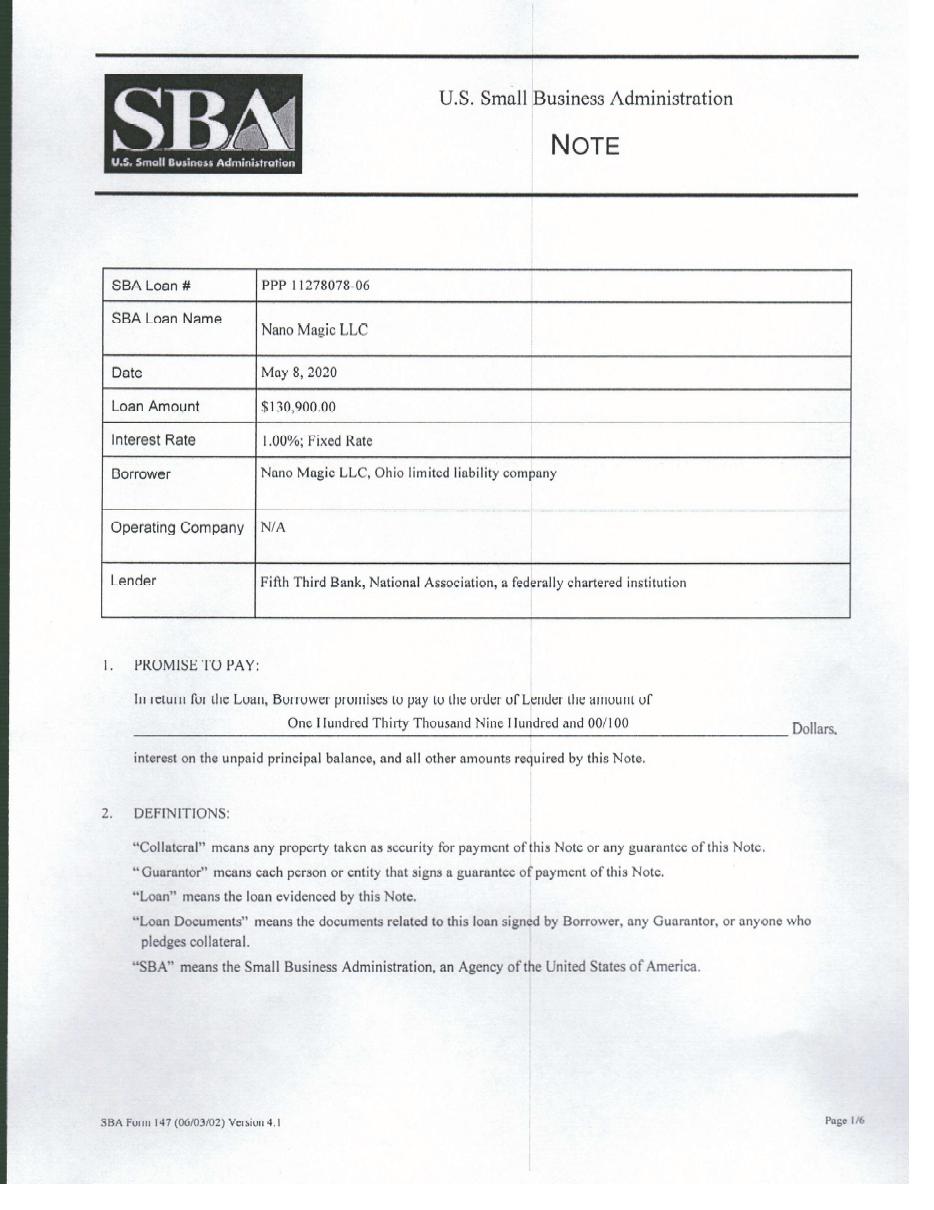





 The financial
statements used for purposes of this Exhibit are the internal financial statements prepared for Nano Magic LLC revised to reflect
all audit adjustments.
The financial
statements used for purposes of this Exhibit are the internal financial statements prepared for Nano Magic LLC revised to reflect
all audit adjustments. property of the Company
shall be returned to the Company upon termination of employment or at the request of the Company at any time. In addition, Employee
may be eligible to participate in the Company’s benefit programs of Paid Time Off, and medical insurance. In the event of
a
property of the Company
shall be returned to the Company upon termination of employment or at the request of the Company at any time. In addition, Employee
may be eligible to participate in the Company’s benefit programs of Paid Time Off, and medical insurance. In the event of
a  conflict, the terms and conditions of the benefit plan documents
and/or separate handout(s) shall control.
conflict, the terms and conditions of the benefit plan documents
and/or separate handout(s) shall control. Company
is terminated, as of the date of termination and thereafter, the Company shall no longer be required to pay and provide to Employee
any salary or other benefits, except for the 5% Quarterly Sales Bonus described above.
Company
is terminated, as of the date of termination and thereafter, the Company shall no longer be required to pay and provide to Employee
any salary or other benefits, except for the 5% Quarterly Sales Bonus described above.