UNITED STATES
SECURITIES AND EXCHANGE COMMISSION
Washington, D.C. 20549
FORM 10-K
| x | Annual report under Section 13 or 15(d) of the Securities Exchange Act of 1934 for the fiscal year ended December 31, 2012; or |
| o | Transition report under Section 13 or 15(d) of the Securities Exchange Act of 1934 |
COMMISSION FILE NO. 1-11602
APPLIED NANOTECH HOLDINGS, INC.
(Exact name of registrant as specified in its charter)
| TEXAS | 76-0273345 |
| (State of Incorporation) | (IRS Employer Identification Number) |
3006 Longhorn Boulevard, Suite 107, Austin,
Texas 78758
(Address of principal executive office, including Zip Code)
Registrant’s telephone number, including area code: (512) 339-5020
Securities registered pursuant to Section 12(b) of the Exchange Act:
| Title of each class | Name of Each Exchange on Which Registered |
| Common Stock, $0.001 par value | OTC Bulletin Board |
Securities registered pursuant to Section 12(g) of the Exchange Act: None
Indicate by check mark if the registrant is a well-known seasoned issuer as defined in Rule 405 of the Securities Act. Yes o No þ
Indicate by check mark if the registrant is not required to file reports pursuant to Section 13 or Section 15(d) of the Act. Yes o No þ
Indicate by check mark whether the registrant: (1) has filed all reports required to be filed by Section 13 or 15(d) of the Securities Exchange Act of 1934 during the past 12 months (or for such shorter period that the registrant was required to file such reports), and (2) has been subject to such filing requirements for the past 90 days.
Yes þ No o
Indicate by check mark whether the registrant has submitted electronically and posted on its corporate website, if any, every Interactive Data File required to be submitted and posted pursuant to Rule 405 of Regulation S-T (232.405 of this chapter) during the preceding 12 months (or for such shorter period that the registrant was required to submit and post such files).
Yes þ No o
Indicate by check mark if disclosure of delinquent filers in response to Item 405 of Regulation S-K is not contained in this form and will not be contained, to the best of registrant’s knowledge, in definitive proxy or information statements incorporated by reference in Part III of this Form 10-K or any amendment to this Form 10-K. þ
Indicate by check mark whether the registrant is a large accelerated filer, an accelerated filer, a non-accelerated filer, or a smaller reporting company.
Large Accelerated Filer o Accelerated Filer o
Non-accelerated Filer o Smaller Reporting Company þ
Indicate by check mark whether the registrant is a shell company (as defined in Rule 12b-2 of the Exchange Act).
Yes o No þ
The aggregate market value of the Common Stock held by non-affiliates of the Registrant, based upon the average of the closing bid and asked price of the Common Stock on the OTC Bulletin Board system on June 30, 2012 of $0.22, was approximately $25 million. As of February 28, 2013, the registrant had 125,418,492 shares of Common Stock issued and outstanding.
Documents Incorporated by Reference
No documents are incorporated by reference into this annual report on Form 10-K
TABLE OF CONTENTS
| Page | |||
| PART I | |||
| Item 1. | Business | 1 | |
| Item 1A. | Risk Factors | 11 | |
| Item 1B. | Unresolved Staff Comments | 18 | |
| Item 2. | Properties | 18 | |
| Item 3. | Legal Proceedings | 18 | |
| PART II | |||
| Item 5. | Market for Registrant’s Common Equity, Related Stockholder Matters and Issuer Purchases of Equity Securities | 19 | |
| Item 6. | Selected Financial Data | 22 | |
| Item 7. | Management’s Discussion and Analysis of Financial Condition and Results of Operations | 23 | |
| Item 7A. | Quantitative and Qualitative Disclosures About Market Risk | 29 | |
| Item 8. | Financial Statements and Supplementary Data | 30 | |
| Item 9. | Changes in and Disagreements with Accountants on Accounting and Financial Disclosure | 51 | |
| Item 9A. | Controls and Procedures | 51 | |
| Item 9B. | Other Information | 52 | |
| PART III | |||
| Item 10. | Directors, Executive Officers and Corporate Governance | 53 | |
| Item 11. | Executive Compensation | 56 | |
| Item 12. | Security Ownership of Certain Beneficial Owners and Management and Related Stockholder Matters | 65 | |
| Item 13. | Certain Relationships and Related Transactions, and Director Independence | 66 | |
| Item 14. | Principal Accountant Fees and Services | 66 | |
| PART IV | |||
| Item 15. | Exhibits and Financial Statement Schedules | 67 | |
Important Information Concerning Forward-Looking Statements
Our disclosure and analysis in this report contains some forward-looking statements. Forward-looking statements give our current expectations or forecasts of future events. They use words such as “anticipate”, “believe”, “expect”, “estimate”, “project”, “intend”, “plan”, and other words and terms of similar meaning in connection with any discussion of future operating or financial performance. In particular, these include statements relating to future actions, prospective products or product approvals, future performance or results of current and anticipated products, sales efforts, expenses, the outcome of contingencies such as legal proceedings, and financial results. From time to time, we also may provide oral or written forward-looking statements in other materials we release to the public.
Any or all of our forward-looking statements in this report and in any other public statements we make may turn out to be wrong. They can be affected by inaccurate assumptions we might make, or by known or unknown risks or uncertainties. Many factors mentioned in the risk factors are important in determining future results. Consequently, no forward-looking statement can be guaranteed. Actual future results may vary materially.
We undertake no obligation to publicly update any forward-looking statements, whether as the result of new information, future events, or otherwise. You are advised; however, to consult any further disclosures we make on related subjects in our 10-Q, 8-K, and 10-K reports to the SEC. Also note that we include a cautionary discussion of risks, uncertainties, and possibly inaccurate assumptions relevant to our business. These are factors that we think could cause our actual results to differ materially from expected and historical results. Other factors besides those listed here could also adversely affect us.
PART I.
When used in this document, the words “anticipate”, “believe”, “expect”, “estimate”, “project”, “intend”, “plan”, and similar expressions are intended to identify forward-looking statements. Such statements are subject to certain risks, uncertainties, and assumptions. Should one or more of these risks or uncertainties materialize, or should underlying assumptions prove incorrect, actual results may vary materially from those anticipated, believed, expected, estimated, projected, intended, or planned. For additional discussion of such risks, uncertainties, and assumptions, see “Important Information Concerning Forward-Looking Statements” included at the beginning of this report and “Item 1A. Risk Factors” beginning on page 11 of this report.
Item 1. Business.
DESCRIPTION OF BUSINESS
General
We are a global leader in nanotechnology research and development, with the goal of commercializing the technology that we develop. Our nanotechnology research is aimed at solving problems at the molecular level – working with the basic properties of matter to create new and improved materials and technologies. In our core focus areas, we have succeeded in overcoming the challenge of nanotechnology, which is how to controllably assemble the fundamental nanoparticle building blocks in order to achieve these new materials for both existing and new applications. Our research efforts are currently primarily focused on the areas of nanosensors, nanocomposites, nanoelectronics, and thermal management technology.
Our nanotechnology research involves performing contract R&D services for others to develop products and materials for new applications, and then leveraging this research by applying it to other similar applications in other industries. During this process, we also develop intellectual property (“IP”) around our products and technologies. Our business is based on the successful development of products and technologies with strong IP and generating revenues based on these technologies. Our ultimate goal is to create sustainable recurring revenues, either by licensing our products and technology to others, forming strategic relationships with others to introduce products into the marketplace, or introducing products into the marketplace ourselves. Whenever feasible, we intend to be actively involved in the commercialization of our technology in order to accelerate the process of bringing products to market.
We were founded in 1987, incorporated in Texas in 1989, and completed our initial public offering in 1993; however, as a result of our strategic review process, we completely shifted direction and refocused the business in 2006. Since that time, the majority of our research has been focused in the four core areas previously mentioned, but based on fundamental knowledge and skills that we gained in the course of our work prior to 2006. We have applied that knowledge and skill to these new areas.
Business Model
Our business model is built on the development of innovative products and technologies with strong intellectual property that we develop to create a portfolio of recurring revenue streams through a combination of the following methods:
| · | Licensing our technology to others; |
| · | Forming strategic relationships with others to commercialize our technology; and |
| · | Selling products based on our technology. |
Since development of IP is a critical part of our strategy, before starting on, or accepting, a project, we analyze the potential to develop IP. As a result of this focus, we have built an extensive IP portfolio over the past 20 years, and we continue to develop new intellectual property every year. We have built a strong base of research revenues over the last four years; however, we cannot sustain profitability based solely on research revenues; therefore, it is critical for us to commercialize the technologies that we develop. Much of our research comes from government contracts, and there are restrictions that prevent us from earning a profit on, or even covering all of the costs associated with, government contracts. In addition, with private research contracts there is a relationship between revenues received on the contract and rights granted to the licensee under the contract. Since a critical component of any research contract is for us to retain the IP rights, we must contribute to the overall cost of the project, and therefore are unable to charge rates that result in us earning a profit on the contract. Our goal on private research contracts is, at a minimum, to cover all out of pocket costs and contribute to our overall overhead.
| Page 1 |
In commercializing our technology, we initially focused on licensing our technology to others. Our research partners frequently have licensing rights as a result of the research that they funded, and upon completion of the work, license the technology for specific applications. Our goal from our license agreements is to obtain upfront payments, generate recurring royalties based on product shipments by the licensee, and secure minimum royalty payments by the licensee in future years to maintain their license. In rare cases, we may license technologies for a one time upfront payment, either to induce the licensee to introduce a product so that others will follow and become potential licensees for us, or because the technology licensed is not part of our core business moving forward. License agreements and the royalties from product shipments are a critical element in us attaining sustainable long-term profitability. We expect to continue to pursue license agreements in those situations where we believe it is the best approach.
In recent years we have expanded our focus beyond licensing. Specifically, we have organized internal teams to focus on the development and commercialization of certain of our high potential products and technologies. In these cases, we are exploring the possibility of forming business units around these technologies. This allows us to participate in the commercialization process - beyond simply licensing our technology to others to manufacture products - and to allow us to bring in resources to commercialize the technology more quickly than we could on our own. We believe that, in some instances, these business units will allow us to create greater value through broader participation in the revenue stream and potentially decrease the time required to bring products to market. In addition, having an ownership interest in an entity created around our core technology allows us to participate in the value created as the technology gains market acceptance and the entity grows.
We intend to commercialize these high potential technologies through strategic relationships and direct sales of products using our technology. In 2011, we began direct sales of some of our products, and we expanded that focus in 2012. The direct sale of products using our technology is an important area of focus for us in 2013. We have added sales resources and see the build-up of our sales/marketing capability as critical to achieving our revenue growth targets in the coming years; however, many of our technologies require product redesign or adjustments to the manufacturing process, and the sales cycle for our products tend to have long lead times. However, once our technology is introduced in products, we would expect significant recurring sales.
Research and Development
Our research and development (R&D) activity is the driver of our technology innovations and is critical in developing and protecting our intellectual property, and therefore, we spend significant amounts on research and development. A significant portion of our research and development costs are associated with revenue producing projects and are a critical component of revenue generation for us. We spent $4,471,208; $5,517,937; and $4,716,363 on research and development in the years ended December 31, 2012, 2011, and 2010, respectively. This represents approximately 54%, 63%, and 62% of our total operating costs and expenses in each of those years. We expect to continue to invest heavily in research and development, and we expect our research and development costs for 2013 to be approximately 61% of our operating costs. We will continue to seek funding for a substantial portion of our research, as we have done historically.
Much of our intellectual property and research relates to next-generation technologies that are not in wide current use and as such, additional development work is required before products can be manufactured using these technologies. Our research and development efforts occur across a continuum moving from concept to commercialization as follows:
Concept → Laboratory → Development → Pilot /Introduction → Commercialization
We have developed a distinctive competence in accelerating the process of moving ideas from the research lab into the marketplace. We currently have technologies that fall into all of these stages of development and to aid in the process of moving our technologies from concept to commercialization, we continually perform funded research for both government entities and large multinational corporations. This enables us to focus our resources in areas that have a high level of interest to end-users, and thus a high probability for commercialization. As research moves into the development phase, we also create venture or business unit teams to help accelerate commercialization for those emerging technologies that have the very highest probability for market success. We’ve also created pilot plant facilities for selected technologies to facilitate commercialization.
| Page 2 |
Business Segments
Our operations currently consist of only one reportable business segment. While we have four separate companies, since all of the revenue is currently derived from one company, we report as one segment. Applied Nanotech Holdings, Inc. (“ANHI”) is the parent company. ANHI is where we incur general operating overhead that is the approximate cost of being a public company, effectively the amount in excess of that which might be incurred by a private company performing these same activities. ANHI’s activities are generally limited to communicating and reporting to shareholders, consolidating financial information, monitoring activities at subsidiaries, and reviewing potential investments. The ANHI CEO oversees these activities.
Applied Nanotech, Inc. (“ANI”), a subsidiary of ANHI, has been the entire focus of our current efforts and until 2012 was our only operating subsidiary. ANI has its own management structure, including its own CEO, Dr. Zvi Yaniv, generated all of the revenues in the consolidated group during the periods presented, and performs all of the research and development. In 2012 we formed EZDiagnostix, Inc., (“EZDX”) and hired a CEO, Alan Jernigan, to run this new subsidiary. EZDX was formed to focus on commercializing our sensor technology and we expect EZDX to generate both development revenues and product revenues in 2013. Our new CEO of EZDX has significant commercialization experience, something we previously lacked within the overall organization. Electronic Billboard Technology, Inc. (“EBT”), a subsidiary of ANHI, is inactive, but could receive royalty revenues in the future.
Overall
We are a global leader in nanotechnology, focusing our efforts on research, development of proof of concepts and prototypes for proposed products, commercializing our technology, and licensing our technology to others. We are developing world-class technologies that generally fall under one of five technology platforms. These platforms are:
| · | Nanosensor technology; |
| · | Nanocomposites, based on carbon nanotube composites; |
| · | Thermal management materials; |
| · | Nanoelectronics applications; and |
| · | Electron emission activities, primarily in the display area. |
Our research and development efforts are all focused in the first four areas; however, we previously developed an extensive portfolio of intellectual property in the electron emission area, and we are actively seeking to monetize that IP by licensing or selling it. We are no longer actively pursuing any research projects in the electron emission area.
We intend to commercialize our core technologies by either licensing these technologies to others to allow them to manufacture products using our technology, by selling products ourselves, or in conjunction with strategic partners. We have no plans to establish any significant manufacturing facilities of our own for our products in the foreseeable future, and manufacturing is not a part of our core strategy. However, we do have a pilot facility that enables us to manufacture significant quantities of some of our products. To the extent that high volume manufacturing capabilities are needed for products using our technology, we intend to use manufacturing partnerships, joint ventures, or arrange to have products manufactured through contract manufacturers, whenever high volume manufacturing is needed. For certain high potential products and technologies, we are exploring establishing business units that would enable us to participate in, and profit from, the commercialization process beyond just licensing or selling the product, and to enable us to bring in resources to commercialize our technology more quickly than we could do on our own.
| Page 3 |
Sensors
Overview. We have greatly expanded our work and intellectual property in the area of sensor technology in the past few years. We expect nanosensors to become an increasingly important part of our business. Our approach to sensor technology offers the unique advantage of manipulating materials at the molecular level, where sensing events occur. We are pursuing a multiplatform approach to address specific market needs. Some of the potential applications are as follows:
Ion Mobility Sensors. We are currently developing sensors based on Ion Mobility Sensor (“IMS”) technology and Differential Mobility Spectroscopy (“DMS”). These sensors are ideal for use when both high sensitivity and high selectivity (low false positives) are required. We have also improved on existing IMS and DMS technology by developing our proprietary nonradioactive gas ionization sources to replace the radioactive isotopes that are currently used in these tools. We are currently involved in projects to develop highly sensitive Mercaptan and Methane sensors for use in the natural gas industry under funding from the North East Gas Association.
We are also applying this technology to other applications including agricultural pathology, wound care, and breath analysis. We are seeking funding for development of a breath analysis sensor for health monitoring using this technology. The human breath contains hundreds of gases and the exact breakdown of these gases is somewhat unique to each individual. There has been extensive research performed that indicates that there is a significant correlation between changes in the level of particular gases in a person’s breath and changes in that person’s health. In fact, research indicates that these changes occur quickly and can be a predictor of future health changes. Breath analysis has the potential to significantly lower health care costs, as a preventive tool, by providing early indications of potential changes in people’s health and providing that information digitally to health professionals.
Because we believe this technology has such high potential, we have formed a subsidiary, EZDiagnostix, Inc., specifically to focus on commercialization of this technology. We have hired a CEO for the subsidiary that has significant commercialization experience, particularly in the medical diagnostics area.
Hydrogen Sensors. These sensors are initially targeted for use in fuel cells for automobiles and for remote monitoring of large power transformers. We developed a hydrogen sensor for use in the measurement of hydrogen in power transformer products. We are currently exploring alternatives to maximize the value to be received from this sensor development by selling our intellectual property portfolio in this area.
Carbon Monoxide Sensors. We have developed a low-power carbon monoxide sensor that can last for 10,000 hours on a single battery. The sensor will be specific to carbon monoxide with no cross sensitivity to other gases and elements and is also easily portable and highly sensitive. We are seeking a development partner interested in commercializing this technology.
Biosensors. Our carbon nanotube technology is ideally suited for use in biosensors. Sensors based on carbon nanotubes or other nanomaterials can be used to detect chemical, organic, or biological warfare agents, as well as explosives, hydrogen, ammonia and numerous other chemicals. We have developed several proofs of concepts demonstrating the viability of our sensor technology, and are currently seeking development partners to license the technology and integrate it into specific products.
Other Sensors. We have demonstrated that carbon nanotubes can be used to develop sensors for chemical, organic, and biological warfare agents. We have also demonstrated that carbon nanotubes and other nanodetectors can be used for the remote detection of explosives, sensors used in environmental monitoring, health care, the food industry, biotech-biopharma applications, genetic biosensors, and immunosensors. We are currently seeking funding to take our research in this area to the next level of development, which would include proofs of concept, and product development. Ideally, we would do this work with a development partner that would fund the development and license the technology for manufacturing upon completion, or in conjunction with a development partner under a government funding program. We most likely would have different development partners for different sensors that may be used in different industries.
Competition. Our competition in the sensor area will come from a variety of technologies and companies depending on the purpose and use of the sensor. There are other technologies used in sensors; however, we believe carbon nanotube based sensors and other nanodetectors are more versatile, can sense a broader range of materials, and are more selective (sensitive) in their sensor results. We believe that selecting the right strategic partners for development of proof of concepts for our sensor technology is an important step in the market acceptance of sensors using our technology.
| Page 4 |
Intellectual Property. In the sensor area, we have developed intellectual property related to several types of sensors, with over 50 U.S. and foreign patents and patent applications pending. In 2011, we received a very important patent related to breath analysis. This patent covers the concept of a system to collect a breath sample from an individual, a gas analysis device, a data storage device, and a data analysis device, to correlating the sample with the medical condition of the individual. We believe this is a very powerful patent with significant potential to impact the area of breath analysis.
Nanocomposites
We are in the advanced stages of development of nanomaterials using carbon nanotube (“CNT”) and other composites. We believe that some of the first widespread use of nanotechnology by established companies will be in this area as they work to improve existing products, materials, and processes. The first products using our technology were introduced in the market place in 2011 and fall within the nanocomposites area. A significant opportunity exists in nanocomposites for us to develop, commercialize, and license our technology. We are well versed in harnessing the unique properties of CNTs for a variety of applications. Our work with CNT composites has been in several areas, including epoxies, nylons, polyesters, vinyl esters and glass fibers.
Epoxies – Epoxies are used in industries with significant worldwide markets, with applications including adhesives, paints, coatings, and composites. The objective of our CNT epoxy program has been to create composite materials to be used as an alternative to traditional materials. We have reinforced epoxy with CNTs to take advantage of CNTs mechanical properties while reducing the weight of materials needed for specific applications. We have developed patented processes and know-how which has enabled us to uniformly disperse CNTs throughout the epoxy to create significant improvements in strength, toughness, durability, vibration dampening, and other mechanical properties.
In September 2005, we signed a development contract with Yonex Co. Ltd., a large sporting goods manufacturer, to develop nanocomposites to be used in sporting equipment. This agreement culminated in a license agreement in October 2008 that allowed Yonex to use our technology in its tennis and badminton racquets. In 2010, we completed an additional agreement with Yonex to license this technology for use in golf shafts. This development agreement served as the foundation of our work in the CNT composites area. In 2011, Yonex introduced golf shafts and badminton racquets using our technology.
Other CNT Enhanced Resins – In addition to epoxy resins, we are developing other types of resins including polyesters and vinyl esters. Our polyester resin development has been funded by the U.S. Army for applications primarily related to ballistic protection, although polyester resins enhanced by CNTs have many other applications. Vinyl esters are currently widely used in a variety of industrial applications including storage tanks, piping, and construction, and we have done initial work in this area with promising results.
Nylons – The addition of CNTs to nylons can enhance certain mechanical properties and the electrical conductivity of insulating material. Of all the types of nylons available, Nylon 6 is the most common, with an estimated 60% of the world volume and with uses in a variety of industries including textiles, carpeting, safety belts, fishing lines, and many other applications. We have developed a patented process for coating nylon pellets with CNTs to improve electrical conductivity. Nylon 6 with improved electrical conductivity can be used for its anti-static qualities, electrostatic discharge, and electromagnetic/RF shielding.
Glass Fibers – We have applied our knowledge in CNT enhanced composites to develop a strengthened fiberglass that can be used for applications with long lifetime requirements, such as wind turbine blades. Current wind blade research is focused on lowering the weight of materials to reduce overall cost and increase efficiency. Our early research has shown dramatic results in lowering the weight of materials using CNT strengthened materials, and we are continuing to apply resources with our partners, to further develop this technology.
Competition. A wide range of companies work with composite materials, including some working with CNT enhanced composites. Since each project is unique, our competition would come from different companies for different applications. Since we rely on patented technology, any competition comes from different composites, or different formulations of CNT composites. Some of the companies known to be working in the CNT composite area are Zyvex Performance Materials in Columbus, Ohio, GSI Creos in Tokyo, Japan, and Amroy Europe, Ltd. in Finland.
| Page 5 |
Intellectual Property. We have developed a strong intellectual property position in the nanocomposites area with over 30 U.S. and foreign patents and patent applications pending.
Thermal Management
We are marketing a unique patented thermal management material called CarbAl™. In 2009, R&D Magazine recognized CarbAl™ as one of the 100 most significant product innovations of 2009 with its R&D 100 Award. The inability to effectively control temperature is the number one cause of failure for electronics, resulting in more failures than dust, humidity, vibration, and other harmful conditions. CarbAl™ provides a passive thermal management solution for temperature control issues that plague electronics manufacturers and has the ability to reduce costs for, and extend the lives of, many electronics applications.
CarbAl™ is a carbon based metal nanocomposite comprised of 80% carbonaceous matrix and a dispersed metal component of 20% aluminum. We have also developed a simplified version of CarbAl™ based on graphite that is less expensive, but still ideal for many applications. CarbAl™ has a unique combination of low density, high thermal diffusivity, high thermal conductivity, and a low coefficient of thermal expansion that results in a material that far exceeds the capabilities of conventional passive thermal management materials. There is an extensive worldwide market for thermal management materials, and CarbAl™ is ideal for applications in the electronics industry, in LED displays, power strips, power LED lighting, and for concentrated photovoltaic solar cell systems.
In 2011, we were able to secure a reliable, high quality, production source for our CarbAl™ material and are now actively pursuing sales of the product. In addition to selling the base product, we have the capability to provide value added services such as segmenting, laminating, and printing directly on the CarbAl™ material. In January 2012, we increased our efforts in the thermal management industry related to direct sales of our product and will continue to focus our sales efforts in this area in 2013. Concentrated photovoltaic solar cells, for example, are a developing product and thermal management remains a significant problem.
Competition. Because CarbAl™ is a new patented material, its competition comes from already existing active and passive thermal management systems. For example, many manufacturers use basic materials such as aluminum, copper, and others as thermal management tools. In addition, computer equipment includes fans, while LED Billboards include air conditioning equipment as thermal management tools.
Intellectual Property. In addition to some underlying patents filed throughout the world, we have a patent application pending in the U.S. and in foreign jurisdictions that we believe is a basic patent critical to manufacturing this product.
Nanoelectronics Applications
Conductive Inks
Copper Inks - As a result of the move towards flexible electronics, the extra processes of soldering are slowly disappearing. New processes that are digital in nature are required to allow industries to move from the design process directly to the production line. One of our areas of focus is conductive inks, starting with copper. Nanotechnology will play an important role in this process because only nanoparticles are capable of producing inks that are compatible with the nozzles used in digital printing.
To facilitate our development of conductive copper inks, we entered into a research and development agreement with Ishihara Chemical Company, Ltd., a leading industrial chemical products company headquartered in Japan, to develop conductive inks that can be deposited using an additive process such as ink-jet printing, aerosol-jet printing or screen printing. The target market for these technical inks includes printed circuit boards, flexible electronics and displays, communications instrumentation, and Radio Frequency Identification tags. Our work with Ishihara started with a feasibility study in early 2006 and culminated with a license agreement for copper inks and pastes in July 2009. As a result of this partnership, we have received over $2.5 million in research funding from Ishihara and a $1.5 million up-front license payment. Because of Ishihara’s heavy financial commitment to the project, all IP generated by the project is jointly owned by ANI and Ishihara and the license agreement signed in 2009 gave Ishihara the exclusive right to use this technology. Ishihara is currently readying its production facility and conducting pilot and prototype manufacturing. We expect Ishihara to introduce a product at some point in the future and we will receive a 4% royalty on product shipments by Ishihara. If, however, Ishihara chooses to give up its exclusivity, it will owe no future royalties.
| Page 6 |
We chose to start our work with conductive inks by focusing on nanocopper inks using copper nanoparticles because of copper’s superior electrical conductivity properties, low cost, and because it is the material of choice in the printed circuit board industry. We have been able to achieve electrical conductivity properties similar to that of bulk copper with these inks. In 2010, we, along with our partner, Ishihara Chemical, won an R&D 100 award, recognizing our inkjetable copper ink as one of the 100 most significant product innovations in 2010.
Solar inks – After our initial work in copper, we expanded our work with conductive inks to other inks including nickel, silver, aluminum, and others, as well as to various conductive pastes. In particular, we have developed aluminum and silver inks and pastes that are ideal for use in the production of solar cells. In the photovoltaic solar cell industry, cells are made starting with silicon wafers and printing aluminum pastes on one side and silver pastes on the other. Currently, the industry uses screen printing techniques, which involves direct contact with the wafer. The wafer thickness can’t be reduced any further because the contact method in use today causes cracking and breaking. Our inks are capable of being printed using noncontact methods, which would allow the wafer thickness to be reduced. Since over half of the cost of the cell is the silicon wafer, this has significant cost reduction potential. In addition, inks result in a more efficient solar cell than the existing pastes. We have also developed a highly efficient aluminum paste that can be used in current solar cell production.
In 2011, we licensed our solar ink technology to Sichuan Anxian Yinhee Construction and Chemical Company (“YHCC”), a Chinese chemical company, for an upfront payment of $1.5 million. An additional payment of $500,000 was paid in 2012, after we achieved certain technical standards. This original license agreement covered Asia, excluding Korea and Japan, and also includes a 3% royalty on products sold by YHCC using our technology. YHCC constructed an $18 million facility in China dedicated to our technology. YHCC intends to establish a strong customer base using the paste so that it can seamlessly transition to the inks as the solar cell manufacturers transition from pastes to the inks. In 2012, we amended the license agreement with YHCC to cover the rest of the world in exchange for an upfront payment of $500,000. We received $250,000 in 2012 and the remaining $250,000 is due in 2013, after we achieve certain technical specifications for our silver paste.
In 2011, we also completed our pilot facility for inks. As a result of funding received from the U.S. Department of Energy, in the amount of $1.6 million, we established a small pilot manufacturing facility in Austin for these inks to facilitate accelerated development and testing by solar cell manufacturers. In this facility, we have the capability of producing up to 8 tons of ink or paste per year, which would be enough to supply a small solar cell manufacturer on an annual basis. Furthermore, the facility can be used for pilot production of all of our inks, not just the solar inks. We are in discussions with others regarding licenses or relationships related to solar inks that would cover the geographic areas not already included in the YHCC license.
Competition. There are silver inks on the market today, but because of the high cost of silver relative to copper, a successful copper ink is likely to open up many additional markets. Most existing inks and pastes in the markets today are manufactured and sold by large multinational chemical companies. For example, the two largest suppliers of inks and pastes for solar cell production are DuPont and Ferro. We are unable to compete directly with companies of that size; consequently, we are targeting, as partners and licensees, medium sized companies with the resources to compete.
Intellectual Property. We have developed a strong intellectual property position in this area with over 30 U.S. and foreign patents and patent applications pending related to copper and other conductive metallic inks.
Technical Inks Printing Solution (TIPS)
Conductive inks have the power to revolutionize many types of electronics manufacturing. Our strategy is to provide a comprehensive solution for end users by not only developing inks, but assisting in the process from start to finish. We call this our Technical Inks Printing Solution. As part of our concept, we have done extensive research on raw materials (nanoparticles). We have developed relationships with nanoparticle suppliers and are able to supply a variety of nanoparticles as a result of these relationships. In addition, we have conducted research and development on a variety of potential end user products to help develop specifications for the inks. We have also formed relationships with hardware manufacturers with the goal of providing seamless integration into high volume manufacturing for companies wishing to use conductive inks in their manufacturing processes.
| Page 7 |
We intend to develop a revenue stream that includes revenue from the sale of nano-particles, research revenue from applications development, commissions on the sale of hardware, and royalties from the sale of inks.
Competition. Numerous other companies are working with other technologies with the goal of achieving results similar to the goals of our technology. The ultimate success of products using our technology depends on the results of our research compared with results achieved by others, as well as other factors including, marketing, resources, and production capabilities.
Electron Emission Activities
Until 2006, our main focus for virtually the entire history of ANHI was on electron emission activities. We performed extensive research and accumulated significant intellectual property in this area. The bulk of that activity has centered on Field Emission Display (“FED”) technology. FED is a next generation display technology that is ideally suited for use in large flat screen televisions. We believe our intellectual property in the electron emission area is mature and well developed. We are now dependent on a manufacturer to introduce a product using our technology. As such, we are no longer devoting any resources to further develop this technology, unless funded for a specific application. We are no longer actively seeking funding in this area. We are, however, closely monitoring developments in the industry to determine if a manufacturer introduces a product that requires a license for our technology.
Our electron emission IP can be divided into display activities and non-display activities.
Display Applications
The display industry is, in general, dominated by large multinational corporations, primarily based in Asia, and participation in manufacturing products for the display market involves significant capital investments. While display applications represent potentially huge markets for the use of our technology, realization of this potential will require one of these companies to introduce a product based on our technology. Our intellectual property in this area is well developed, and we believe that any manufacturer that develops a product based on electron emission activities involving carbon will require a license to our technology; however, any products using this technology are still at present, next generation products. We believe that the successful introduction of any display products using this technology will require the participation of existing display manufacturers or component suppliers. These manufacturers and suppliers have a variety of interests and the introduction of new display products may be affected by general economic conditions as well as the impact of these new products on other areas of their business. Potential applications in the display area include: large area CNT flat screen color field emission displays, large area surface conduction color field emission displays such as the one developed by Canon and Toshiba, backlights for displays, and picture element tubes for medium resolution large area electronic billboards.
Non-Display Applications
There is also a wide array of non-display related electron emission applications. These potential applications are spread among a much larger group of potential licensees, and the markets generally are much smaller than the display markets, although the markets are still very significant and would generate substantial royalties if products were introduced. We have performed research related to lighting applications, ion sources, traveling wave tubes, and have explored other electron emission applications. We believe these applications may have the capability of generating license revenues sooner than display applications, may be easier to integrate into existing products, and may be in wide use sooner than display applications. While the breadth (number of patents) of our display related emission activity patents is currently greater than for non-display patents, our non-display IP is growing, and our basic Raman patent is expected to cover all of our electron emission activities.
Key Intellectual Property
Our most significant patent in the electron emission area is a basic patent that we refer to as the Raman Spectrum Patent (U.S. Patent 5869922) covering emissions from a wide range of carbon forms. This patent covers field emission devices using various forms of carbon, including carbon nanotubes (CNT), carbon films, and other forms of carbon that fall within a particular range on the Ultraviolet Raman band. This basic patent is fundamental and has broad applicability and wide geographic coverage, having been issued in the U.S., China, South Korea, Japan, and validated in several European countries. In addition to this basic patent, we have a wide variety of other patents that compliment this basic patent in specific situations. We believe that any company developing a product that involves the emission of electrons from carbon is likely to require a license to our technology.
| Page 8 |
Competition. Because of the strength of our intellectual property in the electron emission area, our competition comes from other technologies, rather than from other companies. For displays, this competition comes from LCD displays, Plasma displays, LED displays, and color picture tubes.
In 2009, we determined that we should begin efforts to attempt to monetize our Electron Emission Intellectual Property while it still had value, and in March 2010, we included a trial package in an auction. We received no significant interest in the trial package that we submitted for auction. Following that auction, while preparing a package of our entire Electron Emission Portfolio, we were contacted by Samsung Electronics, Ltd. After extensive negotiations, we completed a combination sale/license agreement where we sold 29 patents to Samsung and licensed approximately 150 additional patents for a one-time payment of $3.75 million. This total package represented our entire electron emission portfolio, but did not include any of our other technologies. We retained our key Raman Spectrum patents to be available for license, or sale, to others. In the display industry, when one manufacturer introduces a successful technology, other manufacturers often follow. If Samsung successfully introduces a product and other manufacturers follow, we intend to license our technology, including future royalties, to those manufacturers as well.
Technology Agreements
Till Keesmann. In May 2000, we licensed the rights to 6 carbon nanotube patents from Till Keesmann in exchange for an initial payment of $250,000 and additional minimum royalties payments of $1.0 million, all of which were made. This agreement gave us the exclusive right to license these patents to others. In 2008, as part of a litigation settlement, and as the result of a lack of interest in these patents from potential licensees, we agreed to return the licensing rights to Mr. Keesmann. We retain our irrevocable right to use these patents and we are entitled to 50% of any royalties generated by these patents, up to a maximum of $1.2 million. We believe it is unlikely we will receive any royalties from these patents.
Intellectual Property Rights
An important part of our business and product development strategy is to seek, when appropriate, protection for our products and proprietary technology through the use of various United States and foreign patents. In fact, before starting any research projects, we analyze the potential for the project to generate valuable IP. Our patent portfolio consists of over 300 patents, including 150 issued patents and over 150 patent applications pending before foreign and United States Patent and Trademark Offices. We also have several unsubmitted patent applications in process. In addition, there are foreign counterparts to certain United States patents and applications. We consider our patent portfolio to be our most valuable asset.
The patenting of technology-related products and processes involves uncertain and complex legal and factual questions. To date, no consistent policy has emerged regarding the breadth of claims of such technology patents. Therefore, there is no assurance that our pending United States and foreign applications will issue, or what scope of protection any issued patents will provide, or whether any such patents ultimately will be upheld as valid by a court of competent jurisdiction in the event of a legal challenge. Interference proceedings, to determine priority of invention, also could arise in any of our pending patent applications. The costs of such proceedings would be significant and an unfavorable outcome could result in the loss of rights to the invention at issue in the proceedings. If we fail to obtain patents for our technology, and are required to rely on unpatented proprietary technology, there is no assurance that we can protect our rights in such unpatented proprietary technology, or that others will not independently develop substantially equivalent proprietary products and techniques, or otherwise gain access to our proprietary technology.
Competitors have filed applications for, or have been issued patents, and may obtain additional patents and proprietary rights relating to products or processes used in, necessary to, competitive with, or otherwise related to, our patents. The scope and validity of these patents, and the extent to which we may be required to obtain licenses under these patents or under other proprietary rights and the cost and availability of licenses is unknown. This may limit our ability to license our technology. Litigation concerning these or other patents could be protracted and expensive. If suit were brought against us for patent infringement, a challenge in the suit by us as to the validity of the other patent would have to overcome a legal presumption of validity. There can be no assurance that the validity of the patent would not be upheld by the court or that, in such event, a license of the patent to us would be available. Moreover, even if a license were available, the payments that would be required are unknown and could materially reduce the value of our interest in the affected products. We do, however, consider our patents to be very strong and defendable in any action that may be brought against us. In the past, a major law firm reviewed our patent portfolio and agreed to handle litigation related to certain of our patents on a contingency basis.
| Page 9 |
We also rely upon unpatented trade secrets. No assurances can be given that others will not independently develop substantially equivalent proprietary information and techniques or otherwise gain access to our trade secrets or disclose such technology or that we can meaningfully protect our rights to our unpatented trade secrets.
We require our employees, directors, consultants, outside scientific collaborators, sponsored researchers, and other advisors to execute confidentiality agreements upon the commencement of employment or consulting relationships with us. These agreements provide that all confidential information developed or made known to the individual during the course of the relationship is to be kept confidential and not disclosed to third parties except in specific circumstances. In the case of employees, the agreements provide that all inventions conceived by the individual shall be our exclusive property. There is no assurance, however, that these agreements will provide meaningful protection for our trade secrets in the event of unauthorized use or disclosure of such information.
Government Regulation
Products using our technology will be subject to extensive government regulation in the United States and in other countries. In order to produce and market existing and proposed products using our technology, our licensees must satisfy mandatory safety standards established by the U.S. Occupational Safety and Health Administration (“OSHA”), pollution control standards established by the U.S. Environmental Protection Agency (“EPA”) and comparable state and foreign regulatory agencies. We may also be subject to regulation under the Radiation Control for Health and Safety Act administered by the Center for Devices and Radiological Health (“CDRH”) of the U.S. Food and Drug Administration. OSHA, the EPA, the CDRH and other governmental agencies, both in the United States and in foreign countries, may adopt additional rules and regulations that may affect us and products using our technology. Additionally, our arrangements with our licensees and their affiliates may subject products using our technology to export and import control regulations of the U.S. and other countries. The cost of compliance with these regulations has not been significant in the past and is not expected to be material in the future.
A portion of our revenue has consisted of reimbursement of expenditures under U.S. government contracts. We recognized $1,733,728 of revenue in 2012; $2,956,717 of revenue in 2011; and $2,920,030 of revenue in 2010, related to government contracts. These reimbursements represent all or a portion of the costs associated with such contracts. As of December 31, 2012, we have several government contracts in process that have approximately $1.9 million of revenue yet to be recognized. Government contracts are subject to delays and risk of cancellation. Also, government contractors generally are subject to various kinds of audits and investigations by government agencies. These audits and investigations involve review of a contractor’s performance on its contracts, as well as its pricing practices, the costs it incurs and its compliance with all applicable laws, regulations and standards. We have been audited by the government, with no material changes, and in the future we expect to be audited by the government; however we expect the results of any government audits to have an insignificant effect on our financial statements.
Employees
As of February 28, 2013 we had 25 full-time employees, including 4 executive officers. At the present time, we do not anticipate the need to hire significant additional employees to support our plans for increasing revenue levels in the next 12 months; however, if revenues increase beyond expected levels, we may hire additional employees. We are not subject to any collective bargaining agreements, and we consider our relations with our employees to be good.
Available Information
Our website is http://www.appliednanotech.net. Our periodic reports and all amendments to those reports required to be filed or furnished pursuant to Section 13(a) or Section 15(d) of the Securities Exchange Act of 1934 are available free of charge through its website. During the period covered by this report, the Company made its periodic reports on Form 10-K, and Form 10-Q and its current reports on Form 8-K and amendments to those documents available on its website as soon as reasonably practicable after those reports were filed with or furnished electronically to the Securities and Exchange Commission at www.sec.gov. The Company will continue to make such reports and amendments to those reports available on its website as soon as reasonably practicable after those reports are filed with or furnished to the Securities and Exchange Commission. Material contained on our website is not incorporated by reference in this Annual Report on Form 10-K.
| Page 10 |
Item 1A. Risk Factors
Our success is dependent on our principal technologies
Our technology platforms, which include nanocomposites, nanoelectronics, nanosensors, thermal management, and electron emission activities, are emerging technologies. Our financial condition and prospects are dependent upon commercializing our technology, licensing our intellectual property to others, and introduction of the technology into the marketplace. Additional R&D needs to be conducted on some of our technologies before products can be produced using this technology. Market acceptance of products using our technology will be dependent upon acceptance within the industries of those products of the quality, reliability, performance, efficiency, and breadth of application and cost-effectiveness of the products. There can be no assurances that these products will be able to gain commercial market acceptance.
Our technology development is in its early stages and the outcome is uncertain
Some of our applications of nanotechnologies, and certain products that use these technologies, will require significant additional development, engineering, testing and investment prior to commercialization. We are exploring the use of our technology in several different types of products. We have developed proof of concepts of potential products based on our technologies. In some cases, we are developing products jointly with others based on our technology. Upon successful completion of the development process, our development partners will likely be required to license our technology to produce and sell the products. Our development partners retain all rights to any intellectual property that they develop in the process.
If any of the potential products that are being developed using our technologies are successfully developed, it may not be possible for us or potential licensees to produce these products in significant quantities at a price that is competitive with other similar products. At the present time, the only significant revenue that we receive related to our technology is related to reimbursed research expenditures and development fees. These revenues are identified in our quarterly filings on Form 10-Q and our annual filings on Form 10-K in the “Management’s Discussion and Analysis of Financial Condition and Results of Operations” sections. The first products using our technology were introduced in the marketplace in 2011, and we began receiving royalties as a result. We anticipate receiving up-front license fees and royalties in 2013.
We may not be able to provide system integration
In order to prove that our technologies work and will produce a complete product, we may be required to integrate a number of highly technical and complicated subsystems into a fully integrated prototype. There is no assurance that we will be able to successfully complete the development work on some of our proposed products or that there will ultimately be any market for those products.
Many products that may be developed using our technology will need to be integrated into end-user products by manufacturers of those products. Although we intend to develop products to be integrated into existing manufacturing capabilities, manufacturers may be required to make modifications to, or expand their manufacturing capabilities. Manufacturers may elect not to integrate products using our technology into their end-user products, or they may not devote adequate resources to modifying their manufacturing capabilities so that our technologies can be successfully incorporated into their end-user products. The complexity of integration may delay the introduction of products using our technology.
Our development partners have certain rights to jointly developed property and to license our technology
In some cases, we have committed to license our technology to our development partners upon completion of certain development projects that are in process. The terms of all such licenses have not yet been finalized. Our development partners usually also have rights to any jointly developed property; however, any such jointly developed property would likely be based, at least in part, on our underlying technology which would require our partners to enter into a license agreement with us. See also “Our technology development is in its early stages and the outcome is uncertain” above for further discussion. In the case of Ishihara, they have the right to use our jointly owned technology without license and the existing license agreement is only to preserve their exclusivity. They could choose to give up that exclusivity and then would owe no further royalties.
| Page 11 |
Products using our technology may not be accepted by the market
Since our inception, we have focused our product development and R&D efforts on technologies that we believe will be a significant advancement over currently available technologies. With any new technology, there is a risk that the market may not appreciate the benefits or recognize the potential applications of the technology. Market acceptance of products using our technology will depend, in part, on our ability and the ability of our licensees and partners to convince potential customers of the advantages of such products as compared to competitive products. It will also depend upon our ability to train manufacturers and others to use our products.
We have limited resources and our focus on particular products may result in our failure to capitalize on other opportunities
We have limited resources available to successfully develop and commercialize our technology. As of February 28, 2013, we had 25 full-time employees. There is a wide array of potential applications for our technology, and our limited resources require us to focus on specific product areas, while ignoring others. We focus our efforts on those projects for which we can obtain external funding since the availability of funding provides an external verification of the probability of commercial success of resulting products.
Rapid technological changes could render our technology obsolete, and we may not remain competitive
The industries in which we compete are highly competitive and are characterized by rapid technological change. Our existing and proposed products will compete with other existing products and may compete against other developing technologies. Development by others of new or improved products, processes or technologies may reduce the size of potential markets for our products. There is no assurance that other products, processes or technologies will not render our proposed products obsolete or less competitive. Most of our competitors have greater financial, managerial, distribution, and technical resources than we do. We will be required to devote substantial financial resources and effort to further R&D. There is no assurance that we will successfully differentiate our technology from our competitors’ technology, or that we will adapt to evolving markets and technologies, develop new technologies, or achieve and maintain technological advantages.
We have limited manufacturing capacity and experience
Our employees are primarily scientists, and we have no significant manufacturing experience. We have no established commercial manufacturing facilities, and we have no intention of establishing a large scale manufacturing facility on our own. We are focusing our efforts on licensing our intellectual property to others for use in their manufacturing processes, or working with strategic partners that have manufacturing capabilities. To the extent that any of the products that we develop require significant manufacturing facilities, we intend to either contract with a qualified manufacturer, or enter into a joint venture or other similar arrangement. We have established a pilot manufacturing facility for our inks, nanocomposites, and thermal management materials. Should the development proceed to the point where a production facility is required, we intend to license or contract with others for production.
The health effects of nanotechnology are unknown
There is no scientific agreement on the health effects of nanomaterials, but some scientists believe that in some cases, nanomaterials may be hazardous to an individual’s health or the environment. The science of nanotechnology is based on arranging atoms in such a way as to modify or build materials not found naturally in nature; therefore, the effects are unknown. The Company takes appropriate precautions for its employees working with carbon nanotubes and believes that any health risks related to carbon nanotubes used in potential products can be minimized. Future research into the effects of nanomaterials in general, and carbon nanotubes in particular, on health and environmental issues may have an adverse effect on products using our technology.
We are dependent on the availability of materials and suppliers
The materials used in producing current and future products using our technology are purchased from other vendors. We anticipate that the majority of raw materials used in products to be developed by us will be readily available to manufacturers. However, there is no assurance that the current availability of these materials will continue in the future, or if available, will be procurable at favorable prices.
| Page 12 |
We have a history of net losses
We have a history of net losses, although in 2010 we were profitable based on a one time licensing event. From our inception through December 31, 2012, we incurred net losses of approximately $118 million. Although we were profitable in 2010, and we expect to at least breakeven in 2013, there is no guarantee that we will be profitable in the future. We have incurred net income and losses for the ten preceding years as shown below:
Year Ended December 31 |
Net Income (Loss) | |
| 2003 | ($4,017,374) | |
| 2004 | ($7,139,109) | |
| 2005 | ($5,818,816) | |
| 2006 | ($6,593,892) | |
| 2007 | ($4,256,891) | |
| 2008 | ($2,685,867) | |
| 2009 | ($2,152,605) | |
| 2010 | 411,304 | |
| 2011 | ($2,570,248) | |
| 2012 | ($5,129,150) |
Although we expect to be profitable in the future, we may not be. It is not possible for us to achieve profitability solely based on our research revenues, given the rate limitations imposed by the government and market factors related to private research contracts. It is critical that we commercialize our technology to achieve profitability, whether that commercialization is the result of licensing, product sales, or other strategic relationships. Our profitability in 2013 is dependent upon a combination of signing of additional license agreements, obtaining additional research funding, product sales by our licensees, and product sales by us. We may, however, continue to incur additional operating losses for an extended period of time as we continue to develop our technologies. We do, however, expect the magnitude of those losses, if they continue, to decrease. Currently, we are primarily a contract research and development organization and are dependent on license agreements and research funding to achieve profitability. In order to continue development of our technology, we anticipate that substantial research and development expenditures will continue to be incurred. We have funded our operations to date primarily through the proceeds from the sale of our equity securities and debt offerings. Our auditors have included a going concern paragraph in their opinion on our financial statements, which could impact our ability to obtain financing, if needed. We expect to be profitable in 2013 and do not anticipate the need for any financing for basic operating purposes; however, we expect to raise capital for expansion, accelerate commercialization of our technologies, and retire debt, as needed.
We have only one current royalty agreement producing significant revenue
At the present time, our strategy is dependent on licensing our technology to other companies and obtaining royalties based on products that these licensees develop and sell. We are beginning to sell certain products ourselves; however, we have no plans to manufacture any products in significant quantities ourselves, and as such at the present time, and we have limited product revenues. We may enter into joint ventures or other business arrangements where we collaborate with others to sell or manufacture products. While we do have existing licenses, only one of the licensees are producing products at the present time, and therefore at the present time, we are receiving limited royalty revenue. Successful implementation of our strategy requires additional royalty bearing license agreements, as well as product sales by us. We expect at least two additional licensees to introduce products into the marketplace in 2013; however, there is no guarantee that products will be introduced, or that they will be successful.
We expect to license our technology to be used in many applications. See additional discussion in the risk factor above entitled “Our technology development is in its early stages and the outcome is uncertain”. It is our intention that all future license agreements will include a provision that requires the payment of ongoing royalties, although there is no assurance that will occur.
| Page 13 |
Our revenues have been dependent on government contracts in the past
Historically, a significant portion of our revenues have been derived from contracts with agencies of the United States government. The contracts are a critical revenue source for us and are critical to our development process. Following is a summary of those revenues for the past ten years:
| Year Ended December 31 | Revenues from Government Contracts | Percentage of Total Revenue | ||||||
| 2003 | $ | 339,790 | 44% | |||||
| 2004 | $ | 305,721 | 80% | |||||
| 2005 | $ | 208,211 | 37% | |||||
| 2006 | $ | 583,236 | 52% | |||||
| 2007 | $ | 2,328,010 | 58% | |||||
| 2008 | $ | 2,295,887 | 58% | |||||
| 2009 | $ | 1,694,082 | 42% | |||||
| 2010 | $ | 2,920,030 | 36% | |||||
| 2011 | $ | 2,956,717 | 46% | |||||
| 2012 | $ | 1,733,728 | 48% | |||||
We currently have commitments for future government funding of approximately $1.9 million. We do not intend to seek any government funding unless it directly relates to achievement of our strategic objectives.
Contracts involving the United States government are, or may be, subject to various risks including, but not limited to, the following:
| · | Unilateral termination for the convenience of the government |
| · | Reduction or modification in the event of changes in the government’s requirements or budgetary constraints |
| · | Increased or unexpected costs causing losses or reduced profits under fixed-price contracts or unallowable costs under cost reimbursement contracts |
| · | Potential disclosure of our confidential information to third parties |
| · | The failure or inability of the prime contractor to perform its prime contract in circumstances where we are a subcontractor |
| · | The failure of the government to exercise options provided for in the contract |
| · | The right of the government to obtain a non-exclusive, royalty free, irrevocable world-wide license to technology developed under contracts funded by the government if we fail to continue to develop the technology. |
In addition, the current political environment and current budget deficits may result in cuts in government research funding, which could have a significant negative impact on us. Additionally, any delays in payment by the government as a result of the failure of Congress to increase any debt limitations, to extend debt deadlines, or other limitations imposed, would likely have a significant negative impact on us.
We have technologies subject to licenses
In May 2000, we licensed the rights to 6 carbon nanotube patents from Till Keesmann in exchange for an initial payment of $250,000 and additional minimum royalties payments of $1.0 million, all of which were made. This agreement gave us the exclusive right to license these patents to others. In 2008, as part of a litigation settlement, and as the result of a lack of interest in these patents from potential licensees, we agreed to return the licensing rights to Mr. Keesmann. We retain our irrevocable right to use these patents, and we are entitled to 50% of any royalties generated by these patents, up to a maximum of $1.2 million. We believe it is unlikely we will receive any royalties from these patents.
| Page 14 |
We may be exposed to litigation liability
We have had lawsuits that arise in the normal course of business. We have been subject to litigation in the past and have settled litigation in the past that has in rare instances resulted in material payments. We expect all current lawsuits to be resolved with no material negative impact on our financial statements, and we are unaware of any other potential significant litigation. If we were to become subject to a judgment that exceeds our ability to pay, that judgment would have a material impact on our financial condition and could affect our ability to continue in existence.
We may have future capital needs and the source of that funding is uncertain
We expect to continue to incur substantial expenses for R&D, product testing, and administrative overhead. The majority of R&D expenditures are for the development of our technologies. Some of the proposed products using our technology may not be available for commercial sale or routine use in the immediate future. Commercialization of existing and proposed products that would use our technology may require additional capital in excess of that currently available to us. A shortage of capital could prevent us from achieving profitability for an extended period of time. Because the timing and receipt of revenues from the sale of products using our technology will be tied to the achievement of certain product development, testing, manufacturing and marketing objectives, which cannot be predicted with certainty, there may be substantial fluctuations in our results of operations. If revenues do not increase as rapidly as anticipated, or if product development and testing requires more funding than anticipated, we may be required to curtail our activities and/or seek additional financing from other sources. We may seek additional financing through the offer of debt, equity, or any combination of the two at any time.
We have developed a plan to allow us to maintain operations until we are able to sustain ourselves. We achieved profitability in 2010 based on a significant license agreement, and while we incurred losses in 2011 and 2012, we expect to at least breakeven in 2013. We believe that we have the existing resources, including expected revenues and the refund of a $600,000 deposit we have reflected in prepaid expenses, to continue operations for a period through at least the end of 2013. New license agreements, or other agreements, may extend that period. Our cash on hand, however, is only sufficient to allow us to operate for approximately 30 days from the date of this filing. Our plan is primarily dependent on raising funds through the licensing of our technology, product sales, and revenue generated from performing contract research services. We expect to sign significant license and development contracts within the next year, although there is no assurance that this will occur.
Our plan is based on current development plans, current operating plans, the current regulatory environment, historical experience in the development of electronic products and general economic conditions. Changes could occur which would cause certain assumptions on which this plan is based to be no longer valid. Our plan is primarily dependent on increasing revenues, licensing our technology, selling products, and raising additional funds through additional debt and equity offerings, only if necessary. If adequate funds were not available from operations or additional sources of financing, we may have to eliminate, or reduce substantially, expenditures for research and development, and testing of our products. We may have to obtain funds through arrangements with other entities that may require us to relinquish rights to certain of our technologies or products. These actions could materially and adversely affect us.
Changes in patent laws could have a negative impact on us
New legislation, regulations, or rules related to obtaining or enforcing patents could significantly increase our operating costs and make it more difficult to enforce or license our patents. If new legislation, regulations, or rules are implemented by Congress, the United States Patent and Trademark Office, or the courts that impact the patent application process, the patent enforcement process, or the rights of patent holders, these changes could negatively affect our expenses and potential revenue.
Our business is subject to changing regulation of corporate governance and public disclosure
Because our common stock is publicly traded, we are subject to certain rules and regulations of federal and state entities charged with the protection of investors and the oversight of companies whose securities are publicly traded. These entities have continued to develop additional regulations and requirements in response to laws enacted by Congress, most notably the Sarbanes-Oxley Act of 2002. Complying with these new regulations has resulted in, and is likely to continue to result in, increased general & administrative costs and a diversion of management time and attention from revenue generating and other business activities to compliance activities.
| Page 15 |
We may be unable to enforce or defend our ownership and use of proprietary technology
Our ability to compete effectively with other companies will depend on our ability to maintain the proprietary nature of our technology. Although we have been awarded patents, have filed applications for patents, or have licensed technology under patents that we do not own, the degree of protection offered by these patents or the likelihood that pending patents will be issued is uncertain. Competitors in both the United States and foreign countries, many of which have substantially greater resources and have made substantial investment in competing technologies, may already have, or may apply for and obtain patents that will prevent, limit or interfere with our licensee’s ability to make and sell our products using our technology. Competitors or potential licensees may also intentionally infringe on our patents. The defense and prosecution of patent suits is both costly and time-consuming, even if the outcome is favorable to us.
In foreign countries, the expenses associated with such proceedings can be prohibitive. In addition, there is an inherent unpredictability in obtaining and enforcing patents in foreign countries. An adverse outcome in the defense of a patent suit could subject us to significant liabilities to third parties. Although third parties have not asserted infringement claims against us, there is no assurance that third parties will not assert such claims in the future. In the past, a major law firm has reviewed our patent portfolio and agreed to handle litigation related to certain of our patents on a contingency basis.
We rely on unpatented proprietary technology
We also rely on unpatented proprietary technology, and there is no assurance that others will not independently develop the same or similar technology, or otherwise obtain access to our proprietary technology. To protect our rights in these areas, we require employees, consultants, advisors and collaborators to enter into confidentiality agreements. These agreements may not provide meaningful protection for our trade secrets, know-how, or other proprietary information in the event of any unauthorized use, misappropriation or disclosure of such trade secrets, know-how, or other proprietary information. While we have attempted to protect proprietary technology that we develop or acquire and will continue to attempt to protect future proprietary technology through patents, copyrights and trade secrets, we believe that our success will depend upon further innovation and technological expertise.
Public perception(s) of ethical and social issues may discourage the use of nanotechnology
Nanotechnology has received both positive and negative publicity and is increasingly the subject of public discussion and debate. Governments may, for social or health purposes, prohibit or regulate the use of nanotechnology. This may restrict our ability to license our technology, or the ability of our licensees to sell their products.
Our business is subject to economic uncertainties
A portion of our research revenues come from private sources, primarily large multinational corporations. In addition, our strategy is dependent upon the receipt of royalties related to the introduction of new products by these and other companies. During times of extreme economic uncertainty, some companies may cut back on spending on research projects, or delay the introduction of new products.
The loss of key personnel could adversely affect our business
Our future success will depend on our ability to continue to attract and retain highly qualified scientific, technical and managerial personnel. Competition for such personnel may be intense. In addition, our limited financial resources make it difficult for us to pay market salaries. We may not be able to attract and retain all personnel necessary for the development of our business. In addition, some of the know-how and processes developed by us reside in our key scientific and technical personnel. The loss of the services of key scientific, technical and managerial personnel could have a material adverse effect on us until we are able to replace those personnel.
| Page 16 |
We have significant convertible debt
We have significant amounts of convertible debt due in January 2014. It is unlikely that we can generate sufficient cash flow to pay this debt and therefore are dependent upon the majority of the debt being converted to equity, or being replaced with another funding source. If debt holders do not convert, or otherwise agree to extend amounts due, we likely will be unable to meet our cash flow obligations and may be forced to curtail activities, or seek financing on less favorable terms.
We have limited resources
We are a small company with limited human and financial resources. Most of our competitors are larger than us with greater financial strength. Our limited resources may prevent us from moving as quickly as the market requires, or from taking advantage of all the opportunities that we have available to us on a timely basis. We do not have the resources to commercialize products ourselves and must rely on others for our ultimate success. Other competitors may move more quickly and gain an advantage by establishing a presence in the market place before us.
Our licensees may have conflicting priorities
The products that are produced by our licensees using technologies that they have licensed from us generally make up only part of their overall business. There may be other factors besides the product itself that affect product introduction and sales by our licensees. These considerations may include other products sold by the licensee, financial commitments to other product lines, marketing considerations, financial considerations, desire to minimize royalties, and other factors. In addition, licensees may decide they no longer wish to maintain exclusivity and not make payments required to do so, may make improvements to the products such that they no longer believe they use our technology, may intentionally infringe on our technology for selected products, or may underreport sales of the products to minimize royalties.
We have limited experience with product sales
We are increasing our focus on product sales and this is an important part of our business plan, however; we have limited experience in the sale of products and we do not have the financial resources to develop a strong sales force quickly. Our experience in generating revenue is through research and development agreements and license agreements. Product sales require a different skill set and will require us to hire new personnel to implement our business plan. Building a qualified sales force will take time. We may not be successful in our transition to a product sales model.
| Page 17 |
Item 1B. Unresolved Staff Comments
None.
Item 2. Properties
We lease a facility in Austin that is used for our corporate headquarters and research and development activities under a lease expiring in February 2014. The lease calls for total payments of approximately $20,000 per month through February 2014.
We believe that these facilities are suitable for our current needs and will be adequate for our anticipated research, development, and administrative activities, at least through the end of the lease period. We continuously monitor our facility needs and, if circumstances warrant, we may move to a different facility at the end of the lease period. We would expect a new facility to be similar in size to our existing facility. If we embark on new research that requires significant additional employees, we may have to establish additional facilities.
We do not currently invest in real estate or interests in real estate, real estate mortgages, or securities of or interests in persons primarily engaged in real estate activities. However, the Company has no policy, either for or against, making such investments.
Item 3. Legal Proceedings
From time to time the Company and its subsidiaries are also defendants in various lawsuits that may arise related to minor matters. It is expected that any such lawsuits would be settled for an amount no greater than the liability recorded in the financial statements for such matters. If resolution of any of these suits results in a liability greater than that recorded, it could have a material impact on us.
Item 4. [Removed and Reserved]
| Page 18 |
PART II
Item 5. Market for Registrant’s Common Equity, Related Stockholder Matters and Issuer Purchases of Equity Securities
Our common stock, $0.001 par value, trades on the OTC Bulletin Board system under the symbol “APNT”. The following table sets forth, on a per share basis for the periods indicated, the high and low sale prices for the common stock as reported by the OTC Bulletin Board system. These quotations reflect inter-dealer prices, without retail mark-up, mark-down or commission and may not represent actual transactions.
| High | Low | ||||||
| 2011 | First Quarter | $0.70 | $0.35 | ||||
| Second Quarter | $0.53 | $0.35 | |||||
| Third Quarter | $0.42 | $0.27 | |||||
| Fourth Quarter | $0.34 | $0.20 | |||||
| 2012 | First Quarter | $0.37 | $0.22 | ||||
| Second Quarter | $0.25 | $0.17 | |||||
| Third Quarter | $0.21 | $0.14 | |||||
| Fourth Quarter | $0.21 | $0.05 | |||||
| 2013 | First Quarter (through February 22, 2013) | $0.20 | $0.09 |
As of February 22, 2013, the closing sale price for our common stock as reported on the OTC Bulletin Board system was $0.14. As of February 22, 2013, there were approximately 350 shareholders of record for our common stock. This does not include shareholders holding stock in street name in brokerage accounts. As of our last record of total shareholders, including those holding stock in street name, there were approximately 7,000 shareholders.
Cash Dividends
We have never paid cash dividends on our common stock, have no plans to pay any dividends, and it is unlikely that we will pay any dividends in the foreseeable future. We currently intend to invest future earnings, if any, to finance expansion of our business. Any payment of cash dividends in the future will be dependent upon our earnings, financial condition, capital requirements, and other factors deemed relevant by our board of directors.
| Page 19 |
Performance Graph
The following graph shows a comparison, since December 31, 2007, of cumulative total return for Applied Nanotech Holdings, the NASDAQ Market Index, and an index for Commercial Physical Research (SIC code 8731).
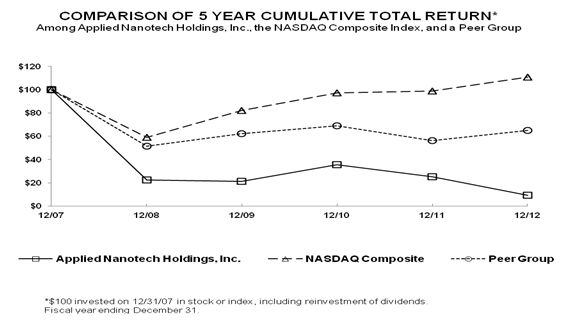
| 12/31/07 | 12/31/08 | 12/31/09 | 12/31/10 | 12/31/11 | 12/31/12 | |||||||||||||||||||
| Applied Nanotech Holdings, Inc. | 100.00 | 22.22 | 21.30 | 35.65 | 25.00 | 9.26 | ||||||||||||||||||
| NASDAQ Market Index | 100.00 | 59.03 | 82.25 | 97.32 | 98.63 | 110.78 | ||||||||||||||||||
| Commercial Physical Research (SIC Code 8731) | 100.00 | 51.38 | 62.23 | 69.01 | 56.36 | 65.09 | ||||||||||||||||||
The performance graph assumes $100 invested on December 31, 2007 in our common stock, the NASDAQ Market Index, and an index based on a basket of stocks composing SIC Code 8731. The total return assumes reinvestment of dividends for the NASDAQ Market Index and the SIC Code Index. The total return is based on historical results and is not intended to indicate future performance. These dates represent arbitrary points in time and if different dates were presented, different results would be obtained.
| Page 20 |
Recent Sales of Unregistered Securities
We issued no unregistered shares of our securities in the fiscal quarter ended December 31, 2012.
SECURITIES AUTHORIZED FOR ISSUANCE UNDER EQUITY COMPENSATION PLANS
| Equity
Compensation Plans Not Approved by the Shareholders of Applied Nanotech Holdings |
Number
of Securities to be issued upon exercise of outstanding options |
Weighted-average exercise price of outstanding options |
Number
of Securities remaining available for future issuance under equity compensation plans (2) |
| (a) | (b) | (c) | |
| 2002 Equity Compensation Plan (1) |
6,289,754 | $0.80 | – |
|
2012 Equity Compensation Plan |
157,500 | $0.23 | 4,739,737 |
| Total | 6,447,254 | $0.80 | 4,739,737 |
| (1) | The 2002 Equity Compensation Plan was approved by a wide majority of the shareholders actually casting votes at each of the 2010, 2008, and 2007 annual meetings of shareholders. However, since less than 50% of the shares eligible to vote actually cast votes at each meeting, the plan does not fall into the category of plans approved by shareholders under SEC rules. |
| (2) | This column excludes securities reflected in column (a) |
There are no equity compensation plans approved by shareholders at the present time.
In 2002, the Company’s Board of Directors established the 2002 Equity Compensation Plan for the purpose of granting incentive or non-qualified stock options to employees or directors of the Company. The plan expired in March 2012 and no future options can be granted under the plan. In April 2012, the Company’s Board of Directors established the 2012 Equity Compensation Plan to replace the 2002 plan. All options granted under both plans were priced at the fair market value of our common stock, or greater, on the date of grant and have a life of up to ten (10) years from their date of grant, subject to earlier termination as set forth in such plan. A total of 5,000,000 options were authorized under the 2012 plan.
For a further description of the stock option plan described above, please see Note 9 to the Consolidated Financial Statements herein.
| Page 21 |
Item 6. Selected Financial Data
| 2012 | 2011 | 2010 | 2009 | 2008 | ||||||||||||||||
| Revenues | $ | 3,593,368 | $ | 6,487,461 | $ | 8,043,795 | $ | 4,052,746 | $ | 3,957,832 | ||||||||||
| Net income (loss) | $ | (5,129,150 | ) | $ | (2,570,248 | ) | $ | 411,304 | $ | (2,152,605 | ) | $ | (2,685,867 | ) | ||||||
| Income (loss) per share | $ | (0.04 | ) | $ | (0.02 | ) | $ | 0.00 | $ | (0.02 | ) | $ | (0.03 | ) | ||||||
| Total assets | $ | 1,692,813 | $ | 4,396,467 | $ | 3,844,383 | $ | 893,367 | $ | 1,792,489 | ||||||||||
| Long-term obligations | $ | 1,641,552 | $ | 48,559 | $ | 1,584,390 | $ | 196,958 | $ | 27,909 | ||||||||||
| Net shareholders’ equity (deficit) | $ | (2,533,358 | ) | $ | 1,916,689 | $ | 810,080 | $ | (1,070,838 | ) | $ | 858,286 | ||||||||
| Cash dividends per common share | $ | – | $ | – | $ | – | $ | – | $ | – | ||||||||||
| Page 22 |
Item 7. Management’s Discussion and Analysis of Financial Condition and Results of Operations
The following discussion should assist in understanding our financial condition, liquidity, and capital resources as of December 31, 2012, and the results of operations for the years ended December 31, 2012, 2011 and 2010. The Notes to our Consolidated Financial Statements included later in this report contain detailed information that should also be read in conjunction with this discussion.
OVERVIEW
We are engaged in research, development, and the commercialization of products that we develop or improve using nanotechnology. We focus on four main areas – Nanosensors, nanomaterials, thermal management, and nanoelectronics. We also possess extensive intellectual property related to electron emission technology. Our technologies, as well as many of the potential applications, are still new and in the early stages of development. To date, our revenue has primarily consisted of development projects involving either the U.S. government or large multinational corporations. We have also received upfront payments related to royalty agreements. In 2011, we also begin receiving royalties from the first products commercialized using our technology, and began directly selling some of the products that we have developed.
OUTLOOK
We expect our total cash needs for 2013 to be approximately $5.3 million. We intend to fund those needs through revenue sources including sales, reimbursements for research, and license agreements. We anticipate increasing our revenue in 2013 over 2012 levels. We had approximately $330,000 of cash and cash equivalents on hand as of December 31, 2012. We have focused on cutting expenses and increasing revenue to achieve at least break even. We believe we will be able to cover our cash needs for 2013; however, we have very little cushion for any unexpected expenses, and we may have to raise debt or equity funds to cover any shortfalls.
We have a history of net operating losses, but in recent years we have been focusing on increasing our revenues and reaching profitability. We were profitable in 2010 based on a one-time event, a license agreement with Samsung that resulted in revenue of $2.5 million and an additional gain of approximately $1.0 million; however, we incurred losses in 2011 and 2012. We are targeting at least breakeven operations and positive cash flow for 2013. There can be no assurances that we will be profitable in 2013 or the future; however, we believe that based on our recent results, our revenue backlog, products expected to be introduced in 2013, and the status of discussions with potential additional revenue sources, that we will be able to at least reach breakeven in 2013. We expect to continue our concentrated research and development of our technology in 2013, although full commercial development of many of our technologies likely will require additional funds in the future.
Based on our plan, we believe that we can reach the point where we can sustain ourselves on our own revenue. Our plan is primarily dependent on raising funds through the licensing of our technology and through reimbursed research arrangements. Our current cash balances, when combined with expected revenues sources and other assets that can be converted to cash, are expected to be adequate to insure that we can maintain our operations at the present level. We believe that we have the ability to continue to secure short term funding, if it were needed, to enable us to continue operations until our plan can be completed if this plan takes longer than anticipated. Our auditors have included a going concern paragraph in their opinion on our financial statements, which could impact our ability to obtain financing, if needed. While we expect to operate achieve at least breakeven and generate positive cash flow from operations in 2013, we may need to raise additional debt or equity to maintain an operating cash cushion to cover temporary shortages.
Our plan is based on current development plans, current operating plans, the current regulatory environment, historical experience in the development of electronic products, and general economic conditions. Changes could occur which would cause certain assumptions on which this plan is based to be no longer valid. Our plan is primarily dependent upon increasing the level of revenues that we achieved in 2012. Although we do not expect funding our operations to be an insurmountable problem, if adequate funds are not available from operations, or additional sources of financing, we may have to eliminate, or reduce substantially, expenditures for research and development, testing of our products, or obtain funds through arrangements with other entities that may require us to relinquish rights to certain technologies or products. Such results could materially and adversely affect us.
| Page 23 |
Critical Accounting Policies
Our significant accounting policies are summarized in the footnotes to our financial statements. Some of the most critical policies are also discussed below.
Stock based compensation - We routinely grant stock options to employees and others. We have granted options in the past and each year all employees have the opportunity to earn additional performance-based option awards. We account for these options using the fair value method of accounting.
Other - As a matter of policy, we review our major assets for impairment. Our major operating assets are accounts receivable, and property and equipment. We depreciate our property and equipment over their estimated useful lives. We did not identify any impaired items in 2010, 2011 or 2012. We have not experienced significant bad debt expense, and we do not believe that we need an allowance for doubtful accounts for any exposure to loss in our December 31, 2012 accounts receivable.
LIQUIDITY AND CAPITAL RESOURCES
Our cash balance decreased significantly during the year – from approximately $3.1 million at December 31, 2011 to approximately $330,000 at December 31, 2012. Our working capital also decreased significantly, primarily as a result of our decrease in cash. Our current liabilities remained relatively constant, but a decrease in the current portion of long-term debt was offset by significant increases in accounts payable and accrued expenses as a result of cash conservation programs and working capital management.
The principal source of our liquidity has historically been from funds received from exempt offerings of our common stock. We received $2.5 million and $200,000 in 2011 and 2010, respectively, from issuance of our stock in private placements. We also issued convertible notes payable with a face amount of $935,700 and $1,946,000 in 2012 and 2010, respectively. These notes are convertible into common stock, and $549,200 of these notes have been converted as of December 31, 2012. We expect the majority of the remaining notes to be converted into common stock in 2013 and 2014. We did receive proceeds of approximately $50,000, and $4,000 from the exercise of stock options by current and former employees in 2011 and 2010, respectively.
We believe that our current cash level, when combined with our backlog, expected revenue, and the expected refund of a deposit reflected in prepaid expenses, is sufficient for us to operate at least through the end of 2013; however, our cash on hand as of the date of this filing only allows us to operate through the end of March, 2013. We expect to at least breakeven in 2013, and if that occurs, we will generate positive cash flow from operations and have no need to raise funding solely to continue operations. We have cut costs significantly, and if revenue sources do not materialize as quickly as we expect, we intend to cut expenses further to a level to enable us to continue operations, and may have to seek debt or equity funding to fill any gap.
Since December 31, 2012, we have received approximately $200,000 in additional convertible debt, and in the event that we were to need additional funds in the future, beyond the amount that we have on hand and those that we expect to receive as revenues or from other sources, we may seek to sell additional debt or equity securities. While we expect to be able to obtain any funds needed for operations, there is no assurance that any financing alternatives can be arranged on commercially acceptable terms. We believe that our success in maintaining profitability will be dependent upon the viability of products using our technology and their acceptance in the marketplace.
The primary factor that drives our cash provided by, or used in, operations is net income or loss. We had net operating losses in both 2012 and 2011 and therefore had cash used in operations in both of those years. We had net income in 2010 and therefore had cash provided by operations in that year. Factors affecting net income or loss are discussed in the Results of Operations section below. In 2012, because of our reduced cash position, a substantial portion of the net loss was offset by management of working capital items, including reduction of accounts receivable, increase in accounts payable, and deferral of officer, employee, and board compensation resulting in an increase in accrued expenses. The cash used in operations in 2011 relative to the net loss in that period is a much more normal relationship between the net loss and cash used in operations. We plan to generate positive cash flow from operations again in 2013, based primarily on achieving at least break-even operations and continued working capital management.
| Page 24 |
Cash used in investing activities was the result of the purchase of capital assets in all years. We would expect minimal cash to be used in investing activities in 2013. No material commitments exist as of December 31, 2012, for future purchases of capital assets.
Our contractual obligations as of December 31, 2012 consist of notes payable (including interest), operating leases, and capital leases. The notes payable are convertible into common stock at rates of $0.16 to $0.25 per share (including one in the amount of $110,000 convertible at a discount of 30% to market at the time of conversion) and many likely will be converted before their due dates in 2013 and 2014. A summary of our obligations at December 31, 2012 is as follows:
| Total | 2013 | 2014 | 2015 | 2016 | 2017 | |
| Capital leases | $72,290 | $61,632 | $10,658 | — | — | — |
| Operating leases | $369,115 | $270,968 | $64,619 | $18,288 | $15,240 | — |
| Convertible notes payable | $2,925,880 | $950,436 | 1,975,444 | — | — | — |
This table reflects the lease of our current facility through its expiration in February 2014. At that time, we may move to a less costly facility, or reduce our space at our present location. We would expect to sign a new lease prior to February 2014. We believe that we will have the cash available to meet our cash requirements for fiscal 2013, and we believe that many of the notes due in 2013 and 2014, including both principal and interest, will be converted to common stock rather than paid in cash.
RESULTS OF OPERATIONS
Business Segments. We operate with a single reportable business segment.
Revenues. Following is a summary of key revenue categories for the three years covered by this report.
| 2012 | 2011 | 2010 | ||||||||||
| Government Revenues | $ | 1,733,728 | $ | 2,956,717 | $ | 2,920,030 | ||||||
| Other Contract Research | $ | 309,274 | $ | 1,102,428 | $ | 1,137,370 | ||||||
| Upfront License Fees | $ | 750,000 | $ | 1,500,000 | $ | 1,250,000 | ||||||
| Product Royalties | $ | 433,453 | $ | 499,638 | $ | – | ||||||
| Product Sales | $ | 228,200 | $ | 186,267 | $ | 83,979 | ||||||
| Other Revenues | $ | 138,713 | $ | 242,411 | $ | 152,416 | ||||||
| Total Core Revenues | $ | 3,593,368 | $ | 6,487,461 | $ | 5,543,795 | ||||||
| Noncore Revenues | $ | – | $ | – | $ | 2,500,000 | ||||||
| Total Revenues | $ | 3,593,368 | $ | 6,487,461 | $ | 8,043,795 | ||||||
| Revenue backlog at December 31 | $ | 2,929,000 | $ | 2,268,000 | $ | 3,361,000 | ||||||
Our total revenue decreased significantly from 2011 to 2012, after increasing from 2010 to 2011 in our core areas. The main reason for the increase from 2010 to 2011 was the product introduction by Yonex which generated approximately $500,000 of product royalties in 2011, as compared to no royalties in 2010, plus increased upfront royalties in 2011.
Our revenues decreased in 2012 as a result of several factors. In the government revenue area, we had an extraordinary $1.6 million contract that spanned 2010 and 2011, resulting in increased government revenues in those years. In addition, we focused on product sales in 2012. This focus diverted resources from government contracts and proposals for new contracts. We were unable to generate product sales as quickly as we expected and we lost research revenue as a result of this reallocation of resources. We have pulled back on our product sales effort and are moving more slowly in that area. We are now focusing our rebuilding our core, bread and butter, research efforts and expect government contract revenues to increase to approximately $2.6 million in 2013. This same product sale focus negatively impacted our private contract research. In addition, we had a couple of large contracts that were completed in early 2012 that were not replaced. As a result of our increased focus in this area, we expect our private contract research to exceed $2.0 million in 2013.
| Page 25 |
Our royalty revenue – both upfront payments and product royalties decreased from 2011 to 2012, primarily as a result of our decreased focus on licensing. The upfront payments were all from YHCC in both 2011 and 2012, and the product royalties were all from Yonex in both years. We expect both of our upfront payments and product royalties to increase in 2013.
The revenue backlog as of December 31, 2012 results from several government programs and private contracts. The majority of these programs are currently in progress and generating revenue, with the remainder related to contracts awarded, but not yet started. The overwhelming majority of this backlog will be converted into revenue in 2013. The revenue backlog at December 31, 2010 was higher than normal for us because we had a Phase III commercialization project related to our solar inks in progress that started in late 2010. That project has been completed, and our backlog has returned to a more historically normal level. We also have some highly likely contracts that have not yet been finalized, and therefore, are not included in the backlog numbers as of December 31, 2012. In addition, Yonex has products in the market that are generating royalty revenue for us and will continue to do so in 2013, and we expect to sign additional licenses that will generate upfront payments, and possibly royalties, in 2013.
We expect revenue to be higher in 2013 than in 2012. We are targeting minimum revenues in 2013 of $7.0 million, an increase of approximately 100% over 2012. Of that, $2.9 million is already committed and in process, and we have specifically identified, and are working on, opportunities that would make up the majority of the remaining $4.1 million needed to achieve $7.0 million in revenue in 2013. There is no guarantee that these revenues will be obtained; however, we think this target is reasonable. Revenues could increase above these levels as a result of unanticipated royalty agreements or additional research revenues, but there is no assurance that this will occur, or that even the targeted minimum of $7.0 million in revenue will be achieved. We are currently pursuing opportunities in several areas that could result in additional revenue in 2013.
Cost of sales. Because we do not ship significant amounts of products or provide homogenous services, we do not incur costs of sales in the traditional sense. We do keep track of our costs on individual projects, but because there is a wide variation in cost percentages, presenting cost of sales information is not meaningful. Government sponsored research has nominal or no gross margins and is primarily just a reimbursement of costs. In some cases we charge nominal amounts for projects that have much higher costs because we are proving a concept that will be helpful to us in other areas, or are seeking a significantly larger follow up contract with the customer. In other instances we may perform research contracts that have significant positive margins because we are able to capitalize on work that we have done and knowledge that we have gained in the past. At the present stage of our development, it is more meaningful to look at total research and development costs in conjunction with revenues than to look at solely internally funded research projects and the cost of research associated with revenue producing contracts. We have, however, broken out some of our costs in the R&D discussion below.
| Page 26 |
Research and development. Following is a summary of research and development expenditures for the past three years.
| 2012 | 2011 | 2010 | ||||||||||
| Direct Materials – Funded Projects | 405,014 | 1,016,803 | 580,854 | |||||||||
| Direct Materials – Internal Projects | 422,675 | 486,836 | 667,318 | |||||||||
| Direct Subcontractors – Funded Projects | 321,332 | 236,826 | 364,702 | |||||||||
| Direct Subcontractors – Internal Projects | – | 18,813 | 3,200 | |||||||||
| Direct Labor - Funded Projects | 734,263 | 1,030,037 | 675,659 | |||||||||
| Direct Labor – Internal Projects | 552,330 | 398,569 | 508,383 | |||||||||
| Overhead Labor | 296,450 | 339,343 | 294,439 | |||||||||
| Benefits | 634,037 | 768,727 | 700,962 | |||||||||
| Facilities and supplies | 937,894 | 1,006,203 | 746,523 | |||||||||
| Other Overhead | 167,213 | 215,780 | 174,323 | |||||||||
| Total Research and development | $ | 4,471,208 | $ | 5,517,937 | $ | 4,716,363 | ||||||
Our research and development spending varies with revenue, as a significant portion of our spending is on funded programs. Our spending on internal projects in 2012 was largely in support of potential product sales – working with potential customers, tailoring our technology to products, and providing samples, as well as continued refinement of our licensed products, as opposed to new research. Subcontractors are usually involved in specific projects and the amount spent on subcontractors depends on the type of contracts that we have in process at any particular time.
Our labor and benefits in the research and development area also varies with the amount of revenue. Our labor devoted to internal projects in 2012 was, like material, largely in support of potential product sales and continued refinement of licensed technologies.
We expect to continue to incur substantial expenses in support of additional research and development activities related to the commercial development of our technologies. We expect to incur approximately 10% less research and development related expenditures in 2013 than those incurred in 2012, as we cut back on spending on internal projects and focus on funded projects. We may, however, incur more research and development expense in 2013 than presently expected. We are pursuing numerous opportunities for research contracts and depending upon the nature of the contracts signed, we may require more research materials than expected, or we may require additional personnel. If research revenue does not materialize as expected at the present time, we would likely reduce research expenditures accordingly.
Selling, general, and administrative. Following are some key components of selling, general, and administrative expense:
| 2012 | 2011 | 2010 | ||||||||||
| Labor and benefits | $ | 1,525,923 | $ | 1,162,202 | $ | 1,174,596 | ||||||
| Board of Director costs | $ | 180,038 | $ | 180,153 | $ | 43,679 | ||||||
| Professional fees | $ | 876,964 | $ | 474,764 | $ | 299,776 | ||||||
| Patent expense | $ | 629,985 | $ | 744,658 | $ | 393,217 | ||||||
| Trade shows and conferences | $ | 83,734 | $ | 134,695 | $ | 123,193 | ||||||
| Patent license commission | $ | – | – | 460,938 | ||||||||
| Other S, G, & A | $ | 503,652 | $ | 475,922 | $ | 409,277 | ||||||
| Total selling, general, and administrative | $ | 3,800,296 | $ | 3,172,394 | $ | 2,904,676 | ||||||
The most significant cost in selling, general and administrative expense is labor and benefits. After remaining relatively constant in 2010 and 2011, we experienced an increase in 2012. This increase was almost entirely related to new hires, and spending, in the sales and marketing area, as we focused on product sales. We would expect labor and benefits to decrease in 2013 from the 2012 level, as we have cut back on our sales and marketing efforts.
| Page 27 |
Board of Director costs were similar in 2012 and 2011, but significantly higher than 2010, as a result of the new Board compensation package adopted at the end of 2010.
We also spend a significant amount on patents. Our patent expense decreased from approximately $745,000 in 2011 to approximately $630,000 in 2012 as we did an extensive review of our portfolio and discontinued maintenance payments on old patents that we considered to no longer have value to us. Our patent expense was lower than normal in 2010, when reached a favorable resolution on a fee dispute with our previous patent firm that resulted in us paying less than the amount previously billed. We expect patent expense to remain at similar levels in 2013 as it was in 2012, although we are continuing to review our patent portfolio and will eliminate or sell any patents we no longer consider useful to us as part of our core strategy.
In 2010, we retained a patent broker to represent us in auctioning a portion of our electron emission patent portfolio. This broker also represented us in the transaction with Samsung Electronics. The portion of the fee allocated to the license portion of the Samsung agreement was $460,938 and is included in selling general and administrative expense. No such fees were incurred in 2011 or 2012.
We expect total selling, general, and administrative expenses to be approximately $2.6 million in 2013, as we focus on keeping costs low to match our revenue levels. If revenues increase above anticipated levels, or other unanticipated transactions occur, our selling, general and administrative expenses could increase above expected levels.
Gain on sale of intellectual property and other assets.
In 2010, we had a gain related to the sale of intellectual property. We entered into a transaction with Samsung Electronics Co., Ltd whereby we sold 29 patents (11 U.S. and 18 foreign counterparts) and licensed approximately 150 additional patents in exchange for a one-time payment of $3.75 million. The proceeds of $3.75 million were allocated between the patents sold and the patents licensed. A total of $2.5 million was allocated to the license and recorded as license revenue. A total of $1.25 million was allocated to the patents sold. The gain of $1,019,531 represents the sale proceeds of $1.25 million reduced by a pro rata share of the expenses related to a patent broker associated with the transaction. The balance of the gain came from the sale of miscellaneous items.
Other income. Following is a summary of other income for the last three fiscal years.
| 2012 | 2011 | 2010 | ||||||||||
| Interest expense associated with capital leases | $ | (11,025 | ) | $ | (6,274 | ) | $ | (5,764 | ) | |||
| Interest expense associated with notes payable | $ | (187,797 | ) | $ | (135,879 | ) | $ | (144,953 | ) | |||
| Interest expense associated notes payable discount | $ | (253,779 | ) | $ | (241,939 | ) | $ | (270,987 | ) | |||
| Interest income | $ | 1,587 | $ | 16,714 | $ | 2,031 | ||||||
| Miscellaneous income | $ | – | $ | – | $ | 4,707 | ||||||
Our convertible notes bear interest at a rate of 8%. In addition, the value of the conversion feature was recorded as a discount at the time of issuance and is being amortized to expense over the life of the notes. We expect approximately $200,000 of interest expense on notes in 2013, as well as roughly $180,000 of additional discount amortization in 2013.
Our interest income is earned as a result of the investment of excess cash balances. Our interest income is negligible in all years, and we expect it to be negligible in 2013.
Provision for taxes. In 2010, we paid $618,750 of Korean taxes that were withheld related to the previously described transaction with Samsung. No such taxes were paid in 2011 or 2012. These Korean taxes are available to offset U.S. income taxes in the future. As a result of net operating loss carry forwards and credits available, we have no liability for U.S. income taxes in any year and expect no such liability in 2013, or the near future.
| Page 28 |
Overview
The largest single component of cost that we incur is payroll related expense. Excluding the cost related to stock based compensation, we incurred payroll related expense of approximately $3.2 million in 2010, $3.3 million in 2011, and $3.6 million in 2012. The increase in 2012 was primarily related to increased spending in the sales and marketing area. We expect payroll related expense in 2013 to decrease to approximately $3.3 million, as a result of our cost reduction efforts. We expect our spending rate for 2013, excluding any revenue, to average approximately $575,000 per month. Based on this, we believe we can reach breakeven at a revenue level of $7.0 million, but there is no assurance that this will occur, or that we will achieve that level of revenue. We are, however, targeting minimum revenues of $7.0 million in 2013. The monthly spending rate of $575,000 includes approximately $100,000 per month of non-cash expenses, resulting in a cash spending rate, excluding any revenue of approximately $475,000 per month on average.
We expect expenditures will increase if additional revenue producing projects, beyond those expected, are obtained. This expenditure level is based on anticipated revenue levels. If these revenue levels are not attained, we will not incur many of these expenses, and our expense level will also be lower than anticipated.
SEASONALITY AND INFLATION
Applied Nanotech Holdings’ business is not seasonal in nature. Management believes that Applied Nanotech Holdings’ operations have not been affected by inflation.
ACCOUNTING PRONOUNCEMENTS
There are no recently issued accounting pronouncements which have not been implemented in our financial statements that would have a material impact on our financial statements.
Item 7A. Quantitative and Qualitative Disclosures About Market Risk
We do not use any derivative financial instruments for hedging, speculative, or trading purposes. Our exposure to market risk is currently immaterial.
| Page 29 |
Item 8. Financial Statements and Supplementary Data
INDEX TO CONSOLIDATED FINANCIAL STATEMENTS
OF APPLIED NANOTECH HOLDINGS, INC.
CONSOLIDATED FINANCIAL STATEMENTS
| Independent Auditor’s Report | 31 |
| Consolidated Balance Sheets - December 31, 2012 and 2011 | 32 |
| Consolidated Statements of Operations - Years Ended December 31, 2012, 2011, and 2010 | 33 |
| Consolidated Statements of Shareholders’ Equity (Deficit) - Years Ended December 31, 2012, 2011, and 2010 | 34 |
| Consolidated Statements of Cash Flows - Years Ended December 31, 2012, 2011, and 2010 | 35 |
| Notes to Consolidated Financial Statements | 36 |
| Page 30 |
REPORT OF INDEPENDENT REGISTERED PUBLIC ACCOUNTING FIRM
To the Board of Directors
and Shareholders
Applied Nanotech Holdings, Inc.
Austin, Texas
We have audited the accompanying consolidated balance sheets of Applied Nanotech Holdings, Inc. and Subsidiaries as of December 31, 2012 and 2011, and the related consolidated statements of operations, shareholders' equity, and cash flows for the years in the three-year period ended December 31, 2012. These consolidated financial statements are the responsibility of the Company's management. Our responsibility is to express an opinion on these consolidated financial statements based on our audits.
We conducted our audits in accordance with the standards of the Public Company Accounting Oversight Board (United States). Those standards require that we plan and perform the audit to obtain reasonable assurance about whether the consolidated financial statements are free of material misstatement. The Company is not required to have, nor were we engaged to perform, an audit of its internal control over financial reporting. Our audits included consideration of internal control over financial reporting as a basis for designing audit procedures that are appropriate in the circumstances, but not for the purpose of expressing an opinion on the effectiveness of the Company’s internal control over financial reporting. Accordingly, we express no such opinion. An audit also includes examining, on a test basis, evidence supporting the amounts and disclosures in the financial statements, assessing the accounting principles used and significant estimates made by management, as well as evaluating the overall financial statement presentation. We believe that our audits provide a reasonable basis for our opinion.
In our opinion, the consolidated financial statements referred to above present fairly, in all material respects, the financial position of Applied Nanotech Holdings, Inc. and Subsidiaries as of December 31, 2012 and 2011, and the results of their operations and their cash flows for each of the years in the three-year period ended December 31, 2012, in conformity with U.S. generally accepted accounting principles.
The accompanying consolidated financial statements have been prepared assuming that the Company will continue as a going concern. As discussed in note 1 to the consolidated financial statements, the Company has experienced recurring losses from operations and negative cash flow from operations. This raises substantial doubt about the Company’s ability to continue as a going concern. Management’s plan in regard to these matters is also described in note 1 to the consolidated financial statements. The consolidated financial statements do not include any adjustments that might result from the outcome of this uncertainty.
Padgett, Stratemann & Co, L.L.P.
San Antonio, Texas
February 28, 2013
| Page 31 |
APPLIED NANOTECH
HOLDINGS, INC. AND SUBSIDIARIES
CONSOLIDATED BALANCE SHEETS
| ASSETS | ||||||||
| December 31, | ||||||||
| 2012 | 2011 | |||||||
| Current assets: | ||||||||
| Cash and cash equivalents | $ | 331,579 | $ | 3,071,783 | ||||
| Accounts receivable, trade – net of allowance for doubtful accounts | 369,409 | 839,863 | ||||||
| Prepaid expenses and other current assets | 692,541 | 153,021 | ||||||
| Total current assets | 1,393,529 | 4,064,667 | ||||||
| Property and equipment, net | 270,693 | 303,055 | ||||||
| Other assets | 28,591 | 28,745 | ||||||
| Total assets | $ | 1,692,813 | $ | 4,396,467 | ||||
| LIABILITIES AND SHAREHOLDERS’ EQUITY (DEFICIT) | ||||||||
| Current liabilities: | ||||||||
| Accounts payable | $ | 813,505 | $ | 324,333 | ||||
| Convertible notes payable , net of discount of $45,000 and $133,490 | 755,800 | 1,486,510 | ||||||
| Obligations under capital lease | 56,680 | 40,701 | ||||||
| Accrued liabilities | 855,264 | 379,675 | ||||||
| Deferred revenue | 103,370 | 200,000 | ||||||
| Total current liabilities | 2,584,619 | 2,431,219 | ||||||
| Obligations under capital lease, long-term | 10,480 | 48,559 | ||||||
| Convertible notes payable, net of discount of $133,186 and $0 | 1,631,072 | – | ||||||
| Total long-term liabilities | 1,641,552 | 48,559 | ||||||
| Total liabilities | 4,226,171 | 2,479,778 | ||||||
| Commitments and contingencies | – | – | ||||||
| Shareholders’ equity (deficit) : | ||||||||
| Preferred stock, $1.00 par value, 2,000,000 shares authorized; no shares issued and outstanding | – | – | ||||||
| Common stock, 160,000,000 shares authorized, $.001 par value, 119,699,286 and 118,915,698 shares issued and outstanding, respectively | 119,699 | 118,916 | ||||||
| Additional paid-in capital | 115,332,346 | 114,654,026 | ||||||
| Accumulated deficit | (117,985,403 | ) | (112,856,253 | ) | ||||
| Total shareholders’ equity (deficit) | (2,533,358 | ) | 1,916,689 | |||||
| Total liabilities and shareholders’ equity (deficit) | $ | 1,692,813 | $ | 4,396,467 | ||||
See notes to consolidated financial statements.
| Page 32 |
APPLIED NANOTECH HOLDINGS, INC. AND
SUBSIDIARIES
CONSOLIDATED STATEMENTS OF OPERATIONS
| Year ended December 31, | ||||||||||||
| 2012 | 2011 | 2010 | ||||||||||
| Revenues | ||||||||||||
| Contract research | $ | 309,274 | $ | 1,102,428 | $ | 1,137,370 | ||||||
| Government contracts | 1,733,728 | 2,956,717 | 2,920,030 | |||||||||
| License fees and royalties | 1,183,453 | 1,999,638 | 3,750,000 | |||||||||
| Product sales | 228,200 | 186,267 | 83,979 | |||||||||
| Other | 138,713 | 242,411 | 152,416 | |||||||||
| Total revenues | 3,593,368 | 6,487,461 | 8,043,795 | |||||||||
| Operating costs | ||||||||||||
| Research and development | 4,471,208 | 5,517,937 | 4,716,363 | |||||||||
| Selling, general and administrative expenses | 3,800,296 | 3,172,394 | 2,904,676 | |||||||||
| Total operating costs | 8,271,504 | 8,690,331 | 7,621,039 | |||||||||
| Gain on sale of assets and other intellectual property | – | – | 1,022,264 | |||||||||
| Income (loss) from operations | (4,678,136 | ) | (2,202,870 | ) | 1,445,020 | |||||||
| Other income (expense): | ||||||||||||
| Interest income | 1,587 | 16,714 | 2,031 | |||||||||
| Interest expense | (452,601 | ) | (384,092 | ) | (421,704 | ) | ||||||
| Other | – | – | 4,707 | |||||||||
| Total other income (expense) | (451,014 | ) | (367,378 | ) | (414,966 | ) | ||||||
| Income (loss) before taxes | (5,129,150 | ) | (2,570,248 | ) | 1,030,054 | |||||||
| Provision for taxes | – | – | 618,750 | |||||||||
| Net income (loss) applicable to common shareholders | $ | (5,129,150 | ) | $ | (2,570,248 | ) | $ | 411,304 | ||||
| Earnings (loss) per share | ||||||||||||
| Basic and diluted | $ | (0.04 | ) | $ | (0.02 | ) | $ | 0.00 | ||||
| Weighted average common shares outstanding | ||||||||||||
| Basic | 119,311,519 | 116,851,588 | 108,835,772 | |||||||||
| Diluted | 119,311,519 | 116,851,588 | 109,069,524 | |||||||||
See notes to consolidated financial statements.
| Page 33 |
APPLIED NANOTECH HOLDINGS, INC. AND SUBSIDIARIES
CONSOLIDATED STATEMENTS OF SHAREHOLDERS’ EQUITY (DEFICIT)
| Preferred | Common | Additional Paid-In | Accumulated | |||||||||||||||||||||||||
| Shares | Amount | Shares | Amount | Capital | Deficit | Total | ||||||||||||||||||||||
| Balance December 31, 2009 | – | $ | – | 107,473,133 | $ | 107,473 | $ | 109,518,998 | $ | (110,697,309 | ) | $ | (1,070,838 | ) | ||||||||||||||
| Conversion rights associated with issuance of convertible notes | – | – | – | – | 612,250 | – | 612,250 | |||||||||||||||||||||
| Issuance of common stock options as compensation | – | – | – | – | 227,124 | – | 227,124 | |||||||||||||||||||||
| Employee restricted stock, including committed to be released shares | – | – | 75,118 | 75 | 126,093 | – | 126,168 | |||||||||||||||||||||
| Issuance of shares upon conversion of accounts payable | – | – | 352,657 | 353 | 89,647 | – | 90,000 | |||||||||||||||||||||
| Issuance of common shares for cash | – | – | 1,000,000 | 1,000 | 199,000 | – | 200,000 | |||||||||||||||||||||
| Issuance of common stock as the result of the exercise of employee stock options | – | – | 18,200 | 18 | 4,350 | – | 4,368 | |||||||||||||||||||||
| Conversion of notes | – | – | 1,048,520 | 1,049 | 208,655 | – | 209,704 | |||||||||||||||||||||
| Net income | – | – | – | – | – | 411,304 | 411,304 | |||||||||||||||||||||
| Balance December 31, 2010 | – | $ | – | 109,967,628 | $ | 109,968 | $ | 110,986,117 | $ | (110,286,005 | ) | $ | 810,080 | |||||||||||||||
| Issuance of common shares for cash | – | – | 6,578,948 | 6,579 | 2,493,421 | – | 2,500,000 | |||||||||||||||||||||
| Issuance of shares upon conversion of accounts payable | – | – | 300,752 | 301 | 119,699 | – | 120,000 | |||||||||||||||||||||
| Issuance of common stock options as compensation | – | – | – | – | 462,431 | – | 462,431 | |||||||||||||||||||||
| Issuance of common stock as the result of the exercise of employee stock options | – | – | 200,454 | 200 | 51,551 | – | 51,751 | |||||||||||||||||||||
| Employee restricted stock, including committed to be released shares | – | – | 103,772 | 104 | 185,177 | – | 185,281 | |||||||||||||||||||||
| Conversion of notes | – | – | 1,764,144 | 1,764 | 355,630 | – | 357,394 | |||||||||||||||||||||
| Net loss | – | – | – | – | – | (2,570,248 | ) | (2,570,248 | ) | |||||||||||||||||||
| Balance December 31, 2011 | – | $ | – | 118,915,698 | $ | 118,916 | $ | 114,654,026 | $ | (112,856,253 | ) | 1,916,689 | ||||||||||||||||
| Issuance of shares upon conversion of accounts payable | – | – | 494,949 | 495 | 119,505 | – | 120,000 | |||||||||||||||||||||
| Issuance of common stock options as compensation | – | – | – | – | 223,025 | – | 223,025 | |||||||||||||||||||||
| Conversion of notes | – | – | 145,306 | 145 | 23,104 | – | 23,249 | |||||||||||||||||||||
| Conversion rights associated with issuance of convertible notes | – | – | – | – | 288,475 | – | 288,475 | |||||||||||||||||||||
| Employee restricted stock, including committed to be released shares | – | – | 143,333 | 143 | 24,211 | – | 24,354 | |||||||||||||||||||||
| Net loss | – | – | – | – | – | (5,129,150 | ) | (5,129,150 | ) | |||||||||||||||||||
| Balance December 31, 2012 | – | $ | – | 119,699,286 | $ | 119,699 | $ | 115,332,346 | $ | (117,985,403 | ) | $ | (2,533,358 | ) | ||||||||||||||
See notes to consolidated financial statements.
| Page 34 |
APPLIED NANOTECH HOLDINGS, INC. AND
SUBSIDIARIES
CONSOLIDATED STATEMENTS OF CASH FLOWS
| Year Ended December 31, | ||||||||||||
| 2012 | 2011 | 2010 | ||||||||||
| Cash flows from operating activities: | ||||||||||||
| Net income (loss) | $ | (5,129,150 | ) | $ | (2,570,248 | ) | $ | 411,304 | ||||
| Adjustments to reconcile net income ( loss) to net cash provided by (used in) operating activities: | ||||||||||||
| Depreciation and amortization expense | 111,327 | 75,741 | 63,356 | |||||||||
| Stock and options issued for services | 247,379 | 647,712 | 353,292 | |||||||||
| Amortization of discount on debt | 253,779 | 241,939 | 270,987 | |||||||||
| Changes in assets and liabilities: | ||||||||||||
| Accounts receivable, trade | 470,454 | (82,356 | ) | (508,343 | ) | |||||||
| Prepaid expenses and other assets | (539,366 | ) | (42,749 | ) | (48,793 | ) | ||||||
| Accounts payable | 609,172 | (101,640 | ) | 23,294 | ||||||||
| Accrued expenses | 508,196 | (155,554 | ) | 309,698 | ||||||||
| Deferred revenue and other current liabilities | (96,630 | ) | (120,000 | ) | 10,000 | |||||||
| Total adjustments | 1,564,311 | 463,093 | 473,491 | |||||||||
| Net cash provided by (used in) operating activities | (3,564,839 | ) | (2,107,155 | ) | 884,795 | |||||||
| Cash flows from investing activities: | ||||||||||||
| Capital expenditures | (50,398 | ) | (78,138 | ) | (11,637 | ) | ||||||
| Net cash used in investing activities | (50,398 | ) | (78,138 | ) | (11,637 | ) | ||||||
| Cash flows from financing activities: | ||||||||||||
| Proceeds from issuance of common stock | – | 2,551,751 | 204,368 | |||||||||
| Proceeds of long term debt | 935,700 | – | 1,730,000 | |||||||||
| Repayment of short-term notes payable | – | – | (340,000 | ) | ||||||||
| Repayment of capital lease obligations and long term debt | (60,667 | ) | (27,245 | ) | (21,927 | ) | ||||||
| Net cash provided by financing activities | 875,033 | 2,524,506 | 1,572,441 | |||||||||
| Net increase (decrease) in cash and cash equivalents | (2,740,204 | ) | 339,213 | 2,445,599 | ||||||||
| Cash and cash equivalents, beginning of year | 3,071,783 | 2,732,570 | 286,971 | |||||||||
| Cash and cash equivalents, end of year | $ | 331,579 | $ | 3,071,783 | $ | 2,732,570 | ||||||
See notes to consolidated financial statements.
| Page 35 |
APPLIED NANOTECH HOLDINGS, INC. AND
SUBSIDIARIES
NOTES TO CONSOLIDATED FINANCIAL STATEMENTS
1. Organization, Operations, and Liquidity:
Applied Nanotech Holdings, Inc. and its subsidiaries (“the Company”) are engaged in using nanotechnology to develop products for applications in the thermal management, nanomaterials, nanosensors, and nanoelectronics areas, as well as the performance of significant research in those areas. We intend to obtain development revenues for applying our technology to specific applications for our development partners, to obtain royalty revenues from licensing this technology to those partners and others, and to sell products using this technology.
We incurred an operating loss in 2012, but expect to at least breakeven in 2013; however; unless we are able to operate profitably on a continuous basis as a result of revenues from either reimbursed research or license agreements, we may be required to seek additional funds through the equity markets, or raise funds through debt instruments to allow us to maintain operations. There is no assurance that additional license agreements will be signed, that commercialization of our technology and products will result in income from operations, or that funds will be available in the equity or debt markets, if needed. Management believes it will be able to operate profitability and if not, be able to secure additional funding, if needed.
The principal source of our liquidity since the time of our initial public offering in 1993 has been from the funds received from exempt offerings of common stock, preferred stock, and convertible debt securities, as well as license and development revenues. We may receive additional funds from the exercise of employee stock options. We may also seek to increase our liquidity through bank borrowings or other financings, although this is not likely. There can be no assurance that any of these financing alternatives can be arranged on commercially acceptable terms. We believe that our success in reaching sustained profitability will depend on the viability of our technology and products using that technology, their acceptance in the marketplace, and our ability to obtain additional debt or equity financings in the future, if needed.
A portion of our research and development has been funded by others. To the extent that other funding is not available, research and development may be internally funded by us or curtailed; however, our primary objective is to focus our resources on projects for which we receive funding.
The Company has a history of net losses and negative cash flow from operations. We were profitable in 2010 and had positive cash flows from operations in 2010, but had losses in 2011 and 2012. We expect to reach at least breakeven in 2013. The accompanying financial statements have been prepared in conformity with generally accepted accounting principles, which contemplate continuation of the Company as a going concern, and do not include any adjustments that may be required if it were unable to continue as a going concern. Management believes that actions currently being taken, which primarily involve increasing revenues, will allow the Company to achieve profitability and allow the Company to continue as a going concern.
Certain prior year amounts have been reclassified to conform with the current year presentation.
2. Summary of Significant Accounting Policies:
Principles of consolidation
The accompanying consolidated financial statements include the accounts of the Company and its subsidiaries, Applied Nanotech, Inc. (“ANI”), EZDiagnostix, Inc. (“EZDX”), and Electronic Billboard Technology, Inc. (“EBT”), after the elimination of all significant intercompany accounts and transactions. ANI is primarily involved in developing products for applications using the Company’s proprietary nanocomposites, nanosensors, nanoelectronics, thermal management, and field emission technologies. EZDX is focused on commercializing the Company’s sensor technology. EBT was primarily involved in the commercialization of electronic digitized sign technology, but has now sold its technology and is inactive, but could receive royalties in future years.
| Page 36 |
APPLIED NANOTECH HOLDINGS, INC. AND
SUBSIDIARIES
NOTES TO CONSOLIDATED FINANCIAL STATEMENTS - (CONTINUED)
Management’s estimates
The preparation of financial statements in conformity with generally accepted accounting principles requires management to make estimates and assumptions that affect the reported amounts of assets, liabilities, revenues, and expenses, as well as the disclosure of contingent assets and liabilities. Actual results could differ from those estimates. Significant estimates include deferred tax asset reserves, bad debt reserves, assumptions used in calculating share based compensation, and depreciation.
Revenue recognition
Our revenues include reimbursements under agreements to perform research and development for government agencies and others. We do not perform research contracts that are contingent upon successful results. Larger projects are sometimes broken down in phases to allow the customer to determine at the end of each phase if they wish to move to the next phase. The agreements with federal government agencies generally provide that, upon completion of a technology development program, the funding agency is granted a royalty-free license to use any technology developed during the course of the program for its own purposes, but not any preexisting technology that we use in connection with the program. We retain all other rights to use, develop, and commercialize the technology and recognize revenue when it is earned pursuant to the terms of the contract. Agreements with nongovernmental entities generally allow the entity the first opportunity to license the technology from us upon completion of the project.
The Company’s revenues also include royalties from licensing its technology, revenue from the sale of products, and other miscellaneous revenues. Many of the company’s projects may involve a combination of these types of revenues. Revenues are recognized as follows:
Government Contracts - Revenue from government contracts is recognized when it is earned pursuant to the terms of the contract. Long-term projects, such as SBIR Phase II grants that usually range from $500,000 to $1,000,000 in total and usually extend for a period of approximately two years, are generally based on reimbursement of costs. These projects are usually billed monthly based on costs, hours, or some other measure of activity during the month. As a general rule, we recognize revenue on these contracts based on the activity level of the contract during the period as compared with total estimated activity. This generally would be a measure of proportional performance on the contract, such as cost incurred compared with total expected cost. The recognition of revenue may not correspond with the billings allowable under the contract. To the extent that billings exceed revenue earned, a portion of the revenue is deferred until such time as it is earned. Short-term projects, such as SBIR Phase I grants that usually are less than $100,000 and usually extend for a period of approximately 6 months, are billed at periodic intervals as specified in the contract.
Other Research Contracts - Revenue from nongovernmental contracts is recognized when it is earned pursuant to the terms of the contract. Each contract is unique and tailored to the needs of the customer and goals of the project. Some contracts may call for a monthly payment for a fixed period of time. Other contracts may be for a fixed dollar amount with an unspecified time period, although there is frequently a targeted completion date. These contracts generally involve some sort of up-front payment. Some contracts may call for the delivery of samples, or may call for the transfer of equipment or other items developed during the project to the customer. As a general rule, we recognize revenue on long term contracts based on the activity level of the contract during the period as compared with total estimated activity. This generally would be a measure of proportional performance on the contract, such as cost incurred compared with total expected cost. However, to the extent there are other significant contract provisions such as the delivery of more than a nominal amount of samples or delivery of equipment, we would modify this as appropriate. For other short term contracts, generally less than $50,000, we recognize revenue when it is billed under the terms of the contract.
Royalty Revenue - The Company recognizes royalty revenues based on the shipment of products by a licensee at the time the underlying product upon which the royalty is based is shipped by the entity paying the royalty, if that is able to be ascertained at the time. For minimum royalty payments paid by a licensee that are required for the licensee to maintain exclusivity, royalty revenue is recognized at the time the minimum royalty payment is due, which normally corresponds somewhat with the time that the payment is received. The Company recognizes license fees due at the time of the signing of a royalty agreement when the licensee has an enforceable commitment to pay. This normally corresponds with, or is reasonably close to, the time of receipt of the payment.
| Page 37 |
APPLIED NANOTECH HOLDINGS, INC. AND
SUBSIDIARIES
NOTES TO CONSOLIDATED FINANCIAL STATEMENTS - (CONTINUED)
Product Sales - Revenue from product sales is recognized at the time the product shipped. The Company’s primary business is research and development and the licensing of its technology, not the sale of products. Product sales are generally insignificant in number, and are usually limited to the sale of samples, proofs of concepts, prototypes, or other items resulting from its research. Product sales are expected to increase in 2013.
Other Revenue - Other miscellaneous revenue is recognized as deemed appropriate given the facts of the situation and is generally not material.
Cash and cash equivalents
The Company considers all highly liquid investments purchased with an original maturity of three months or less to be cash equivalents.
Accounts receivable
The Company occasionally provides services or sells products to others on credit; however most services or sales are to large financially stable companies, or the U.S. Federal government. It is the Company’s policy to record reserves for potential credit losses. Since inception, the Company has experienced minimal credit losses. The Company considered no reserves to be necessary for any of the years presented.
Property and equipment
Property and equipment are recorded at cost, net of accumulated depreciation and amortization. Depreciation is provided on the straight-line method over the estimated useful lives of the assets, which range from three to seven years, or the remaining lease term for leasehold improvements, if less. Expenses for major renewals and betterments that extend the original estimated economic useful lives of the applicable assets are capitalized. Expenses for normal repairs and maintenance are charged to operations as incurred. The cost and related accumulated depreciation of assets sold or otherwise disposed of are removed from the accounts, and any gain or loss is included in income.
Impairment
At each balance sheet date, the Company evaluates the carrying amount and the amortization period for its long-lived assets. If an indicator of impairment exists, it is recorded at that time. There have been no impairment charges recorded in any of the years presented in these financial statements.
Income taxes
The Company accounts for income taxes using the asset and liability method. Under this method, deferred income taxes are recorded to reflect the tax consequences on future years of temporary differences between the tax basis of the assets and liabilities and their financial amounts at year-end. The Company provides a valuation allowance to reduce deferred tax assets to their net realizable value. The Company has determined that no reserve for uncertain tax positions is required; however, tax years 2009 through 2012 remain open for examination by the taxing authorities.
Research and development expenses
Costs of research and development for Company-sponsored projects are expensed as incurred.
| Page 38 |
APPLIED NANOTECH HOLDINGS, INC. AND
SUBSIDIARIES
NOTES TO CONSOLIDATED FINANCIAL STATEMENTS - (CONTINUED)
Disclosures about fair value of financial instruments
The following methods and assumptions were used to estimate the fair value of each class of certain financial instruments for which it is practicable to estimate that fair value. For cash equivalents and accounts receivable, the carrying amount approximates fair value because of the short-term nature of these instruments. The fair value of the Company’s capital lease obligations and notes payable is estimated based on the quoted market prices for the same, or similar issues, or on the current rates offered to the Company for obligations of the same remaining maturities with similar collateral requirements. For all years presented, the fair value of the Company’s capital lease obligations and notes payable approximate their carrying values.
Income (loss) per common share
Basic per share amounts are computed, generally, by dividing net income or loss by the weighted average number of common shares outstanding. Diluted per-share amounts assume the conversion, exercise, or issuance of all potential common stock instruments unless the effect is anti-dilutive, thereby reducing the loss or increasing the income per common share. As described in Notes 8, 9 and 10, the Company had options and warrants outstanding as indicated in the table below. In addition, the Company has convertible notes payable, which if converted, would have resulted in additional shares outstanding as indicated in the table below.
However, because of the interest expense associated with the notes payable, inclusion of the notes payable in the calculation of diluted earnings per share would have an anti-dilutive effect. In addition, since the Company incurred losses in 2012 and 2011, the inclusion of any potential common shares in the calculation of diluted loss per-share would have an anti-dilutive effect in those years. A small portion of the options outstanding have a dilutive effect and are included in the calculation of dilutive earnings per share in 2010. Because this effect is insignificant, basic and diluted per-share amounts are the same in all years presented.
| 2012 | 2011 | 2010 | ||||||||||
| Options | 6,447,254 | 6,378,495 | 6,222,972 | |||||||||
| Warrants | 181,524 | 181,524 | 1,304,353 | |||||||||
| Weighted average exercise price | $ | 0.80 | $ | 0.90 | $ | 1.10 | ||||||
| Convertible notes payable | 16,469,961 | 9,079,530 | 10,180,301 | |||||||||
Recently issued accounting pronouncements
There are no recently issued accounting pronouncements which have not been implemented in our financial statements that would have a material impact on our financial statements.
| Page 39 |
APPLIED NANOTECH HOLDINGS, INC. AND
SUBSIDIARIES
NOTES TO CONSOLIDATED FINANCIAL STATEMENTS - (CONTINUED)
Share-based payments
The Company has a stock based compensation plan described in greater detail in Note 9 to these financial statements. The Company uses the fair value method to account for stock-based compensation. The fair value of each award is estimated on the date of each grant. For restricted stock the fair market value is based on the market value of the stock granted on the date of the grant. For options, it is estimated using the Black Scholes option pricing model that uses the assumptions noted in the following table. Estimated volatilities are based on the historical volatility of the Company’s stock over the same period as the expected term of the options. The expected term of options granted represents the period of time that options granted are expected to be outstanding. The Company uses historical data to estimate option exercise behavior and to determine this term. The risk free rate used is based on the U.S. Treasury yield curve in effect at the time of the grant using a time period equal to the expected option term. The Company has never paid dividends and does not expect to pay any dividends in the future.
| 2012 | 2011 | 2010 | ||||
| Expected dividend yield | 0% | 0% | 0% | |||
| Risk Free Interest Rate | 0.39%-0.51% | 0 .35%-1.28% | 0.57%-1.40% | |||
| Expected option term (in years) | 3.5 – 5.0 | 3.5 – 5.0 | 3.5 | |||
| Turnover/Forfeiture Rate | 0% | 0% | 0% | |||
| Expected volatility | 94% - 100% | 93% - 99% | 98% - 102% | |||
| Weighted-average volatility | 96% | 96% | 100% |
The Black-Scholes option valuation model and other existing models were developed for use in estimating the fair value of traded options that have no vesting restrictions and are fully transferable. These option valuation models require the input of, and are highly sensitive to, subjective assumptions including the expected stock price volatility. Applied Nanotech Holdings’ stock options have characteristics significantly different from those of traded options, and changes in the subjective input assumptions could materially affect the fair value estimate.
3. Operating Lease Obligations:
The Company leases various facilities and equipment under operating lease agreements having terms expiring at various dates through 2016. Rental expense was $274,538; $251,566; and $190,697 for the years ended December 31, 2012, 2011, and 2010, respectively.
Future minimum lease payments under operating leases that have initial or remaining noncancelable lease terms in excess of one year at December 31, 2012, were as follows:
| 2013 | 270,968 | |||
| 2014 | 64,619 | |||
| 2015 | 18,288 | |||
| 2016 | 15,240 | |||
| Total future minimum lease payments | $ | 369,115 |
| Page 40 |
APPLIED NANOTECH HOLDINGS, INC. AND
SUBSIDIARIES
NOTES TO CONSOLIDATED FINANCIAL STATEMENTS - (CONTINUED)
4. Convertible Notes Payable:
Notes payable at December 31, 2012 and 2011 consisted of notes payable to shareholders. The notes are generally unsecured notes, bearing interest at 8%, and due in lump sums from January 2013 to January 2014, if not converted earlier. These notes, including any accrued interest, are convertible into shares of common stock at the option of the note holder at fixed rates ranging from $0.16 to $0.25 per share. $110,000 of the notes are convertible into common stock at a discount of 30% to market at the time of conversion. Notes with a face amount of $2,146,000 were issued in 2009 and 2010; however, the conversion rights were valued at $647,250 and recorded as a discount to the note at the time of issuance. $272,655 of the discount was amortized to expense as of December 31, 2010, $513,760 was amortized to expense as of December 31, 2011, and the balance by December 31, 2012. A total of $200,000, $326,000, and $19,200 of these notes were converted to common stock in 2010, 2011, and 2012, respectively. Three notes with a total face value of $500,000 are secured by a blanket security interest in all assets of the company. Notes with a face amount of $945,700 were issued in 2012, however the conversion rights were valued at $298,475 and recorded as a discount at the time of issuance. $120,289 has been amortized to expense as of December 30, 2012. The total face amount of the remaining notes at December 31, 2012 is $2,565,058.
5. Capital Lease Obligations:
Capital leases payable at December 31, 2012 and 2011 consisted of the following:
| 2012 | 2011 | |||||||
| Capital lease equipment due in monthly installments of $3,322 through February 2014. The equipment value and lease obligation was determined using a discount rate of 12.35%. The equipment is included in property and equipment at December 31, 2012 at a cost of $118,700 and with accumulated amortization of $34,409. | $ | 46,508 | $ | 86,377 | ||||
| Capital lease equipment due in monthly installments of $816 through July 2013. The equipment value and lease obligation was determined using a discount rate of 14.08%. The equipment is included in property and equipment at December 31, 2012 at a cost of $42,040 and with accumulated amortization of $37,136. | $ | 5,712 | $ | 15,497 | ||||
| Capital lease equipment due in monthly installments of $1,338 through March 2014. The equipment value and lease obligation was determined using a discount rate of 11.46%. The equipment is included in property and equipment at December 31, 2012 at a cost of $33,177, with accumulated amortization of $4,977. | 20,070 | – | ||||||
| Total capital leases | 72,290 | 101,874 | ||||||
| Less interest | 5,130 | 12,614 | ||||||
| Less current portion | 56,680 | 40,701 | ||||||
| Capital lease obligations, long-term | $ | 10,480 | $ | 48,559 | ||||
These leases result in minimum payments of $61,632; and $10,658, respectively, in 2013 and 2014.
| Page 41 |
APPLIED NANOTECH HOLDINGS, INC. AND
SUBSIDIARIES
NOTES TO CONSOLIDATED FINANCIAL STATEMENTS - (CONTINUED)
6. Details of Certain Balance Sheet Accounts:
Additional information regarding certain balance sheet accounts at December 31, 2012 and 2011 is as follows:
| December 31, | ||||||||
| 2012 | 2011 | |||||||
| Property and equipment: | ||||||||
| Plant and equipment | $ | 822,273 | $ | 1,222,309 | ||||
| Furniture and office equipment | 110,534 | 162,902 | ||||||
| Leasehold improvements | 41,627 | 41,627 | ||||||
| Total carrying cost | 974,434 | 1,426,838 | ||||||
| Less accumulated depreciation | (703,741 | ) | (1,123,783 | ) | ||||
| $ | 270,693 | $ | 303,055 | |||||
| Accrued liabilities: | ||||||||
| Payroll and related accruals | $ | 468,441 | $ | 107,044 | ||||
| Other (primarily interest) | 386,823 | 272,631 | ||||||
| Total | $ | 855,264 | $ | 379,675 | ||||
Depreciation and amortization for the years ended December 31, 2012, 2011, and 2010 was $111,327; $75,741; and $63,356, respectively. Equipment held under capital leases and accumulated amortization on that equipment is included in these totals.
7. Income Taxes:
The components of deferred tax assets (liabilities) at December 31, 2012 and 2011, were as follows:
| December 31, | ||||||||
| 2012 | 2011 | |||||||
| Deferred tax assets: | ||||||||
| Net operating loss carry forwards | $ | 22,173,000 | $ | 22,752,000 | ||||
| Stock based compensation | 2,228,000 | 2,152,000 | ||||||
| Partnership asset | 39,000 | 39,000 | ||||||
| Capitalized intangible assets | 14,000 | 19,000 | ||||||
| Difference in tax basis of assets | 6,000 | 2,000 | ||||||
| Foreign tax credit | 619,000 | 619,000 | ||||||
| Accrued expenses not deductible until paid | 202,000 | 109,000 | ||||||
| Total deferred tax assets | 25,281,000 | 25,692,000 | ||||||
| Deferred tax liabilities: | – | – | ||||||
| Net deferred tax assets before valuation allowance | 25,281,000 | 25,692,000 | ||||||
| Valuation allowance | (25,281,000 | ) | (25,692,000 | ) | ||||
| Net deferred tax asset | $ | – | $ | – | ||||
| Page 42 |
APPLIED NANOTECH HOLDINGS, INC. AND
SUBSIDIARIES
NOTES TO CONSOLIDATED FINANCIAL STATEMENTS - (CONTINUED)
7. Income Taxes (continued):
The following is a reconciliation of the amount of the income tax expense (benefit) that would result from applying the statutory federal income tax rates to pretax income (loss) and the reported amount of income tax expense (benefit) for the periods ended December 31, 2012, 2011, and 2010.
| December 31, | ||||||||||||
| 2012 | 2011 | 2010 | ||||||||||
| Expected income tax expense (benefit) | $ | (1,744,000 | ) | $ | (874,000 | ) | $ | 350,000 | ||||
| Non-deductible expenses | 13,000 | 12,000 | 15,000 | |||||||||
| Expiration of tax credit carryforwards | – | 61,000 | 64,000 | |||||||||
| Expiration of NOL carryforwards | 2,142,000 | 4,055,000 | 3,975,000 | |||||||||
| Foreign tax credit | – | – | (619,000 | ) | ||||||||
| Foreign taxes paid | – | – | 618,750 | |||||||||
| Increase (decrease) in valuation allowance | (411,000 | ) | (3,254,000 | ) | (3,785,000 | ) | ||||||
| Total tax | $ | – | $ | – | $ | 618,750 | ||||||
As of December 31, 2012, the Company had net operating loss carry forwards of approximately $65 million that expire from 2013 through 2032, that are available to offset future taxable income. The majority of these carry forwards expire after 2013. Additionally, the Company has tax credit carry forwards related to foreign taxes of $619,000 that expire in 2019.
Under certain circumstances issuance of common shares can result in an ownership change under Internal Revenue Code Section 382 which limits the Company’s ability to utilize carry forwards from prior to the ownership change. Any such ownership change resulting from stock issuances could limit the Company’s ability to utilize any net operating loss carry forwards or credits generated before this change in ownership. These limitations tend to relate to the timing of usage, rather than the loss of the ability to use these net operating losses.
The foreign taxes paid in 2010 represent Korean taxes associated with the patent sale/license transaction described in greater detail in Note 14 to these financial statements.
8. Capital Stock:
Preferred stock
The Company has authorization for the issuance of 2,000,000 shares of $1.00 par value preferred stock. There were no shares of preferred stock outstanding for any of the years presented.
Common stock
The Company has authorization for the issuance of 160,000,000 shares of $0.001 par value common stock.
No shares were issued in private placements in 2012; however, during 2010 and 2011, the Company issued shares of its common stock in a private placement in an exempt offering under Regulation D of the Securities Act of 1933. The 2010 shares were issued at a price that represented a slight discount to the market price of the stock at the time of the offering. All of these shares were registered to enable the shareholder to be able to sell the shares, with the latest registration statement declared effective November 22, 2010. A total of 1,000,000 shares were issued and proceeds of $200,000 were received. The 2011 shares were issued at the market price at the time of the offering and have not been registered for sale. In 2011, a total of 6,578,948 shares were issued and proceeds of $2.5 million were received.
| Page 43 |
APPLIED NANOTECH HOLDINGS, INC. AND
SUBSIDIARIES
NOTES TO CONSOLIDATED FINANCIAL STATEMENTS - (CONTINUED)
8. Capital Stock (continued):
Committed to be released common shares
As discussed in Note 9, the Company awards restricted stock to employees as compensation. Shares awarded, but not yet issued and outstanding are accounted for as committed to be released shares.
At December 31, 2012, common stock was reserved for the following reasons:
| Exercise of stock warrants | 181,524 | |||
| Conversion of notes payable and accrued interest | 16,469,961 | |||
| Committed to be released common shares | 628,135 | |||
| Exercise and future grants of stock options | 11,186,991 | |||
| Total shares reserved | 28,466,611 |
9. Stock Options:
The Company sponsors a stock-based incentive compensation plan, the 2012 Equity Compensation Plan (the “Plan”), which was established by the Board of Directors of the Company in April 2012. A total of 5,000,000 shares were initially reserved for issuance under the plan. A total of 4,739,737 shares remain available for grant under this plan at December 31, 2012. This plan replaced the 2002 Equity Compensation Plan, which expired in March 2012. The compensation cost that has been charged against income for both plans for the years ended December 31, 2012, 2011, and 2010 was $247,379; $647,712; and $353,292, respectively. No income tax benefit was recognized in the income statement and no compensation was capitalized in any of the years presented.
The plan allows the Company to grant incentive stock options, non-qualified stock options, or restricted stock. The incentive stock options are exercisable for up to ten years, at an option price per share not less than the fair market value on the date the option is granted. The incentive stock options are limited to persons who have been regular full-time employees of the Company or its present and future subsidiaries for more than one (1) year and at the date of the grant of any option are in the employ of the Company or its present and future subsidiaries. Historically, the Company has not granted incentive stock options. Non-qualified options may be granted to any person, including, but not limited to, employees, independent agents, consultants and attorneys, who the Company’s Compensation Committee believes have contributed, or will contribute, to the success of the Company. Non-qualified options may be issued at option prices of less than fair market value on the date of grant and are exercisable for up to ten years from date of grant. The option vesting schedule for options granted is determined by the Compensation Committee of the Board of Directors at the time of the grant. The Plan provides for accelerated vesting of unvested options if there is a change in control, as defined in the plan.
| Page 44 |
APPLIED NANOTECH HOLDINGS, INC. AND
SUBSIDIARIES
NOTES TO CONSOLIDATED FINANCIAL STATEMENTS - (CONTINUED)
9. Stock Options (continued):
The company issues new shares for all options exercised. It does not expect to repurchase any shares to facilitate future option exercises. The following table summarizes information about stock options outstanding, some of which may not ultimately vest, and options currently exercisable under the option plan at December 31, 2012:
| Options Outstanding | Options Exercisable | ||||||
| Range of Exercise Prices |
Number Outstanding at 12/31/12 |
Wgtd. Avg. Remaining Contractual Life |
Wgtd. Avg. Exercise Price |
Number Exercisable at 12/31/12 |
Wgtd. Avg. Remaining Contractual Life |
Wgtd. Avg. Exercise Price | |
| $0.00 - $0.25 | 641,849 | 6.3 Years | $0.24 | 621,014 | 6.3 Years | $0.24 | |
| $0.26 - $0.50 | 3,805,220 | 7.1 Years | $0.37 | 3,797,941 | 7.1 Years | $0.37 | |
| $0.51 - $1.00 | 331,748 | 4.2 Years | $0.70 | 325,501 | 4.2 Years | $0.70 | |
| $1.01 - $2.00 | 598,396 | 4.0 Years | $1.31 | 598,396 | 4.0 Years | $1.31 | |
| $2.01 - $3.00 | 1,070,041 | 1.6 Years | $2.43 | 1,070,041 | 1.6 Years | $2.43 | |
| Total | 6,447,254 | 5.7 Years | $0.80 | 6,412,893 | 5.7 Years | $0.80 | |
| Aggregate intrinsic value | $0.00 | $0.00 | |||||
The following is a summary of stock option plan activity:
| Number of Shares |
Wgtd. Ave. Exercise Price | ||
| Options outstanding at December 31, 2009 | 4,430,392 | $1.28 | |
| Granted | 2,803,538 | $0.37 | |
| Exercised | (18,200) | $0.24 | |
| Cancelled | (992,758) | $1.35 | |
| Options outstanding at December 31, 2010 | 6,222,972 | $0.86 | |
| Granted | 1,303,498 | $0.43 | |
| Exercised | (200,454) | $0.26 | |
| Cancelled | (947,521) | $0.68 | |
| Options outstanding at December 31, 2011 | 6,378,495 | $0.82 | |
| Granted | 325,000 | $0.30 | |
| Exercised | – | $0.00 | |
| Cancelled | (256,241) | $0.53 | |
| Options outstanding at December 31, 2012 | 6,447,254 | $0.80 |
| Page 45 |
APPLIED NANOTECH HOLDINGS, INC. AND
SUBSIDIARIES
NOTES TO CONSOLIDATED FINANCIAL STATEMENTS - (CONTINUED)
9. Stock Options (continued):
The weighted-average grant-date fair value of options granted during the years ended December 31, 2012, 2011, and 2010 was $0.19, $0.28, and $0.24, respectively. The total intrinsic value of options exercised during the years ended December 31, 2011, and 2010 was $59,635, and $2,002 respectively. No options were exercised in the year ended December 31, 2012. As of December 31, 2012, there was a total of $23,373 of unrecognized compensation cost related to 26,042 non-vested options granted under the plan. These unvested options all vest based on the passage of time over a one to two year period. All of this expense will be recognized in 2013. The fair value of shares vested during the years ended December 31, 2012, 2011, and 2010 was $223,025; $462,431; and $227,124, respectively.
The 2012 Equity Compensation Plan, as did the 2002 plan, also allows the issuance of restricted shares of common stock and we granted restricted stock to non-officer employees as part of their compensation. We granted a total of 381,237 shares with a value of $126,168 in 2010 and a total of 443,544 shares with a value of $185,281 in 2011, and 125,577 shares with a value of $24,354 in 2012, which represents the market price at the date of grant. A total of 75,118 shares, 103,772 shares, and 143,333 shares were issued to employees in 2010, 2011, and 2012, respectively, and are included in issued and outstanding shares at the end of each of the respective years. The remaining 628,135 shares are classified as committed to be released shares at December 31, 2012.
10. Stock Warrants:
Common stock warrants
In 2007, we issued 1,304,353 warrants in connection with a private placement of the Company’s stock. These warrants enable the holder to purchase shares of the Company’s common stock at a price of $2.50 per share through the earlier of April 2013, or the date that the shares acquired in the private placement are sold by the shareholder. As of December 31, 2012 shares associated with 900,002 of the warrants are known to have been sold, shares associated with 222,827 of the warrants are assumed to have been sold, and shares associated with the remaining 181,524 warrants are still outstanding. None of the warrants issued have ever been exercised and it is unlikely that the warrants will be exercised prior to the expiration date of April 2013.
11. Supplemental Cash Flow Information:
Cash paid for interest was $46,025; $6,274; and $5,764 for 2012, 2011, and 2010, respectively. Cash paid for income taxes in 2010 was $618,750. No cash was paid for income taxes in either 2011 or 2012. The following non-cash transactions have been excluded from the accompanying consolidated statement of cash flows:
| 2012 | 2011 | 2010 | ||||||||||
| Non-cash financing activities: | ||||||||||||
| Issuance of common shares in payment of accounts payable | $ | 120,000 | $ | 120,000 | $ | 90,000 | ||||||
| Issuance of note payable in payment of accounts payable | $ | – | $ | – | $ | 340,000 | ||||||
| Issuance of note payable in payment of accrued interest | $ | 32,558 | $ | – | $ | – | ||||||
| Conversion of notes payable and accrued interest | $ | 23,249 | $ | 357,394 | $ | 209,704 | ||||||
| Issuance of notes payable to Officers and Directors in payment of accrued expenses | $ | – | $ | – | $ | 216,000 | ||||||
| Capital lease transactions | $ | 28,567 | $ | 85,369 | $ | – | ||||||
12. Retirement Plan:
The Company sponsors a defined contribution 401(k) profit sharing plan. Company contributions are discretionary and no company contributions were made in any of the years presented.
| Page 46 |
APPLIED NANOTECH HOLDINGS, INC. AND
SUBSIDIARIES
NOTES TO CONSOLIDATED FINANCIAL STATEMENTS - (CONTINUED)
13. Commitments and Contingencies:
Till Keesmann Agreement
In May 2000, we licensed the rights, including the exclusive right to sublicense, to 6 carbon nanotube patents from Till Keesmann. The agreement was amended in 2008 and in May 2010, the sublicensing rights to the patent reverted to Mr. Keesmann. We will receive 50% of any licensing revenue received by Mr. Keesmann up to a maximum of $1.2 million of revenue to us. In 2008, we also sold a portion of our potential future royalty stream related to the Keesmann patents to IP Verwertungs GmbH (“IPV”) for $1.4 million. A total of $1.226 million has been received and the remaining $174,000 will be offset against future royalties due IPV. IPV will receive 25% of our portion of the Keesmann royalties, if any are received. If we received the maximum potential amount of $1.2 million from Mr. Keesmann, we would be obligated to pay IPV $126,000. It is unlikely that we will receive any licensing revenue, or pay any royalties under these agreements.
Research and development commitments
As of December 31, 2012, the Company had several research contracts pending and in process. The total amount of those contracts is $4,976,768. Of that total, $2,047,487 has been recognized as revenue and $2,929,281 will be recognized in the future. The revenue to be recognized from these research contracts in 2013 is expected to exceed the cost of this research.
Government contracts
Governmental contractors are subject to many levels of audit and investigation. Among United States agencies that oversee contract performance are: the Defense Contract Audit Agency, the Inspector General, the Defense Criminal Investigative Service, the General Accounting Office, the Department of Commerce, the Department of Justice and Congressional Committees. The Company’s management believes that an audit or investigation, if any, as a result of such oversight would not have any material adverse effect upon the Company’s financial condition or results of operations.
Legal proceedings
On July 20, 1998, TFI Telemark, Inc. filed a complaint in the County Court at Law No. 2 of Travis County, Texas against the Company for debts of its now defunct subsidiary, Plasmatron. The Company was served with notice of this suit on August 5, 1998. The Company believes that no amounts are due to TFI; however, all amounts claimed as owing by TFI are recorded as liabilities in the consolidated financial statements of the Company. There has been no activity on this case in the last year. The Company believes the ultimate resolution of this matter will not have a material impact on the consolidated financial statements of the Company.
From time to time the Company and its subsidiaries are also defendants in various lawsuits that may arise related to minor matters. It is expected that all such lawsuits will be settled for an amount no greater than the liability recorded in the financial statements for such matters. If resolution of any of these suits results in a liability greater than that recorded, it could have a material impact on the Company.
14. Gain on Sale of Intellectual Property and Other Assets:
In 2010, we entered into a transaction with Samsung Electronics Co., Ltd whereby we sold 29 patents (11 U.S. and 18 foreign counterparts) and licensed approximately 150 additional patents in exchange for a payment of $3.75 million. The proceeds of $3.75 million were allocated between the patents sold and the patents licensed. A total of $2.5 million was allocated to the license and recorded as license revenue. A total of $1.25 million was allocated to the patents sold. The gain of $1,019,531 represents the sale proceeds of $1.25 million reduced by a prorata share of the expenses associated with the transaction.
| Page 47 |
APPLIED NANOTECH HOLDINGS, INC. AND
SUBSIDIARIES
NOTES TO CONSOLIDATED FINANCIAL STATEMENTS - (CONTINUED)
15. Research and Development Contracts:
The Company makes significant expenditures for research and development. We seek funding for our research and development costs to reduce the cost of such expenditures to the Company. We only seek funding for projects that fit within our strategic vision. A substantial portion of our funded research has been from government contracts. Under government contracts, the government has the right to utilize the results for its purposes, and we have the right to utilize the technology for commercial purposes. Generally, when we contract with other entities, the entity is also conducting its own internal research related to application of our technology to its products and such expenditures by the entity frequently exceeds the amount of funding provided to the Company. Usually the entity has the first opportunity to license the technology at the conclusion of the project, if they desire. The costs of a particular research program may exceed the funding received; however, since the goal of the research is to ultimately lead to a license, our willingness to share part of the development cost is evaluated on a case by case basis.
The following schedule summarizes certain information with respect to research and development contracts:
| 2012 | 2011 | 2010 | ||||||||||
| Contract research revenues | $ | 2,043,002 | $ | 4,059,145 | $ | 4,057,400 | ||||||
| Direct costs incurred included in research and development expense | $ | 1,421,542 | $ | 2,338,863 | $ | 2,224,885 | ||||||
| Amount of additional funding commitments at December 31 | $ | 2,929,281 | $ | 2,268,173 | $ | 3,361,453 | ||||||
16. Significant Customers:
Applied Nanotech, Inc. received research and development revenues from the U.S. Government in the three years as disclosed on the income statement. In addition to the U.S. Government, the Company had three customers from which it has received in excess of 10% of its consolidated revenues in one or more of the past three years as set forth in the following table.
| Year ended December 31 | ||||||||||||
| Customer | 2012 | 2011 | 2010 | |||||||||
| Ishihara Chemical Company, Ltd. | $ | 79,985 | $ | 142,920 | $ | 1,265,370 | ||||||
| Sichuan Anxian Yinhee Construction and Chemical Company | $ | 750,000 | $ | 1,500,000 | $ | – | ||||||
| Samsung Electronics Co., Ltd. | $ | – | $ | – | $ | 2,500,000 | ||||||
The Company does not have any significant receivables from these customers at December 31, of the years presented
17. Concentrations of Credit Risk:
The Company’s financial instruments that are exposed to concentrations of credit risk consist of cash and cash equivalents and receivables. The Company places its cash and cash equivalents with high credit quality financial institutions; however for periods of time during the year, bank balances on deposit were in excess of the Federal Deposit Insurance Corporation insurance limit. The Company had $1,674,684 and $1,351,982 in excess of the FDIC insurance limit on deposit at JP Morgan Chase & Co. at December 31, 2011 and 2010, respectively. There were no funds in excess of the FDIC limit at December 31, 2012. The Company held $261,578 and $720 in excess of the Securities Investor Protection Corporation limits in an account at Charles Schwab & Co. Inc. at December 31, 2011 and 2010, respectively. There were no funds in excess of the SIPC limit at December 31, 2012.
| Page 48 |
APPLIED NANOTECH HOLDINGS, INC. AND
SUBSIDIARIES
NOTES TO CONSOLIDATED FINANCIAL STATEMENTS - (CONTINUED)
17. Concentrations of Credit Risk (continued):
The Company’s receivables are uncollateralized and result primarily from its research and development projects performed primarily for U.S. Federal Government Agencies, services performed for large U.S. and multinational corporations, and royalties from large U.S. and multinational corporations. The Company has not incurred any material losses on these receivables.
18. Related Party Transactions:
As of December 31, 2012 and 2011, $195,000 of the convertible notes payable were payable to Officers of the Company. These notes are convertible at a rate of $0.25 per share.
19. Quarterly Financial Information (Unaudited):
| First | Second | Third | Fourth | Total | ||||||||||||||||
| Quarter | Quarter | Quarter | Quarter | Year | ||||||||||||||||
| 2012 | ||||||||||||||||||||
| Revenues | $ | 777,136 | $ | 1,129,951 | $ | 705,505 | $ | 980,776 | $ | 3,593,368 | ||||||||||
| Operating income (loss) | (1,518,134 | ) | (1,453,482 | ) | (1,114,252 | ) | (592,268 | ) | (4,678,136 | ) | ||||||||||
| Net (loss) | (1,607,199 | ) | (1,550,805 | ) | (1,245,809 | ) | (725 ,337) | (5,129,150 | ) | |||||||||||
| Earnings (loss) per share | ||||||||||||||||||||
| Basic and Diluted | (0.01 | ) | (0.01 | ) | (0.01 | ) | (0.01 | ) | (0.04 | ) | ||||||||||
| 2011 | ||||||||||||||||||||
| Revenues | $ | 1,936,981 | $ | 1,662,534 | $ | 2,249,019 | $ | 638,927 | $ | 6,487,461 | ||||||||||
| Operating income (loss) | (482,308 | ) | (367,513 | ) | 22,350 | (1,375,399 | ) | (2,202,870 | ) | |||||||||||
| Net (loss) | (613,797 | ) | (433,119 | ) | (62,066 | ) | (1,461,266 | ) | (2,570,248 | ) | ||||||||||
| Earnings (loss) per share | ||||||||||||||||||||
| Basic and Diluted | (0.01 | ) | (0.00 | ) | (0.00 | ) | (0.01 | ) | (0.02 | ) | ||||||||||
| 2010 | ||||||||||||||||||||
| Revenues | $ | 1,009,636 | $ | 1,865,939 | $ | 949,233 | $ | 4,218,987 | $ | 8,043,795 | ||||||||||
| Operating income (loss) | (520,811 | ) | 525,949 | (939,541 | ) | 2,379,423 | 1,445,020 | |||||||||||||
| Net income (loss) | (569,940 | ) | 418,786 | (1,053,997 | ) | 1,616,455 | 411,304 | |||||||||||||
| Earnings (loss) per share | ||||||||||||||||||||
| Basic and Diluted | (0.01 | ) | 0.00 | (0.01 | ) | 0.01 | 0.00 | |||||||||||||
Annual earnings (loss) per share may not equal the sum of the four quarterly amounts due to rounding.
| Page 49 |
APPLIED NANOTECH HOLDINGS, INC. AND
SUBSIDIARIES
NOTES TO CONSOLIDATED FINANCIAL STATEMENTS - (CONTINUED)
20. Subsequent Events:
From January 1, 2012 through February 28, 2013, we issued 600,000 shares of common stock to our patent attorney in payment of an accounts payable of $60,000 under a longstanding agreement where a portion of the fees are paid in common stock. In addition, we issued 4,636,173 shares of common stock upon conversion of a notes payable with face amounts totaling $419,200 and accrued interest totaling $52,479.
We also issued a convertible note payable, bearing interest at 8% and with a 10% original issue discount, with a face amount of $225,000 in January 2013. The note is due in eight monthly installments of principal plus interest beginning in August 2013. If converted by the note holder, the note is convertible at a fixed price of $0.13 per share. The company has the option of making the installment payments in common stock at a discount of 35% to the market price of the common stock at the time of the installment. The transaction also included warrants priced at $0.13 per share and 470,085 restricted shares were issued in full satisfaction of these warrants in a cashless transaction in January 2013.
| Page 50 |
I tem 9. Changes in and Disagreements with Accountants on Accounting and Financial Disclosure.
None
Item 9A. Controls and Procedures.
Management is responsible for establishing and maintaining effective disclosure controls and procedures, as defined under Rule 13a-15 of the Securities Exchange Act of 1934, that are designed to cause the material information required to be disclosed by Applied Nanotech Holdings (the “Company”) in the reports it files or submits under the Securities Exchange Act of 1934 to be recorded, processed, summarized, and reported to the extent applicable within the time periods required by the Securities and Exchange Commission’s rules and forms. In designing and evaluating the disclosure controls and procedures, management recognized that a control system, no matter how well designed and operated, can provide only reasonable, not absolute, assurance that the objectives of the control system are met. Because of the inherent limitations in all control systems, no evaluation of controls can provide absolute assurance that all control issues and instances of fraud, if any, with a company have been detected.
As of the end of the period covered by this report, the Company performed an evaluation under the supervision and with the participation of management, including the Chief Executive Officer (“CEO”) and Chief Financial Officer (“CFO”), of the effectiveness of the design and operation of its disclosure controls and procedures pursuant to Rule 13a-15 of the Securities Exchange Act of 1934. Based upon that evaluation, the CEO and CFO concluded that the disclosure controls and procedures were effective at the reasonable assurance level.
Management’s Annual Report on Internal Control over Financial Reporting
Management of the Company is responsible for establishing and maintaining adequate internal control over financial reporting. Internal control over financial reporting is defined under applicable Securities and Exchange Commission rules as a process designed under the supervision of the Company’s CEO and CFO and effected by the Company’s Board of Directors, management and other personnel to provide reasonable assurance regarding the reliability of financial reporting and the preparation of the Company’s financial statements for external purposes in accordance with U.S. generally accepted accounting principles. The Company’s internal control over financial reporting includes those policies and procedures that:
| · | Pertain to the maintenance of records that, in reasonable detail, accurately and fairly reflect the transactions and dispositions of the assets of the Company; |
| · | Provide reasonable assurance that transactions are recorded as necessary to permit preparation of financial statements in accordance with U.S. generally accepted accounting principles, and that receipts and expenditures of the Company are being made only in accordance with authorizations of management and the directors of the Company; and |
| · | Provide reasonable assurance regarding prevention or timely detection of unauthorized acquisition, use or disposition of the Company’s assets that could have a material effect on the financial statements. |
Because of its inherent limitations, internal control over financial reporting may not prevent or detect misstatements. Also, projections of any evaluation of effectiveness to future periods are subject to the risk that controls may become inadequate because of changes in conditions, or that the degree of compliance with the policies or procedures may deteriorate.
As of December 31, 2012, management, with the participation of the Company’s CEO and CFO, assessed the effectiveness of the Company’s internal control over financial reporting based on the criteria for effective internal control over financial reporting established in “Internal Control — Integrated Framework,” issued by the Committee of Sponsoring Organizations (COSO) of the Treadway Commission. Based on the assessment, management determined that the Company’s internal control over financial reporting was effective as of December 31, 2012.
This annual report does not include an attestation report of the Company’s registered public accounting firm regarding internal control over financial reporting. Management’s report was not subject to attestation by the Company’s registered public accounting firm pursuant to the rules of the Securities and Exchange Commission that permit the Company to provide only management’s report in this annual report.
| Page 51 |
Changes in Internal Control over Financial Reporting
No changes were made to the Company’s internal control over financial reporting (as defined in Rule 13a-15 under the Securities Exchange Act of 1934) during the last fiscal quarter that materially affected, or are reasonably likely to materially affect, the Company’s internal control over financial reporting.
Item 9B. Other Information.
None
| Page 52 |
PART III
Item 10. Directors, Executive Officers and Corporate Governance
The following sets forth the names, ages, and certain information concerning the Directors and Executive Officers of Applied Nanotech Holdings.
| Name | Age | Position | Director/Officer Since | Term Expires |
| Douglas P. Baker | 56 | Director, Chief Executive Officer, Chief Financial Officer |
June 1996 | 2013 |
| Dr. Zvi Yaniv | 66 | Director, President, Chief Operating Officer |
July 1996 | 2013 |
| Dr. Richard Fink | 53 | Executive Vice President | January 2008 | N/A |
| Alan Jernigan | 50 | CEO, EZDiagnostix, Inc. | May 2012 | N/A |
| Ronald J. Berman | 56 | Director | May 1996 | 2013 |
| Tracy K. Bramlett | 57 | Director | September 2007 | 2013 |
| David Li | 32 | Director | March 2011 | 2013 |
| Paul F. Rocheleau | 59 | Director, Vice Chairman | May 2009 | 2013 |
| Dr. Robert Ronstadt | 71 | Director, Chairman | January 2003 | 2013 |
| Howard Westerman | 60 | Director | May 2007 | 2013 |
______________
Douglas P. Baker joined the Company as CFO in June 1996, has been a Director since May 2006, and has been CEO of Applied Nanotech Holdings, Inc. since May 2009. Mr. Baker is a Certified Public Accountant and has both a Bachelors in Business Administration and a Masters in Business Administration. Prior to joining the Company, Mr. Baker had prior experience in public accounting at a large regional CPA firm, as CFO of a small privately held company, and as a divisional controller at a large publicly held Company. Mr. Baker is also Chairman of the Board of Directors of Total Health Care, Inc., a non-profit Health Maintenance Organization and has been a member of the Board of Directors of that organization since 1987.
Dr. Zvi Yaniv has served as Applied Nanotech Holdings, Inc.’s President and Chief Operating Officer and a Director since July 1996. Dr. Yaniv is also CEO of Applied Nanotech, Inc., the only operating subsidiary of the Company and is responsible for all operating activities of the Company. Dr. Yaniv has degrees in physics, mathematics, and electro-optics as well as a Ph.D. in Physics. Prior to joining the Company, in May 1996, Dr. Yaniv operated a consulting practice and previously was President and CEO of Optical Imaging Systems Inc., a publicly held supplier of flat panel color liquid crystal displays to the avionics and defense industries.
Dr. Richard Fink is Executive Vice President of Applied Nanotech, Inc., a subsidiary of Applied Nanotech Holdings, Inc. Dr. Fink has a Bachelor in Science degree from South Dakota State University and a Masters in Science and Ph.D. in Physics from the University of Illinois and has worked for the Company since 1995. Dr. Fink is also the co-founder of the Nanomaterials Applications Center at Texas State University – San Marcos, and has been chairman of the Texas Chapter of the Society for Information Display since 2004.
Alan Jernigan joined the company in May 2012 as CEO of EZDiagnostix, Inc., a subsidiary of the Company. Prior to that he served as Chief Commercial Officer of One, Lambda, Inc., a molecular diagnostics company, since 2010. From 2006 to 2010, he was Vice President and General Manager of Thrombovision, a point of care diagnostics company. Mr. Jernigan also has work experience at Abbott Labs, Idexx Labs, Igen International, and Innnova-Tek Corp.
Ronald J. Berman has been a Director since May 1996. After graduating law school with honors, Mr. Berman went into the private practice of law from 1980-1987. Mr. Berman co-founded Rock Financial (now Quicken Loans) in 1985 and was a member of its Board of Directors. Mr. Berman cofounded BEG Enterprises and served as its President from 1989 to 1998. Mr. Berman is currently President of R.J. Berman Enterprises, Ltd., a real estate investment company. Mr. Berman is a licensed attorney in both the states of Michigan in Florida. Mr. Berman filed for personal bankruptcy in 2011.
| Page 53 |
Tracy K. Bramlett is President of Industrial Hygiene and Safety Technology, Inc. (IHST), a privately held, full service industrial hygiene consulting company that he formed in 1987. IHST specializes in Indoor Environmental Quality issues. Prior to forming IHST, Mr. Bramlett was a corporate industrial hygienist for Burlington Northern Railroad.
David (Xin) Li has been a Director of the Company since March 2011 and is currently the Deputy Director of Project Development at Sichuan Anxian Yinhee Construction and Chemical Group Co., Ltd. (“YHCC”). Prior to that position, Mr. Li was general manager of Mianyang Vanetta Chemical Industrial Co., Ltd., a subsidiary of YHCC. Mr. Li holds an MSc in Accounting and an MSc in Biochemical Engineering.
Paul F. Rocheleau has been a Director of the Company since May 2009, and Vice Chairman of the Board since October 2009. He is Chairman of the Board and Chief Investment Officer of Virginia Life Science Investments, LLC. Prior to that he was a managing director at Cary Street Partners, a regional investment banking firm based in Richmond, Virginia. Mr. Rocheleau also serves on the Board of Directors of four specialty materials and medical device companies, and the advisory Board of Apex Systems, an IT staffing company.
Dr. Robert Ronstadt has been a Director since January 2003, and Chairman of the Board of Directors since May 2009. He holds a doctorate in international business and management of technology. Prior to retiring in 2006, Dr. Ronstadt was Vice President of Technology Commercialization for Boston University and Director of Boston University’s Technology Commercialization Institute. For seven years, he was CEO and Chairman of Lord Publishing, Inc., a small privately held software and book publishing company, which he cofounded. He's also held senior academic and administrative positions at the University of Texas in Austin where he was Director of IC2 Institute and the J. Marion West Chair of Constructive Capitalism, professor of entrepreneurship at the Pepperdine University's School of Business Management, and a faculty member at Babson College in Wellesley Massachusetts.
Howard Westerman is the Chief Executive Officer of JW Operating Company, a privately held energy development and energy services company headquartered in Dallas, Texas. Mr. Westerman joined JW Operating Company in 1978 and became CEO in 1999. Under his leadership as CEO, the Company’s revenues increased from approximately $70 million to $1 Billion. Mr. Westerman is also a member of the Board of Directors of Peerless Manufacturing Company, a global provider of environmental and separation filtration products, listed on the NASDAQ Global Market Exchange. Mr. Westerman also serves on numerous charitable and community boards.
The Board of Directors held eight telephonic meetings and one in-person meeting in 2012 and all members of the Board of Directors attended greater than 75% of the meetings of the board of directors and meetings of the committees of the board on which they served with the exception of Mr. Rocheleau, who attended 55% of the meetings of the board and committees on which he served and Mr. Li, who attended 33% of such meetings in 2012.
Shareholder Director Nominating Procedures
The Company has a charter for its nominating committee which can be obtained on the Company’s website at www.appliednanotech.net. The Company has a procedure in place for holders of the Company’s common stock to recommend nominees to the Company’s Board of Directors. These procedures are set forth in Article 9(b) of the Company’s Restated Articles of Incorporation (the “Restated Articles”), a copy of which is filed as Exhibit 3(I) to this Annual Report on Form 10-K. Nominations of persons for election to the Board of Directors of the Company may be made at a meeting of shareholders by or at the direction of the Board of Directors or by any shareholder of the Company entitled to vote for the election of Directors at the meeting who complies with the notice procedures set forth in Article 9(b). Such nominations, other than those made by or at the direction of the Board of Directors, shall be made pursuant to timely notice in writing to the Secretary of the Corporation. To be timely, a shareholder’s notice shall be delivered to or mailed and received at the principal executive offices of the Company not less than 60 days nor more than 90 days prior to the meeting; provided; however, that in the event that less than 70 days’ notice or prior public disclosure of the date of the meeting is given or made to shareholders, notice by the shareholder to be timely must be so received not later than the close of business on the 10th day following the date on which such notice of the date of the meeting was mailed or such public disclosure was made. Such shareholder’s notice shall set forth (i) as to each person whom the shareholder proposes to nominate for election or re-election as a Director, (A) the name, age, business address and residence address of such person, (B) the principal occupation or employment of such person, (C) the class and number of shares of the Company which are beneficially owned by such person, and (D) any other information relating to such person that is required to be disclosed in solicitations of proxies for election of Directors, or is otherwise required, in each case pursuant to Regulation 14A under the Securities Exchange Act of 1934, as amended (including without limitation such person’s written consent to being named in the proxy statement as a nominee and to serve as a Director if elected); and (ii) as to the shareholder giving the notice, (1) the name and address, as they appear on the Company’s books, of such shareholder and (2) the class and number of shares of the Company which are beneficially owned by such shareholder. No person shall be eligible for election as a Director of the Company unless nominated in accordance with the procedures set forth in Article 9(b) of the Restated Articles. The Chairman of the meeting shall, if the facts warrant, determine and declare to the meeting that a nomination was not made in accordance with the procedures prescribed herein, and if he should so determine, he shall so declare to the meeting and the defective nomination shall be disregarded.
| Page 54 |
Committees
The Board of Directors has three formal committees. The audit committee consists of Mr. Westerman and Mr. Rocheleau. The audit committee operates without a chairman and held one telephonic meeting in 2012. In addition, members of the committee independently reviewed drafts of the quarterly 10Qs and 10K prior to filing. The compensation committee consists of Mr. Berman, Mr. Bramlett, and Mr. Rocheleau. Mr. Berman is chairman of the compensation committee, which held two virtual meetings in 2012. The nominating committee consists of Mr. Westerman and Mr. Bramlett. The nominating committee operates without a chairman and did not meet during 2012.
Audit Committee Financial Expert
The Board of Directors has determined that Mr. Westerman and Mr. Rocheleau each qualify as an “audit committee financial expert” under applicable SEC rules and that all members of our audit committee qualify as “independent” as defined under applicable SEC rules.
Code of Ethics
We have adopted a Code of Ethics within the meaning of Item 406(b) of Regulation S-K of the Securities Exchange Act of 1934. This Code of Ethics applies to all directors, officers, and employees of the Company. A copy of this Code of Ethics is publicly available on our website at www.appliednanotech.net. The company will provide to any person, without charge upon their request, a copy of its code of ethics. Any such request can be made by mail to Mr. Doug Baker, Applied Nanotech Holdings, Inc., 3006 Longhorn Blvd., Suite 107, Austin, TX 78758, or by email to dbaker@appliednanotech.net.
Section 16(a) Beneficial Ownership Reporting Compliance
Section 16(a) of the Securities of Exchange Act of 1934 requires Applied Nanotech Holdings’ officers, Directors, and persons who beneficially own more than 10 % of a registered class of Applied Nanotech Holdings’ common stock, to file reports of ownership and changes in ownership with the Securities and Exchange Commission. Officers, Directors, and beneficial owners of more than 10% of Applied Nanotech Holdings’ common stock are required by the Securities and Exchange Commission regulations to furnish Applied Nanotech Holdings with copies of all Section 16(a) forms that they file.
Based solely on review of the copies of such reports furnished to us, or written representations that no reports were required, we believe that for the period from January 1, 2012 through December 31, 2012, all Officers, Directors, and greater than 10% beneficial owners complied with all Section 16(a) filing requirements applicable to them.
| Page 55 |
Item 11. Executive Compensation
Compensation Discussion and Analysis
Objectives of Compensation Program
The primary objective of our compensation program for all employees, including for executive officers, is to attract, retain, and motivate qualified individuals and reward them in a manner that is fair to all stakeholders. We strive to provide incentives for every employee that rewards them for their contribution to the Company, while at the same time promoting an ownership mentality.
Elements of Compensation
There are three main components to our compensation package - base salaries, bonuses (non-equity based incentives), and stock based compensation. A fourth, less significant component is other benefits and perquisites. Our compensation program is designed to be competitive with other employment opportunities and to align the interests of all employees, including executive officers, with the long-term interests of our shareholders. For our executive officers, we link a much higher percentage of total compensation to incentive compensation such as bonus and stock based compensation than we do for other employees.
Base Salaries
We provide our executive officers with a level of cash compensation that is designed to facilitate an appropriate lifestyle and provide a reasonable minimum compensation. We make this determination based on a variety of factors including professional accomplishments, level of education, past experience and scope of responsibilities. The actual amount of base salary earned by each named executive officer is set forth in the Summary Compensation Table included later in this section.
The salary level for our executive officers was basically frozen from 2008 to 2010. As of January 1, 2008 the salaries were CEO - $300,000 (plus $24,000 rent subsidy, total $324,000); COO - $275,000; CFO - $225,000; and VP of Engineering - $125,000. When Mr. Baker, the CFO at the time, assumed the CEO duties in May 2009 as a result of the resignation of the previous CEO, his salary was adjusted to $275,000 the same as the COO, and it remained at that level through December 2010. The salary of the COO remained unchanged from January 2008 through December 2010. The salary of the Executive Vice President remained unchanged at $125,000 from January 2008 to November 2010, when it was adjusted retroactively to July 1, 2010, to a rate of $145,000 per year. In addition, to the freeze, a significant portion of officer salaries from 2008 through 2010 were deferred, and a significant portion of those deferred salaries were invested in the convertible note offering in 2010. As of December 31, 2010, all deferred salaries had either been invested in the note offering, or paid. No additional deferral remained unpaid at December 31, 2010. As discussed more below, the following officer salaries for 2011 became effective January 1, 2011 – CEO - $325,000; COO - $325,000; and VP Engineering - $175,000. No salary increases have been implemented in 2012 or 2013.
In 2012, the Company formed a subsidiary, EZDiagnostix, Inc., and in May 2012, Alan Jernigan was hired as CEO of this subsidiary. Mr. Jernigan was hired through an executive search firm and his base salary is set at an annual rate of $256,800. To preserve cash, all four executive officers voluntarily deferred a significant portion of their salaries in 2012. Mr. Baker and Dr. Yaniv each deferred $71,534 of salary, Dr. Fink deferred $25,833, and Mr. Jernigan deferred $19,500. The executive officers continued the deferrals in 2013 and currently are being paid at an annual rate of $210,000 for Mr. Baker, Dr. Yaniv, and Mr. Jernigan, and Mr. Fink is currently being paid at a rate of $140,000.
Bonuses (Non-Equity Incentives)
We have a formula bonus plan covering all employees, including executive officers. This plan was originally established in 2004 and is based solely on the profitability of the company. This plan is designed to reward all employees when we are successful in reaching profitability. No bonuses were paid under this plan from 2004 to 2009, since we incurred losses in each of those years since adoption of the plan. We attained profitability in 2010, and as result, payments of $78,574 were paid to each of the CEO and the COO, and a payment of $40,000 was paid to the Executive Vice President. No bonuses were paid for 2011 or 2012. The maximum bonuses payable under this plan are $250,000 for the chief executive officer and for the chief operating officer. The maximum amounts would be payable if our pretax income is equal to, or exceeds $10 million. For purposes of this plan, pretax income is calculated using the accounting principles in effect at the time the plan was adopted, meaning stock based compensation using fair value is excluded from the calculation. There are no minimum amounts payable under the plan and the target amounts are equal to the maximum amounts payable. The compensation committee of the board of the directors also has the power to award discretionary bonuses; however, no such bonuses were granted in any of the years covered by this report.
| Page 56 |
Stock Based Compensation
All of our employees participate in our stock based compensation plans and receive awards of non-qualified stock options annually. We use non-qualified options because of the favorable tax treatment to us and the near universal expectation by employees in our industry that they will receive stock options. Historically, the majority of these awards have been performance based awards that only vest upon achievement of specific goals. For non-executive officer employees, these goals tend to be operational oriented goals relating to specific projects or potential projects. For executive officers, these goals are broader in nature and involve more substantial accomplishments. In 2010, we granted more time-based options, in total, than performance based options. All employees, including officers, had participated in salary reductions and accordingly we granted time-based options in 2010, to recognize this sacrifice. Following is a discussion of the option grants to executive officers.
In 2007, the compensation committee adopted a multiyear option program for executive officers covering the years 2008 to 2010. This program included a mixture of time based option and performance based options. The majority of these grants were performance based options with goals related to modified cash flow from operations and various earnings per share targets. Dr. Fink received options as part of this program; however, Dr. Fink became an executive officer effective December 31, 2007 and was not an executive officer at the time of the grant.
A portion of the goals related to options granted in 2007 were tied to cash flow goals for 2008. These options expired unvested as of December 31, 2008. In 2008 and 2009, the executive officers were granted performance based options that vested based on cash flow from operations goals. None of these goals were achieved and none of the options granted in 2008 and 2009 vested. In 2010, the officers were granted performance based options that vested if the company achieved positive cash flow from operations for 2010. We did achieve positive cash flow from operations and those options vested in 2010. In 2011, the officers were also granted performance based options that would have vested if positive cash flow from operations had been achieved; however, it was not achieved and none of the options vested. We grant performance based options to align the interests of the executive officers with those of the shareholders.
As mentioned, we also granted time-based options to executive officers in 2010. This was the first time since 2007 that we granted options to executive officers that were not performance-based. Officer salaries had effectively been frozen since January 2008, with a significant amount of the frozen amount being deferred, so we felt it appropriate to grant non-performance based options.
At the present time, we have no formal policy related to stock ownership for executive officers, other than for those officers that are also members of the Board of Directors and are covered under the Board policy, which is described later in this section. In establishing grant levels, we do not consider the equity ownership levels of the executive officer. In general, we do not consider the existence of fully vested prior awards when establishing new grants. However, with newer executive officers, we may consider the lack of prior awards in establishing a higher level of new grants.
Timing of Option Grants
We do not have a formal written policy related to the timing of option grants; however, we do have certain time periods when options are normally granted. At the present time, we do not have any analysts that follow our stock and the release of our quarterly financial reports normally has no noticeable impact on the price of our stock. As such, we do not have trading windows, nor do we limit option grants to any sort of windows. There are two normal situations where options are granted. The first would be at the time a new employee, including an executive officer, is hired. If a new employee receives options as part of starting employment, those options are granted either at, or shortly after, the employment start date.
| Page 57 |
Historically, the majority of options granted are performance-based awards granted on an annual basis as part of a budgeting/goal setting process. For executive officers, the compensation committee meets annually to establish compensation levels, including salary, bonus, and options, for the year. This meeting normally occurs in late November or early December prior to the start of the new year - for example in December 2009 for 2010 compensation. It could; however, occur as early as November or as late as January. For 2011, the meeting occurred in January 2011. For all other employees, the goal setting process starts in December, but since it involves many more distinct goals and many more individuals, it is a longer process and as a result usually is not ready for submission to the Compensation Committee until January or later. Performance based awards for employees other than executive officers are generally annual awards that must either vest by the end of the calendar year, or they will expire unvested. At the time of the proposed award, we consider whether there are any known upcoming significant events, and have in the past delayed awards as a result of expected positive events. No goal based options were awarded for 2012.
All option grants for employees are approved by the compensation committee of the Board of Directors. The compensation committee has authorized the executive officers to grant limited amounts of options to new hires without seeking additional compensation committee approval. The compensation committee does not delegate any of its powers for granting options to others, except that it has granted the CEO the power to grant up to 20,000 options to new hires without the specific approval of the compensation committee.
Other Benefits and Perquisites
Since we have not yet reached profitability on a consistent basis, we take a relatively bare-bones approach to benefits for all employees, including executive officers. There are no benefit plans available to executive officers that are not available to all employees. Executive officers participate in the same benefit plans covering other employees. These benefits include limited health and dental insurance, and group term life insurance. The only retirement plan that we maintain is a 401K plan funded entirely by employee elective deferrals. We have no company funded retirement plans or deferred compensation plans. We also do not provide any of the perquisites common at larger companies. The only perq that we provide is an auto allowance. Our CEO and COO, as well as the CEO of EZDiagnostix, Inc., receive an auto allowance of $1,000 per month. The amounts paid as auto allowances are considered in setting the overall level of compensation for the executive officer.
Compensation Approval Process
The Compensation Committee of the Board of Directors approves all compensation and awards to executive officers. The CEO provides recommendations to the compensation committee for the other executive officers, all of which directly or indirectly report to him, and regarding most compensation matters, including executive compensation, provides information to the Compensation Committee. However, the Compensation Committee does not delegate any of its functions to others in setting compensation. We did not make formal use of any compensation consultants in determining executive compensation levels for any of the executive officers.
In 2006 we used an executive search firm in connection with our search for a new CEO that year. That firm, Christian & Timbers, indicated that at the time our CEO salary was at the low end of the acceptable range for similar companies, although when considering an extensive option package, total compensation fell within the normal range of CEO compensation. In November 2007, we performed a compensation analysis to benchmark our compensation package against other similar companies. We did not use an outside compensation consultant for this study, but rather performed the analysis internally. We selected the following companies: Nanogen (NGEN), Nanosphere (NSPH), Harris & Harris (TINY), Nanosys (NNSY), Acacia Research/Acacia Technologies (ACTG), Arrowhead Research (ARWR), and Symyx Technologies (SMMX). In selecting these companies, we considered such factors as nanotechnology involvement, market capitalization, revenue levels, profitability, and line of business. While no particular company is a perfect match, we believe that overall this is a representative mix of companies to use as a comparison. We gathered data on these companies from publicly available data, including SEC filings. In general, there was a lag related to these filings, so the most recent data available for these companies was from 2006 or prior.
The results of our benchmarking study showed that the compensation paid to executive officers at Applied Nanotech Holdings, Inc. was well below average for the peer group selected. Salaries were at or near the bottom of the range. In the case of the CEO and COO, all but one of the comparison companies paid higher salaries, and in the case of the CFO, all of the comparison companies paid higher salaries. The majority of the comparison companies paid bonuses despite the existence of net operating losses. While the Applied Nanotech Holdings officers had the potential for larger option grants, based on options actually vested, on average the comparison companies also had higher levels of options granted.
| Page 58 |
When setting compensation levels for 2008, we considered the result of this study. Salaries were set at the previously disclosed levels for 2008 based on this study and in consideration of the fact that salary levels had been unchanged for three years. These new salary levels were, in general, still below average for the comparison companies. Until such time as the Company attains profitability, we believe it reasonable for salaries to continue to be below average. When the Company reaches profitability, it is anticipated that salaries will be adjusted to closer to market levels. Our bonus plan based on profitability remains in place, and it is anticipated that future bonuses will only be paid when we attain profitability. Finally, as previously described, we granted performance-based options to the executive officers in 2008, none of which vested.
We updated the previously mentioned compensation study at the end of 2008 and found that in general, compensation levels had increased at the comparison companies. We; however, left compensation unchanged for our executive officers for 2009. Since we had no intention of increasing salaries in 2010, we did not update our compensation study in 2010, but left salaries at 2009 levels.
We updated the study again in 2010 and, as expected, found that our executive officers remained at the bottom of the range in salary and compensation. Effective January 1, 2011, we adjusted officer salaries as follows: CEO - $325,000; COO - $325,000; and Executive Vice President - $175,000. This was based on several factors, including the fact that salaries had been frozen at previous levels for three years and that salaries remained below market. In addition, the total annualized salaries set for executive officers, now at $825,000 for 2011 and 2012, is still lower than the comparable amount of $949,000 in 2008. When the previous CEO left in 2009 and Mr. Baker assumed the position of CEO as well as CFO, both Mr. Baker and Dr. Yaniv assumed additional duties. The Company is now operating with one less executive officer than it did back in 2008. In addition, this simply reinstates the CEO level salary to approximately the same level as it was for the prior CEO in January 2008. While the salary was $300,000 at the time, it was set at that level taking into account that the Company incurred an extra $24,000 in rent to maintain an office for the prior CEO in Dallas. The rate of $325,000 for Mr. Baker and Dr. Yaniv, results in basically the same cost for each as for the prior CEO in 2008.
When we established EZDiagnostix in 2012, we used a search firm to locate a CEO for the company. The search firm indicated that a qualified candidate for the position would require total compensation of at least $300,000. We hired Mr. Jernigan for an annual base salary of $256,800 and an annual auto allowance of $12,000, paid monthly. In addition, Mr. Jernigan will be paid incentive compensation, bonus and equity, based on specific activities of EZDiagnostix when it is capitalized and operating.
As of the date of this filing, the Company has not increased the compensation of its executive officers for 2013, despite the fact that compensation remains below market levels and at or below 2008 levels. It is anticipated that when the Company achieves sustainable profitability, salary levels will be adjusted to market levels. In addition, it is anticipated that as the Company grows, additional executive officers will be required, including separation of the CEO and CFO position. To attract qualified new executive officers, it is likely that the Company will be required to pay market salaries, or in the alternative, grant significant options to offset the reduction in cash compensation traditionally offered by the Company.
We believe our total compensation package mitigates unreasonable risk-taking by our senior executives. In this regard, we strike a balance between short-term and long-term cash and equity awards. A significant portion of our executives’ pay is linked to the achievement of financial goals directly aligned to stockholder interests. Our long-term equity awards incent executives to take a long term view of the company and to assume reasonable risks to develop new products, explore new markets, and expand existing business.
Compensation Committee Report
We have reviewed and discussed with management certain Compensation Discussion and Analysis provisions to be included in the Company’s 2012 Annual Report on Form 10-K for the fiscal year ended December 31, 2012, filed pursuant to Section 13 or 15(d) of the Securities Exchange Act of 1934 (“Form 10-K”). Based on the reviews and discussions referred to above, we recommend to the Board of Directors that the Compensation Discussion and Analysis referred to above be included in the Company’s Form 10-K.
Compensation Committee
Ronald J. Berman, Chairman; Tracy Bramlett; Paul F. Rocheleau
| Page 59 |
The following table sets forth the total cash compensation paid or to be paid, as well as certain other compensation paid or accrued, for services rendered during the fiscal years ended December 31, 2012, 2011, and 2010 by all individuals that served as Chief Executive Officer during 2012, the Chief Financial Officer, all individuals that were Named Executive Officers as of the end of the previous year, and all executive officers whose total annual salary and bonus exceeded $100,000 for the fiscal year ended December 31, 2012 (the “Named Executive Officers”):
SUMMARY COMPENSATION TABLE
Name & Principal Position |
Year |
Salary (1) |
Option Awards (2) |
Non-Equity Incentive Plan Compensation (3) |
All
Other |
Total | ||||||||||||||||||
| Douglas P. Baker (5) | 2012 | $ | 325,000 | $ | 4,666 | $ | 0 | $ | 12,000 | $ | 341,666 | |||||||||||||
| Chief Executive Officer | 2011 | $ | 325,000 | $ | 85,210 | $ | 0 | $ | 12,000 | $ | 422,210 | |||||||||||||
| Chief Financial Officer | 2010 | $ | 275,000 | $ | 69,958 | $ | 78,574 | $ | 12,000 | $ | 435,532 | |||||||||||||
| Dr. Zvi Yaniv | 2012 | $ | 325,000 | $ | 4,666 | $ | 0 | $ | 12,000 | $ | 341,666 | |||||||||||||
| Chief Operating Officer | 2011 | $ | 325,000 | $ | 33,971 | $ | 0 | $ | 12,000 | $ | 370,971 | |||||||||||||
| 2010 | $ | 275,000 | $ | 77,227 | $ | 78,574 | $ | 12,000 | $ | 442,801 | ||||||||||||||
| Dr. Richard Fink | 2012 | $ | 175,000 | $ | 2,800 | $ | 0 | $ | 0 | $ | 177,800 | |||||||||||||
| Executive Vice President | 2011 | $ | 175,000 | $ | 14,438 | $ | 0 | $ | 0 | $ | 189,438 | |||||||||||||
| 2010 | $ | 135,000 | $ | 22,269 | $ | 40,000 | $ | 0 | $ | 197,269 | ||||||||||||||
| Mr. Alan Jernigan | 2012 | $ | 158,589 | $ | 0 | $ | 0 | $ | 22,000 | $ | 180,589 | |||||||||||||
| CEO, EZDiagnostix, Inc. |
__________________
(1) Salary amounts for all years for all officers reflect amounts earned or accrued during the year and do not reflect cash payments during the year. All four executive officers voluntarily deferred a significant portion of their 2012 salaries to help preserve cash. Mr. Baker and Dr. Yaniv each deferred $71,354, Dr. Fink deferred $25,833, and Mr. Jernigan deferred $19,500. The 2012 amount for Mr. Jernigan represents a partial year amount, from the date of his hire in May through the end of the year.
(2) Amounts included in the option awards column are calculated using fair value accounting. See Note 9 of the consolidated financial statements included in this annual report for the assumptions underlying valuation of equity awards. The amounts are calculated based on options granted during the year that are expected to vest. As discussed in the Compensation Discussion and Analysis, many of options granted are performance based options associated with specific goals. To the extent that the goals are not achieved, the options do not vest.
(3) Amounts included in this column represent payments due under the company’s non-equity incentive plan and were paid in March 2011.
(4) The amounts included in the “All Other Compensation” column represent automobile allowances in all years for Mr. Baker and Dr. Yaniv. For Mr. Jernigan, the amount represents a reimbursement of moving expenses of $15,000 and auto allowance of $7,000.
| Page 60 |
GRANTS OF PLAN-BASED AWARDS TABLE
Estimated Future Payouts Under Non-Equity Incentive Plan Awards ($)(1) | Estimated
Future Payouts Under | |||||||||||||||||||||||||||||||||||||||||||
| Name | Grant Date | Approval Date | Threshold | Target | Maximum | Threshold | Target | Maximum | All Other Option Awards; Number of Shares Underlying Options (3) | Exercise Price of Option Awards | Market Price on Date of Grant | |||||||||||||||||||||||||||||||||
| Douglas P. Baker | 02/02/12 | 02/02/12 | 12,500 | $ | 0.34 | $ | 0.30 | |||||||||||||||||||||||||||||||||||||
| 04/30/12 | 02/02/12 | 12,500 | $ | 0.23 | $ | 0.23 | ||||||||||||||||||||||||||||||||||||||
| Dr. Zvi Yaniv | 02/02/12 | 02/02/12 | 12,500 | $ | 0.34 | $ | 0.30 | |||||||||||||||||||||||||||||||||||||
| 04/30/12 | 02/02/12 | 12,500 | $ | 0.23 | $ | 0.23 | ||||||||||||||||||||||||||||||||||||||
| Dr. Richard Fink | 02/02/12 | 02/02/12 | 7,500 | $ | 0.34 | $ | 0.30 | |||||||||||||||||||||||||||||||||||||
| 04/30/12 | 02/02/12 | 7,500 | $ | 0.23 | $ | 0.23 | ||||||||||||||||||||||||||||||||||||||
__________________
| (1) | Non-Equity Incentive plan is described in greater detail in the Compensation Discussion and Analysis. |
| (2) | No performance-based option awards that vest upon the achievement of goals were granted in 2012.. |
| (3) | Grant was fully vested on date of grant. |
| Page 61 |
OUTSTANDING EQUITY AWARDS AT FISCAL YEAR-END TABLE
The following table sets forth information concerning the outstanding equity awards held by the Named Executive Officers at December 31, 2012.
Option Awards | ||||||||
Name | Number
of
| Equity Incentive Plan Awards: Number of Securities Underlying Unexercised Unearned Options | Option Exercise Price | Option Expiration Date | ||||
| Dr. Zvi Yaniv | 30,000 | - | $0.96 | 07/28/2013 | ||||
| 250,000 | - | $2.73 | 12/31/2013 | |||||
| 250,000 | - | $2.17 | 12/31/2014 | |||||
| 180,000 | - | $1.19 | 12/03/2017 | |||||
| 150,600 | - | $0.33 | 03/08/2020 | |||||
| 200,000 | - | $0.33 | 03/08/2020 | |||||
| 12,500 | - | $0.34 | 02/02/2022 | |||||
| 12,500 | - | $0.23 | 04/30/2022 | |||||
| Douglas P. Baker | 13,000 | - | $0.96 | 07/28/2013 | ||||
| 200,000 | - | $2.73 | 12/31/2013 | |||||
| 150,000 | - | $2.17 | 12/31/2014 | |||||
| 112,500 | - | $1.19 | 12/03/2017 | |||||
| 117,600 | - | $0.33 | 03/08/2020 | |||||
| 200,000 | - | $0.33 | 03/08/2020 | |||||
| 181,000 | - | $0.44 | 01/28/2021 | |||||
| 12,500 | - | $0.34 | 02/02/2022 | |||||
| 12,500 | - | $0.23 | 04/30/2022 | |||||
| Dr. Richard Fink | 6,875 | - | $0.50 | 03/20/2013 | ||||
| 21,000 | - | $0.56 | 04/16/2013 | |||||
| 19,881 | - | $2.50 | 03/10/2014 | |||||
| 15,906 | - | $2.17 | 01/01/2015 | |||||
| 3,487 | - | $2.17 | 02/14/2016 | |||||
| 10,112 | - | $2.25 | 04/11/2016 | |||||
| 16,713 | - | $1.28 | 01/29/2017 | |||||
| 45,000 | - | $1.19 | 12/03/2017 | |||||
| 26,100 | - | $0.33 | 03/08/2020 | |||||
| 75,000 | - | $0.33 | 03/08/2020 | |||||
| 1,000 | - | $0.44 | 01/28/2021 | |||||
| 167,708 | 7,292 | $0.44 | 01/28/2021 | |||||
| 7,500 | - | $0.34 | 02/02/2022 | |||||
| 7,500 | - | $0.23 | 04/30/2022 | |||||
OPTION EXERCISE AND STOCK VESTED TABLE
Named executive officers exercised no options and received no vested stock awards in 2012.
| Page 62 |
PENSION BENEFITS TABLE
We maintain no retirement plans covering Named Executive Officers or other employees, except for a 401K plan funded solely by elective employee contributions. As such no pension benefits table is included.
NON-QUALIFIED DEFERRED COMPENSATION TABLE
We do not maintain any non-qualified deferred compensation plans covering Named Executive Officers or other employees. As such, no deferred compensation table is included.
POTENTIAL PAYMENTS UPON TERMINATION OR CHANGE IN CONTROL
None of the named executive officers have formal written employment contracts, and therefore, there are no formal payments due on a change in control. Our 2012 Equity Compensation Plan, which covers all employees, including executive officers, includes a provision which accelerates the vesting of all unvested options upon certain change in control events. Any unvested options held by Named Executive Officers as of December 31, 2012 are reflected in the Outstanding Equity Awards at Fiscal Year-End Table included in this item.
It is our policy to pay severance upon termination when termination is initiated by us and is for other than cause. We have no formal guidelines that cover all situations, but rather each case is handled based on a variety of factors. Factors considered include position, length of service, reason for termination, possible future relationships, as well as other potential factors. Payments may be made in a lump sum or in periodic installments and are usually accompanied by a severance agreement that includes a release, a non-disparagement clause, and possibly a non-compete agreement. In the case of executive officers, the minimum severance due, is one month of severance for each year or partial year of service at the Company, with a minimum of six months. In the case of the existing executive officers, that would equate to seventeen months for Dr. Yaniv and Mr. Baker, and eighteen months for Dr. Fink. This would be the minimum amount due upon company initiated termination.
DIRECTOR COMPENSATION
| Name | Fees Earned | Less Fees Deferred | Fees Paid | Option Awards (1) | Total | |||||||||||||||
| Dr. Robert Ronstadt | $ | 35,000 | $ | 10,000 | $ | 25,000 | $ | 5,090 | $ | 40,090 | ||||||||||
| Ronald J. Berman | $ | 25,000 | $ | 10,417 | $ | 14,583 | $ | 5,090 | $ | 30,090 | ||||||||||
| Paul F. Rocheleau | $ | 20,000 | $ | 8,333 | $ | 11,667 | $ | 5,090 | $ | 25,090 | ||||||||||
| Tracy K. Bramlett | $ | 20,000 | $ | 8,333 | $ | 11,667 | $ | 5,090 | $ | 25,090 | ||||||||||
| Howard Westerman | $ | 20,000 | $ | 8,333 | $ | 11,667 | $ | 5,090 | $ | 25,090 | ||||||||||
| David Li | $ | 20,000 | $ | 11,667 | $ | 8,333 | $ | 5,090 | $ | 25,090 | ||||||||||
____________________
| (1) | Amounts included in the option awards column are calculated using fair value accounting. See Note 9 of the consolidated financial statements included in this annual report for the assumptions underlying valuation of equity awards. |
In October 2011, at the initiation of the Outside Directors, the Board of Directors changed its compensation policy for Outside Directors. Compensation was changed from an option based plan to a mix of cash and options. Each director receives an annual retainer of $20,000, paid monthly at a rate of $1,667 per month. In addition, the Chairman, if an Outside Director, receives an additional annual retainer of $10,000, paid monthly at a rate of $833. Committee chairs are paid an additional annual retainer of $5,000 per year, paid monthly at a rate of $417. Each Director now also receives an annual grant of 50,000 fully vested options, paid quarterly at a rate of 12,500 options. No fees are paid for board meetings or committee meetings. The Board believed that the previous compensation program, based solely on options, did not adequately compensate Directors for their efforts and that the new program represents an appropriate mix of current cash and potential upside through options. In 2012, Dr. Ronstadt was paid an extra $5,000 for time spent assisting the company with the preparation of strategic planning documents. Effective August 1, 2012, with the exception of Dr. Ronstadt who began September 1, 2012, the outside Directors began voluntarily deferring their fees to help the company preserve cash.
| Page 63 |
All of the Directors have retained the right to pursue additional business activities that are not competitive with the business of Applied Nanotech Holdings, and do not adversely affect their performance as Directors. If conflicts of interest arise, the nature of the conflict must be fully disclosed to the Board of Directors, and the person who is subject to the conflict must abstain from participating in any decision that may impact on his conflict of interest. Except for this disclosure and abstention policy, the Directors will not be in breach of any fiduciary duties owed to Applied Nanotech Holdings or the shareholders by virtue of their participation in such additional business activities.
Director Ownership Requirements
We also have a policy related to stock ownership requirements that covers all Directors - both outside Directors and employee Directors. All Directors are required to own a minimum of 20,000 shares of Applied Nanotech Holdings, Inc. common stock. There is no time limit in which a new director must meet those requirements; however, until a Director owns a minimum of 20,000 shares, the Director is not allowed to sell any shares, including shares related to option exercises. Furthermore, if a Director owns in excess of 20,000 shares, that Director is not allowed to sell shares, whether owned or received as a result of the exercise of options, if at the completion of the transaction, it will result in an ownership position of less than 20,000 shares. All current Directors currently meet this ownership requirement with the exception of Director Rocheleau.
In January 2010, the Board adopted a policy whereby Directors are prohibited from selling shares of the Company’s stock, except during two window periods that will occur each year in the last two full calendar weeks in March and the first two calendar weeks in October, or pursuant to a 10b-5(1) plan adopted during those periods. The Board can grant exceptions to this policy in the case of hardship.
Compensation Committee Interlocks and Insider Participation
The Compensation Committee currently consists of Mr. Berman, Mr. Bramlett, and Mr. Rocheleau. None of them is, or has been, an officer or employee of Applied Nanotech Holdings, Inc. nor do any of them have any relationships requiring disclosure under Item 404 of Regulation S-K. No interlocking relationship existed during the fiscal year ended December 31, 2012, between Applied Nanotech Holdings’ Board of Directors, or Compensation Committee, and the board of directors or compensation committee of any other company.
| Page 64 |
Item 12. Security Ownership of Certain Beneficial Owners and Management and Related Stockholder Matters.
CERTAIN BENEFICIAL OWNERS
The only persons or entities known to be the beneficial owner of 5% or more of the outstanding voting stock of the common stock of Applied Nanotech Holdings, Inc. stock as of February 28. 2013, are listed below. This information is based on public filings as of December 31, 2012. For the purposes of this Annual Report on Form 10-K, beneficial ownership of securities is defined in accordance with the rules of the SEC to mean generally the power to vote or dispose of securities, regardless of any economic interest therein.
| Beneficial Ownership |
Percent of Common Stock | |||
| Sichuan Anxian Yinhee Chemical and Construction Company | 6,578,948 | 5.44% | ||
|
Jushi Town, Anxian 622656 Mianyang City, Sichuan Province, China |
SECURITY OWNERSHIP OF MANAGEMENT
Set forth below is certain information with respect to beneficial ownership of Applied Nanotech Holdings’ common stock as of February 28, 2013, by each Director, each Named Executive Officer, and by the directors and executive officers as a group. Unless otherwise indicated, each person or member of the group listed has sole voting and investment power with respect to the shares of common stock listed.
| Name |
Options Included in Beneficial Ownership (1) |
Shares Related to Convertible Note Payable (2) |
Common Shares Owned |
Common Stock Beneficial Ownership |
Percentage of Class |
| Douglas P. Baker | 999,100 | 496,000 | 100,000 | 1,595,100 | 1.30 |
| Dr. Zvi Yaniv | 1,085,600 | 322,400 | 160,000 | 1,568,000 | 1.28 |
| Dr. Richard Fink | 436,074 | 148,800 | - | 584,874 | * |
| Ronald J. Berman | 87,500 | - | 197,719 | 285,219 | * |
| Howard Westerman | 127,500 | - | 226,707 | 354,207 | * |
| Dr. Robert Ronstadt | 322,500 | - | 92,773 | 415,273 | * |
| David Li (3) | 48,750 | - | 6,578,948 | 6,627,698 | 5.20 |
| Tracy Bramlett | 127,500 | - | 28,333 | 155,833 | * |
| Paul F. Rocheleau | 137,500 | - | 1,667 | 139,167 | * |
|
All Executive Officers and Directors as a group (9 persons) |
3,372,024 | 967,200 | 7,386,147 | 11,725,371 | 9.36% |
| * | Less than 1% |
| (1) | This column lists shares that are subject to options exercisable within sixty (60) days of February 28, 2013, and are included in common stock beneficial ownership pursuant to Rule 13d-3(d)(1) of the Exchange Act. |
| (2) | This column lists shares that are obtainable as result of conversion of convertible notes payable at February 28, 2013. |
| (3) | Stock ownership is as a result of attribution from Sichuan Anxian Yinhee Chemical and Construction Company, of which Mr. Li is a Director. |
| Page 65 |
Item 13. Certain Relationships and Related Transactions, and Director Independence
It is our written policy that all material related party transactions be approved by the Board of Directors, with any member of the Board affected by the related party transaction abstaining from the vote.
In 2010, Directors Baker, Yaniv, Ronstadt, and former Director Everton, as well as named executive officer Dr. Fink participated in a fundraising round consisting of convertible notes payable. The notes bear interest at a rate of 8% annually and for participants that were not affiliates of the Company, the notes are convertible to common stock at a conversion rate of $0.20 per share, which represented a slight discount to market at the time of the issuance. For Directors and Officers, the conversion rate was $0.25, which was greater than or equal to the market price of the stock at the time of commitment. The face of the notes was as follows: Baker - $100,000; Yaniv - $65,000; Fink - $30,000; Ronstadt - $12,000; Everton – $9,000. In 2011, Directors Ronstadt and Everton converted their notes and the related accrued interest into 52,156 and 39,148 shares of common stock, respectively.
Item 14. Principal Accountant Fees and Services
Audit Fees
The aggregate fees billed to the Company by Padgett, Stratemann & Co., L.L.P. for the audit of Applied Nanotech Holdings’ annual financial statements and for the review of the financial statements included in its quarterly reports on Form 10-Q for the Fiscal Years ended December 31, 2012, 2011, and 2010 were $70,400, $66,670, and $65,275.
Audit-Related Fees
Applied Nanotech Holdings did not incur or pay any fees to Padgett, Stratemann & Co. L.L.P. and Padgett, Stratemann & Co. L.L.P. did not provide any services related to audit-related fees in the last two fiscal years.
Tax Fees
There were no fees billed to Applied Nanotech Holdings by Padgett, Stratemann & Co. L.L.P. or for services rendered to Applied Nanotech Holdings during the last two fiscal years for tax compliance, tax advice, or tax planning.
All Other Fees
There were no fees billed to Applied Nanotech Holdings by Padgett, Stratemann & Co. L.L.P. for services rendered to Applied Nanotech Holdings during the last two fiscal years, other than the services described above under “Audit Fees.”
It is the audit committee’s policy to pre-approve all services provided by the Company’s auditors. All services provided by Padgett Stratemann & Co. L.L.P. in 2012, 2011, and 2010 were pre-approved by the audit committee.
As of the date of this filing, Applied Nanotech Holdings current policy is to not engage Padgett, Stratemann & Co., L.L.P. to provide, among other things, bookkeeping services, appraisal or valuation services, or internal audit services. The policy provides that Applied Nanotech Holdings may engage Padgett, Stratemann & Co., L.L.P. to provide audit, tax, and other assurance services, such as review of SEC reports or filings.
The Audit Committee considered and determined that the provision of the services other than the services described under “Audit Fees” is compatible with maintaining the independence of the independent auditors.
| Page 66 |
PART IV
Item 15. Exhibits and Financial Statement Schedules
| (a) | The following documents are filed as part of this Annual Report on Form 10-K: |
| (1) | All Financial Statements |
The response to this portion of Item 15 is set forth in Item 8 of Part II hereof.
| (2) | Financial Statement Schedules |
Schedules for which provision is made in the applicable accounting regulations of the Securities and Exchange Commission are not required under the related instructions or are inapplicable, and therefore have been omitted.
| (3) | Exhibits |
See accompanying Index to Exhibits on page 69 for a descriptive response to this item. The Company will furnish to any shareholder, upon written request, any exhibit listed in the accompanying Index to Exhibits upon payment by such shareholder of the Company’s reasonable expenses in furnishing any such exhibit.
| (b) | Reference is made to Item 15(a) (3) above. |
| (c) | Reference is made to Item 15(a) (2) above. |
| Page 67 |
SIGNATURES
Pursuant to the requirements of Section 13 or 15(d) of the Securities Exchange Act of 1934, the registrant has caused this report to be signed on its behalf by the undersigned, thereunto duly authorized.
| APPLIED NANOTECH HOLDINGS, INC. | |||
| By: | /s/ Douglas P. Baker | ||
|
Douglas P. Baker, Chief Executive Officer, Chief Financial Officer | |||
Pursuant to the requirements of the Securities Exchange Act of 1934, this report has been signed by the following persons on behalf of the registrant and in the capacities and on the dates indicated.
| Signature | Title | Date |
|
/s/ Douglas P. Baker Douglas P. Baker
|
Chief Executive Officer and Chief Financial Officer
(Principal Executive Officer. Principal Financial Officer, Principal Accounting Officer, and Director)
|
March 1, 2013 |
|
Dr. Robert Ronstadt* David Li* Ronald J. Berman* Dr. Zvi Yaniv* Howard Westerman* Tracy Bramlett* Paul F. Rocheleau*
|
Directors
|
March 1, 2013 |
| *By: |
|
|||
| (Douglas P. Baker, Attorney-in-Fact) |
||||
| Page 68 |
INDEX TO EXHIBITS
The exhibits indicated by an asterisk (*)
have been previously filed with the Securities
and Exchange Commission and are incorporated herein by reference.
| EXHIBIT NUMBER |
DESCRIPTION OF EXHIBIT |
| 3(i).1* | Restated Articles of Incorporation of Company, as filed with the Secretary of State for the State of Texas. (Exhibit 3(i).1 to the Company’s Current Report on Form 8-K dated as of December 12, 2007). |
| 3(i).2 | Certificate of Amendment to the Restated Articles of Incorporation, as filed with the Secretary of State for the State of Texas |
| 3(ii).1* | Amended and Restated Bylaws of the Company. (Exhibit 3(ii).1 to the Company’s Current Report on Form 8-K dated as of December 12, 2007). |
| 4.1 * | Form of Certificate for shares of the Company’s common stock (Exhibit 4.1 to the Company’s Registration Statement on Form SB-2[No.33-51446-FW] dated January 7, 1993). |
| 4.2* | Amended and Restated Rights Agreement dated as of November 16, 2000, between the Company and American Securities Transfer, Incorporated, as Rights Agent, which includes as Exhibit A the form of Statement of Resolution establishing and designating series of preferred stock as “Series H Junior Participating Preferred Stock” and fixing and determining the relative rights and preferences thereof, as Exhibit B the form of Rights Certificate, and as Exhibit C the Summary of Rights to Purchase Preferred Shares. (Exhibit 4.1 to the Company’s Current Report on Form 8-K dated as of November 16, 2000). |
| 4.3* | Form of Term sheet for Convertible Notes Payable (Exhibit 99.1 to the Company’s Current Report on Form 8-K dated as of February 19, 2010) |
| 4.4* | Form of Convertible Note Payable (Exhibit 4.4 to the Company’s Annual Report on Form 10-K for the fiscal year ended December 31, 2009). |
| 4.5 | Convertible Promissory Note between the Company and Tonaquint Inc. |
| 4.6 | Securities Purchase Agreement between the Company and Tonaquint, Inc. |
| 10.1* | Amended and Restated 2002 Equity Compensation Plan. (Exhibit 99.1 to the Company’s Current Report on Form 8-K dated as of December 12, 2007). |
| 10.2* | Applied Nanotech Holdings, Inc. Audit Committee Charter (Exhibit 10.23 to the Company’s Annual Report on Form 10-KSB for the fiscal year ended December 31, 2002) |
| 10.3* | Applied Nanotech Holdings, Inc. Compensation Committee Charter (Exhibit 10.18 to the Company’s Current Report on Form 10-K for the fiscal year ended December 31, 2005). |
| 10.4* | Applied Nanotech Holdings, Inc. Nominating Committee Charter (Exhibit 10.19 to the Company’s Current Report on Form 10-K for the fiscal year ended December 31, 2005). |
| 14 * | Applied Nanotech Holdings, Inc. Code of Ethics (Exhibit 14 to the Company’s Annual Report on Form 10-KSB for the fiscal year ended December 31, 2004) |
| 11 | Computation of Income (Loss) per Common Share |
| 21 | Subsidiaries of the Company |
| 24 | Powers of Attorney |
| 31.1 | Rule 13a-14(a)/15d-14(a) Certificate of Douglas P. Baker, Chief Executive Officer and Chief Financial Officer |
| 32.1 | Section 1350 Certificate of Douglas P. Baker, Chief Executive Officer and Chief Financial Officer |
| Page 69 |
EXHIBIT 4.5
Applied
Nanotech Holdings, Inc.
Convertible Promissory Note
| Issuance Date: January 23, 2013 | U.S. $225,000.00 |
FOR VALUE RECEIVED, Applied Nanotech Holdings, Inc., a Texas corporation (the “Company”), hereby promises to pay to the order of Tonaquint, Inc., a Utah corporation, or its registered assigns (the “Holder”), the initial principal sum of $225,000.00 (the “Original Principal Amount”), and any additional advances and other amounts that may accrue or become due under the terms of this Convertible Promissory Note (this “Note”) when due, whether upon the Maturity Date, on any Installment Date with respect to the Installment Amount due on such Installment Date (each as defined below), acceleration, redemption or otherwise (in each case in accordance with the terms hereof), and to pay interest (“Interest”) on any Outstanding Balance (as defined below) at the applicable interest rate as set forth herein, whether upon any Installment Date, the Maturity Date or acceleration, conversion, redemption or otherwise (in each case in accordance with the terms hereof). Certain capitalized terms used herein are defined in Section 27
hereof. For purposes hereof, the term “Outstanding Balance” means the Original Principal Amount, as reduced or increased, as the case may be, pursuant to the terms hereof for redemption, conversion or otherwise, plus any accrued but unpaid Interest, collection and enforcements costs, and any other fees or charges (including without limitation Late Charges (as defined below)) incurred under this Note or under the Agreement (defined below).
This Note is issued pursuant to that certain Securities Purchase Agreement dated January 23, 2013, as the same may be amended from time to time (the “Agreement”), by and between the Company and the Holder.
1. PAYMENTS OF PRINCIPAL; PREPAYMENT. On each Installment Date (which includes the Maturity Date), the Company shall pay to the Holder an amount equal to the Installment Amount due on such Installment Date in accordance with Section 8. Additionally, so long as no Event of Default (as defined below) shall have occurred, the Company may, in its sole and absolute discretion and upon giving the Holder not less than five (5) Trading Days written notice (a “Prepayment Notice”), pay in cash all or any portion of the Outstanding Balance at any time prior to the Maturity Date; provided that in the event the Company elects to prepay all or any portion of the Outstanding Balance, it shall pay to the Holder 115% of the portion of the Outstanding Balance the Company elects to prepay (the “Prepayment Premium”).
2. INTEREST; INTEREST RATE. The Company acknowledges that the Original Principal Amount of this Note exceeds the Purchase Price (as defined in the Agreement) and that such excess consists of (a) an original issue discount of $20,000.00 and (b) the Carried Transaction Expense Amount (as defined in the Agreement) in the amount of $5,000.00, both of which shall be fully earned and charged to the Company as of the Issuance Date and paid to the Holder as part of the Original Principal Amount as set forth in this Note. Interest on the Outstanding Balance shall accrue from the date set forth above as the Issuance Date (the “Issuance Date”) at the rate of eight percent (8%) per annum, provided that upon the occurrence of an Event of Default, Interest shall accrue on the Outstanding Balance at the rate of twenty-two percent (22%) per annum, as set forth in Section 4.2(d) hereof. All Interest calculations hereunder shall be computed on the basis of a 360-day year comprised of twelve (12) thirty (30) day months, shall compound daily and shall be payable in accordance with the terms of this Note. Notwithstanding any provision to the contrary herein, in no event shall the applicable interest rate at any time exceed the maximum interest rate allowed under applicable law. All payments owing hereunder shall be in lawful money of the United States of America or Conversion Shares, as provided for herein, and delivered to Holder at the address furnished to the Company for that purpose. All payments shall be applied first to (a) costs of collection, if any, then to (b) fees and charges, if any, then to (c) accrued and unpaid Interest, and thereafter to (d) principal.
| 1 |
3. CONVERSION OF NOTE. At the option of the Holder, this Note is convertible into validly issued, fully paid and non-assessable shares of Common Stock, on the terms and conditions set forth in this Section 3.
3.1. Conversion Right.
(a) Subject to the provisions of Section 3.4, at any time or times on or after the Issuance Date, the Holder shall be entitled to convert any portion of the Outstanding Balance into validly issued, fully paid and non-assessable shares of Common Stock (the “Section 3 Conversion Shares”) in accordance with Section 3.3, calculated using the Conversion Rate (as defined below).
(b) The Company shall not issue any fraction of a share of Common Stock upon any conversion. All shares issuable upon each conversion of this Note shall be aggregated for purposes of determining whether such conversion would result in the issuance of a fractional share. If the issuance would result in the issuance of a fraction of a share of Common Stock, the Company shall round such fraction of a share of Common Stock up to the nearest whole share. The Company shall pay any and all transfer, stamp, issuance and similar taxes that may be payable with respect to the issuance and delivery of Section 3 Conversion Shares.
3.2. Conversion Rate. The number of Section 3 Conversion Shares issuable upon conversion of any portion of the Outstanding Balance pursuant to Section 3.1(a) shall be determined by dividing (x) the applicable Conversion Amount by (y) the Conversion Price (such formula is referred to herein as the “Conversion Rate”).
(a) “Conversion Amount” means the portion of the Outstanding Balance to be converted.
(b) “Conversion Price” means, as of any Conversion Date or other date of determination, $0.13, subject to adjustment as provided herein.
3.3. Mechanics of Conversion.
(a) Conversion by the Holder. To convert any Conversion Amount into shares of Common Stock on any date, the Holder shall deliver (whether via email, facsimile or otherwise), for receipt on or prior to 11:59 p.m., New York time, on such date (a “Conversion Date”), a copy of an executed notice of conversion substantially in the form attached hereto as Exhibit A (the “Conversion Notice”) to the Company. If the Conversion Notice is received on a Trading Day after the close of trading, then it will be deemed to have been received on the next Trading Day. If it is received on other than a Trading Day, it will be deemed to have been received on the next Trading Day. If required by Section 3.3(c) , within five (5) Trading Days following a conversion of this Note as aforesaid, the Holder shall surrender this Note to a reputable overnight courier for delivery to the Company (or an indemnification undertaking with respect to this Note in the case of its loss, theft or destruction as contemplated by Section 14.2). On or before the first (1st) Trading Day following the date of receipt of a Conversion Notice, the Company shall transmit by facsimile or email an acknowledgment of confirmation, in the form attached hereto as Exhibit B, of receipt of such Conversion Notice to the Holder and the Company’s transfer agent (the “Transfer Agent”). On or before the close of business on the third (3rd) Trading Day following the date of receipt of a Conversion Notice (the “Delivery Date”), the Company shall, provided that all DWAC Eligible Conditions are then satisfied, credit the aggregate number of Section 3 Conversion Shares to which the Holder shall be entitled to the account specified on the Conversion Notice via the DWAC system. If all DWAC Eligible Conditions are not then satisfied, the Company shall instead issue and deliver (via reputable overnight courier) to the address as specified in the Conversion Notice, a certificate, registered in the name of the Holder or its designee, for the number of Section 3 Conversion Shares to which the Holder shall be entitled; provided, however, that, in addition to any other rights or remedies that Holder may have under this Note, such number of shares issued by certificate rather than via the DWAC system shall be increased by 5% for each conversion that occurs more than six (6) months after the Issuance Date. For the avoidance of doubt, the Company has not met its obligation to deliver Section 3 Conversion Shares by the Delivery Date unless the Holder or its broker, as applicable, has actually received the shares electronically into the applicable account, or if the DWAC Eligible Conditions are not then satisfied, has actually received the certificate representing the applicable Section 3 Conversion Shares no later than the close of business on the relevant Delivery Date pursuant to the terms set forth above; provided, however, that if the Holder fails to identify its bank or broker (by providing its name and DTC participant number) or fails to cause its bank or broker to initiate a DWAC Eligible transaction, the Company will not be held in default with respect to the delivery of the applicable shares. If this Note is physically surrendered for conversion pursuant to Section 3.3(c) and the Outstanding Balance of this Note is greater than the principal portion of the Conversion Amount being converted, then the Company shall as soon as practicable and in no event later than three (3) Trading Days after receipt of this Note and at its own expense, issue and deliver to the Holder (or its designee) a new Note (in accordance with Section 14.4)) representing the Outstanding Balance not converted. The Person or Persons entitled to receive the shares of Common Stock issuable upon a conversion of this Note shall be treated for all purposes as the record holder or holders of such shares of Common Stock on the Conversion Date. In the event of a partial conversion of this Note pursuant hereto, the amount converted shall be deducted from the Outstanding Balance but shall not otherwise reduce or limit any Installment Amounts to be paid on any Installment Dates.
| 2 |
(b) Company’s Failure to Timely Deliver. Failure for any reason whatsoever to issue any portion of the Section 3 Conversion Shares to Holder by the applicable Delivery Date in the manner required under this Note shall be a “Conversion Failure”. Upon the occurrence of a Conversion Failure, in addition to all other remedies available to the Holder, the Holder, upon written notice to the Company, may void its Conversion Notice with respect to, and retain or have returned (as the case may be) any portion of this Note that has not been converted pursuant to such Conversion Notice, provided that the voiding of a Conversion Notice shall not affect the Company’s obligations to make any payments which have accrued or are owed to the Holder prior to the date of such notice under any of the Transaction Documents (as defined in the Agreement). Notwithstanding the foregoing, a Conversion Failure shall not exist to the extent Section 3 Conversion Shares are not issued by the Company in order to comply with the limitations set forth in Section 3.4 hereof. Upon the occurrence of a Conversion Failure (unless Holder elects to void the Conversion Notice), in addition to such failure being considered an Event of Default hereunder, for purposes of Section 7.1 the Company shall also be deemed to have issued the Section 3 Conversion Shares to Holder on the latest possible permitted date and pursuant to the terms set forth in this Section 3, with Holder entitled to all the rights and privileges associated with such deemed issued shares (the “Deemed Conversion Issuance”).
(c) Registration; Book-Entry. The Company shall maintain a register (the “Register”) for the recordation of the name and address of the holders of all or any portion of this Note and the principal amount of this Note held by such holder (the “Registered Note”). The entries in the Register shall be conclusive and binding for all purposes absent manifest error. The Company and the holder shall treat each Person whose name is recorded in the Register as the owner of this Note for all purposes (including, without limitation, the right to receive payments of principal and Interest hereunder) notwithstanding notice to the contrary. The Registered Note may be assigned, transferred or sold in whole or in part only by registration of such assignment or sale on the Register. Upon its receipt of a request to assign, transfer or sell all or part of the Registered Note by the holder thereof, the Company shall record the information contained therein in the Register and issue one or more new Registered Notes in the same aggregate principal amount as the principal amount of the surrendered Registered Note to the designated assignee or transferee pursuant to Section 14. Notwithstanding anything to the contrary in this Section 3.3(c), the Holder may assign this Note or any portion thereof to its Affiliate without delivering a request to assign or sell this Note to the Company and the recordation of such assignment or sale in the Register (a “Related Party Assignment”); provided, that (A) the Company may continue to deal solely with such assigning or selling Holder unless and until such Holder has delivered a request to assign or sell this Note or portion thereof to the Company for recordation in the Register; (B) the failure of such assigning or selling Holder to deliver a request to assign or sell such Note or portion thereof to the Company shall not affect the legality, validity, or binding effect of such assignment or sale; and (C) such assigning or selling Holder shall, acting solely for this purpose as a non-fiduciary agent of the Company, maintain a register (the “Related Party Register”) comparable to the Register on behalf of the Company, and any such assignment or sale shall be effective upon recordation of such assignment or sale in the Related Party Register. Notwithstanding anything to the contrary set forth in this Section 3, upon conversion of any portion of this Note in accordance with the terms hereof, the Holder shall not be required to physically surrender this Note to the Company unless (A) the entire Outstanding Balance of this Note is being converted (in which event this Note shall be delivered to the Company as contemplated by Section 3.3(a)) or (B) the Holder has provided the Company with prior written notice (which notice may be included in a Conversion Notice) requesting reissuance of this Note upon physical surrender of this Note. The Holder and the Company shall maintain records showing the Outstanding Balance and Late Charges converted and/or paid (as the case may be) and the dates of such conversions and/or payments (as the case may be) or shall use such other method, reasonably satisfactory to the Holder and the Company, so as not to require physical surrender of this Note upon conversion.
| 3 |
3.4. Limitations on Conversions.
(a) Notwithstanding anything to the contrary contained in this Note (except as set forth below in this subsection), this Note shall not be convertible by the Holder hereof, and the Company shall not effect any conversion of this Note or otherwise issue any shares of Common Stock pursuant to Section 3 or Section 8 hereof, to the extent (but only to the extent) that the Holder together with any of its Affiliates would beneficially own in excess of 4.99% (the “Maximum Percentage”) of the Common Stock outstanding. Notwithstanding the forgoing, (i) if any of the DWAC Eligible Conditions are not then satisfied, the term “4.99%” shall be replaced in the preceding sentence with “9.99%” at such time as the Market Capitalization of the Common Stock is less than $3,000,000.00, but (ii) if all of the DWAC Eligible Conditions are then satisfied, the term “4.99%” shall be replaced in the preceding sentence with “9.99%” only at such time as the Market Capitalization of the Common Stock is less than $1,500,000.00. For the avoidance of any doubt, notwithstanding any other provision contained herein, if the term “4.99%” is replaced with “9.99%” pursuant to the preceding sentence, such change to “9.99%” shall be permanent. For purposes of this Agreement, the term “Market Capitalization of the Common Stock” shall mean the product equal to (i) the average VWAP of the Common Stock for the immediately preceding thirty (30) Trading Days, multiplied by (ii) the aggregate number of outstanding shares of Common Stock as reported on the Company’s most recently filed Form 10-Q or Form 10-K.
(b) To the extent the limitation set forth in subsection (a) immediately above applies, the determination of whether this Note shall be convertible (vis-à-vis other convertible, exercisable or exchangeable securities owned by the Holder or any of its Affiliates) and of which such securities shall be convertible, exercisable or exchangeable (as among all such securities owned by the Holder and its Affiliates) shall, subject to such Maximum Percentage limitation, be determined on the basis of the first submission to the Company for conversion, exercise or exchange (as the case may be). No prior inability to convert this Note, or to issue shares of Common Stock, pursuant to this Section 3.4 shall have any effect on the applicability of the provisions of this Section 3.4 with respect to any subsequent determination of convertibility. For purposes of this Section 3.4 , beneficial ownership and all determinations and calculations (including, without limitation, with respect to calculations of percentage ownership) shall be determined in accordance with Section 13(e) of the 1934 Act (as defined in the Agreement) and the rules and regulations promulgated thereunder. The provisions of this Section 3.4 shall be implemented in a manner otherwise than in strict conformity with the terms of this Section 3.4 to correct this Section 3.4 (or any portion hereof) which may be defective or inconsistent with the intended Maximum Percentage beneficial ownership limitation herein contained or to make changes or supplements necessary or desirable to properly give effect to such Maximum Percentage limitation. The limitations contained in this Section 3.4 shall apply to a successor Holder of this Note. The holders of Common Stock shall be third party beneficiaries of this Section 3.4 and the Company may not waive this Section 3.4 without the consent of holders of a majority of its Common Stock. For any reason at any time, upon the written or oral request of the Holder, the Company shall within one (1) Trading Day confirm orally and in writing to the Holder the number of shares of Common Stock then outstanding, including by virtue of any prior conversion or exercise of convertible or exercisable securities into Common Stock, including, without limitation, pursuant to this Note.
| 4 |
4. RIGHTS UPON EVENT OF DEFAULT.
4.1. Event of Default. Each of the following events shall constitute an “Event of Default”:
(a) Failure to Pay. The Company shall fail to make any payment when due and payable under the terms of this Note including, without limitation, any payment of costs, fees, interest, principal (including, without limitation, the Company’s failure to deliver any Installment Amount when due or to pay any redemption payments or amounts hereunder), or other amount due hereunder or under any other Transaction Document (as defined in the Agreement).
(b) Failure to Deliver or Process Shares. The Company (or its Transfer Agent, as applicable) (i) fails to issue Section 3 Conversion Shares by the Delivery Date; (ii) fails to issue any Pre-Installment Conversion Shares, Post-Installment Conversion Shares, Pre-Installment Certificated Shares, or Post-Installment Certificated Shares, as applicable, within the time periods required by Section 8 ; (iii) announces (or threatens in writing) that it will not honor its obligation to issue shares to Holder in accordance with Section 3 and/or Section 8 of this Note; (iv) fails to transfer or cause its Transfer Agent to transfer or issue (electronically or in certificated form, as applicable) any Section 3 Conversion Shares, Pre-Installment Conversion Shares, Post-Installment Conversion Shares, Pre-Installment Certificated Shares, or Post-Installment Certificated Shares, as applicable, issued to the Holder upon conversion of or otherwise pursuant to this Note as and when required by this Note; (v) directs its Transfer Agent not to transfer, or delays, impairs, and/or hinders its Transfer Agent in transferring or issuing (electronically or in certificated form, as applicable) any Section 3 Conversion Shares, Pre-Installment Conversion Shares, Post-Installment Conversion Shares, Pre-Installment Certificated Shares, or Post-Installment Certificated Shares, as applicable, to be issued to the Holder upon conversion of or otherwise pursuant to this Note as and when required by this Note; or (vi) as applicable, fails to remove (or directs its Transfer Agent not to remove or impairs, delays, and/or hinders its Transfer Agent from removing) any restrictive legend (or to withdraw any stop transfer instructions in respect thereof) on any certificate for any Section 3 Conversion Shares, Pre-Installment Certificated Shares or Post-Installment Certificated Shares as and when required by this Note (or makes any written announcement, statement or threat that it does not intend to honor any such obligations).
| 5 |
(c) Judgment. A final judgment or judgments for the payment of money aggregating in excess of $100,000 are rendered against the Company and/or any of its Subsidiaries and which judgments are not, within thirty (30) calendar days after the entry thereof, bonded, discharged or stayed pending appeal, or are not discharged within thirty (30) calendar days after the expiration of such stay; provided, however, any judgment which is covered by insurance or an indemnity from a credit worthy party shall not be included in calculating the $100,000 amount set forth above so long as the Company provides the Holder a written statement from such insurer or indemnity provider (which written statement shall be reasonably satisfactory to the Holder) to the effect that such judgment is covered by insurance or an indemnity and the Company or such Subsidiary (as the case may be) will receive the proceeds of such insurance or indemnity within thirty (30) calendar days of the issuance of such judgment.
(d) Breach of Obligations; Covenants. The Company or its Subsidiaries, if any, shall fail to observe or perform any other covenant, obligation, condition or agreement contained in this Note or any of the other Transaction Documents, including without limitation (i) all reporting covenants and covenants to timely file all required quarterly and annual reports and any other filings required pursuant to Rule 144, and (ii) strict compliance with all provisions of Sections 3, 8, and 10 of this Note.
(e) Breach of Representations and Warranties. Any representation, warranty, certificate, or other statement (financial or otherwise) made or furnished by or on behalf of the Company to the Holder in writing included in this Note or in connection with any of the Transaction Documents, or as an inducement to the Holder to enter into this Note or any of the other Transaction Documents, shall be false, incorrect, incomplete or misleading in any material respect when made or furnished or becomes false thereafter.
(f) Receiver or Trustee. The Company shall make an assignment for the benefit of creditors, or apply for, or consent to, or otherwise be subject to, the appointment of a receiver, trustee, liquidator, assignee, custodian, sequestrator, or other similar official for a substantial part of its property or business.
(g) Failure to Pay Debts. If any of the Company’s assets are assigned to its creditors, or upon the occurrence of any default under, redemption of or acceleration prior to maturity of any Indebtedness of the Company or any of its Subsidiaries in an amount equal to $100,000 or more.
(h) Bankruptcy. Bankruptcy, insolvency, reorganization or liquidation proceedings or other proceedings, voluntary or involuntary, for relief under any bankruptcy law or any law for the relief of debtors shall be instituted by or against the Company.
(i) Delisting of Common Stock. The suspension from trading or the failure of the Common Stock to be trading on an Eligible Market for a period of five (5) consecutive Trading Days or for more than an aggregate of ten (10) Trading Days in any 365-day period.
(j) Liquidation. Any dissolution, liquidation, or winding up of the Company or any substantial portion of its business.
(k) Cessation of Operations. Any cessation of operations by the Company or the Company admits it is otherwise generally unable to pay its debts as such debts become due; provided, however, that any disclosure of the Company’s ability to continue as a “going concern” shall not be an admission that the Company cannot pay its debts as they become due.
| 6 |
(l) Maintenance of Assets. The failure by the Company to maintain any material intellectual property rights, personal, real property or other assets which are reasonably necessary to conduct its business (whether now or in the future).
(m) Financial Statement Restatement. The restatement of any financial statements filed by the Company with the SEC for any date or period from two years prior to the date of this Note and until this Note is no longer outstanding, if the result of such restatement would, by comparison to the unrestated financial statement, have constituted a material adverse effect on the rights of the Company with respect to this Note or the Agreement.
(n) Reverse Split. The Company effectuates a reverse split of its Common Stock without twenty (20) Trading Days prior written notice to the Holder.
(o) Replacement of Transfer Agent. In the event that the Company proposes to replace its Transfer Agent, the Company fails to provide, prior to the effective date of such replacement, a fully executed Transfer Agent Letter (as defined by the Agreement) in a form as required to be initially delivered pursuant to the Agreement (including but not limited to the provision to irrevocably reserve shares of Common Stock in the Share Reserve) signed by the successor transfer agent and delivered to the Company and the Holder.
(p) Governmental Action. If any governmental or regulatory authority takes or institutes any action against the Company, a Subsidiary, or an executive officer or director of the Company, that will materially affect the Company’s financial condition, operations or ability to pay or perform the Company’s obligations under this Note.
(q) Share Reserve. The Company’s failure to maintain the Share Reserve (as defined in the Agreement).
(r) Certification of Equity Conditions. A materially false or inaccurate certification (including, without limitation, a false or inaccurate deemed certification) by the Company that the Equity Conditions are satisfied, that there has been no Equity Conditions Failure or as to whether any Event of Default has occurred.
(s) DWAC Eligibility. The failure of any of the DWAC Eligible Conditions to be satisfied at any time during which the Company has obligations under this Note.
(t) Cross Default. Notwithstanding anything to the contrary contained in this Note or the other Transaction Documents, a breach or default by the Company of any covenant or other term or condition contained in (i) any of the other Transaction Documents, or (ii) any Other Agreements (defined below); shall, at the option of the Holder, be considered a default under this Note, in which event the Holder shall be entitled (but in no event required) to apply all rights and remedies of the Holder under the terms of this Note. The Company hereby agrees to notify the Holder in writing within three (3) Trading Days after any such default; provided, however, any filing of an 8-K that identifies any such default shall not be deemed notice under this Section 4.1(t). “Other Agreements” means, collectively, (1) all existing and future agreements and instruments between, among or by the Company (or a Subsidiary), on the one hand, and the Holder (or an Affiliate of Holder), on the other hand, and (2) any financing agreement or a material agreement that affects the Company’s ongoing business operations. For the avoidance of doubt, all existing and future loan transactions between the Company and the Holder and its Affiliates will be cross-defaulted with each other loan transaction and with all other existing and future debt of the Company to the Holder.
| 7 |
(u) Reduced Market Capitalization of the Common Stock. If at any time the Market Capitalization of the Common Stock is less than five (5) times the Original Principal Amount.
Each subsection of this Section 4.1 shall be interpreted and applied independently, and no such subsection shall be deemed to limit or qualify any other subsection in any manner whatsoever.
4.2. Notice of an Event of Default; Remedies; Redemption Right.
(a) Upon the Company becoming aware of an occurrence of an Event of Default, the Company shall within one (1) Trading Day deliver written notice thereof via facsimile and reputable overnight courier (with next day delivery specified) (an “Event of Default Notice”) to the Holder, unless overnight delivery is waived by Holder upon receipt of the facsimile.
(b) At any time and from time to time (i) after the fifth (5th) day following the earlier of the Holder’s receipt of an Event of Default Notice pertaining to any Event of Default occurring under any of Sections 4.1(c), (d), (e), (i), (l), or (p) above, and the Holder becoming aware of any such Event of Default, if such Event of Default is not cured by such fifth (5th) day, or (ii) after the thirtieth (30th) day following the earlier of the Holder’s receipt of an Event of Default Notice pertaining to any Event of Default occurring under Section 4.1(s) above, and the Holder becoming aware of any such Event of Default, if such Event of Default is not cured by such thirtieth (30th) day; provided, however, that if such an Event of Default cannot reasonably be cured within such thirty (30) day period, the Company shall not have any right to cure the same and subsection (iii) immediately below shall pertain to such Event of Default instead of this subsection (ii), or (iii) after the earlier of the Holder’s receipt of an Event of Default Notice pertaining to any Event of Default occurring under any provision of Section 4.1 not specifically referenced immediately above in this Section 4.2(b), and the Holder becoming aware of any such Event of Default, the Holder may require the Company to redeem (regardless of whether such Event of Default has been cured) all or any portion of this Note by delivering written notice thereof (the “Event of Default Redemption Notice”) to the Company, which Event of Default Redemption Notice shall indicate the portion of the Outstanding Balance the Holder is electing to redeem (the “Default Redemption Amount”). Redemptions required by this Section 4.2(b) shall be made in accordance with the provisions of Section 10. Notwithstanding anything to the contrary in this Section 4, but subject to Section 3.4, until the Default Redemption Amount (together with Late Charges thereon) is paid in full pursuant to and in accordance with the terms set forth in Section 10, the Outstanding Balance (together with any Late Charges thereon), may be converted, in whole or in part from time to time, by the Holder into Common Stock pursuant to the other terms of this Note. In the event of a partial redemption of this Note pursuant hereto, the applicable Default Redemption Amount shall be deducted from the Installment Amount(s) relating to the applicable Installment Date(s) as set forth in the Event of Default Redemption Notice. Notwithstanding the foregoing, this Section 4.2(b) shall not apply to an Event of Default arising under Section 4.1(h) (Bankruptcy). Notwithstanding any other provision contained herein, and for the avoidance of doubt, the Company shall not have any right to cure any Event of Default occurring under Sections 4.1(a) or (b) above.
(c) Upon the occurrence of an Event of Default occurring under Section 4.1(h) due to the institution by or against the Company of any bankruptcy proceeding for relief under any bankruptcy law or any law for the relief of debtors, (i) the Outstanding Balance shall automatically increase to an amount equal to the Outstanding Balance immediately prior to such Event of Default multiplied by the Redemption Premium, and (ii) all amounts owed under this Note shall accelerate and be immediately due and payable, all without the need for any further notice to or action by any party hereunder.
| 8 |
(d) Upon the occurrence of any Event of Default not cured within the applicable cure period, this Note shall thereafter accrue interest at the rate of 1.83% per month (or 22% per annum), compounding daily, whether before or after judgment; provided, however, that notwithstanding any provision to the contrary herein, in no event shall the applicable interest rate at any time exceed the maximum interest rate allowed under applicable law.
5. RIGHTS UPON FUNDAMENTAL TRANSACTION.
5.1. Assumption. The Company shall not enter into or be party to a Fundamental Transaction unless (i) the Successor Entity assumes in writing all of the obligations of the Company under this Note and the other Transaction Documents in accordance with the provisions of this Section 5.1 pursuant to written agreements in form and substance satisfactory to the Holder and approved by the Holder, in its sole discretion, prior to such Fundamental Transaction, including agreements to deliver to the Holder in exchange for this Note a security of the Successor Entity evidenced by a written instrument substantially similar in form and substance to this Note, including, without limitation, having a principal amount and interest rate equal to the principal amounts then outstanding and the interest rates of this Note, having similar conversion rights as this Note and having similar ranking to this Note, and being satisfactory to the Holder in its sole discretion, (ii) the Successor Entity is a publicly traded corporation whose common stock is quoted on or listed for trading on an Eligible Market, and (iii) the Company has received the Holder’s prior written consent to enter into such Fundamental Transaction. Upon the occurrence of any Fundamental Transaction, the Successor Entity shall succeed to, and be substituted for (so that from and after the date of such Fundamental Transaction, the provisions of this Note and the other Transaction Documents referring to the “Company” shall refer instead to the Successor Entity), and may exercise every right and power of the Company and shall assume all of the obligations of the Company under this Note and the other Transaction Documents with the same effect as if such Successor Entity had been named as the Company herein. Upon consummation of a Fundamental Transaction, the Successor Entity shall deliver to the Holder confirmation that there shall be issued upon conversion or redemption of this Note at any time after the consummation of such Fundamental Transaction, in lieu of the shares of the Company’s Common Stock (or other securities, cash, assets or other property (except such items still issuable under Section 6 , which shall continue to be receivable thereafter) issuable upon the conversion or redemption of this Note prior to such Fundamental Transaction), such shares of the publicly traded common stock (or their equivalent) of the Successor Entity (including its Parent Entity) which the Holder would have been entitled to receive upon the happening of such Fundamental Transaction had this Note been converted immediately prior to such Fundamental Transaction (without regard to any limitations on the conversion of this Note), as adjusted in accordance with the provisions of this Note. The provisions of this Section 5 shall apply similarly and equally to successive Fundamental Transactions and shall be applied without regard to any limitations on the conversion of this Note.
5.2. Notice of a Fundamental Transaction; Redemption Right. No sooner than twenty (20) Trading Days nor later than ten (10) Trading Days prior to the consummation of a Fundamental Transaction, but not prior to the public announcement of such Fundamental Transaction, the Company shall deliver written notice thereof via facsimile and reputable overnight courier to the Holder (a “Fundamental Transaction Notice”). At any time during the period beginning after the Holder’s receipt of a Fundamental Transaction Notice or the Holder becoming aware of a Fundamental Transaction if a Fundamental Transaction Notice is not delivered to the Holder in accordance with the immediately preceding sentence (as applicable) and ending on the later of twenty (20) Trading Days after (i) consummation of such Fundamental Transaction and (ii) the date of receipt of such Fundamental Transaction Notice, the Holder may require the Company to redeem all or any portion of this Note by delivering written notice thereof (“Fundamental Transaction Redemption Notice”) to the Company, which Fundamental Transaction Redemption Notice shall indicate the portion of the Outstanding Balance the Holder is electing to redeem (the “Fundamental Transaction Redemption Amount”). The Fundamental Transaction Redemption Amount shall be redeemed by the Company in cash pursuant to and in accordance with Section 10 and shall have priority to payments to stockholders in connection with such Fundamental Transaction. Notwithstanding anything to the contrary in this Section 5, but subject to Section 3.4, until the Fundamental Transaction Redemption Amount (together with any Late Charges thereon) is paid in full pursuant to and in accordance with the terms set forth in Section 10, the Outstanding Balance (together with any Late Charges thereon), may be converted, in whole or in part from time to time, by the Holder into Common Stock pursuant to Section 3. In the event of a partial redemption of this Note pursuant hereto, the applicable Fundamental Transaction Redemption Amount shall be deducted from the Installment Amount(s) relating to the applicable Installment Date(s) as set forth in the Fundamental Transaction Redemption Notice.
| 9 |
5.3. Paid in Full. Notwithstanding anything to the contrary in this Section 5, in no case shall any Fundamental Transaction be consummated prior to the prepayment in full of the Outstanding Balance of this Note, with such prepayment subject to the Prepayment Premium for the entire Outstanding Balance.
6. DISTRIBUTION OF ASSETS; RIGHTS UPON ISSUANCE OF PURCHASE RIGHTS AND OTHER CORPORATE EVENTS.
6.1. Distribution of Assets. Without the prior written consent of Holder, the Company agrees not to declare or make any dividend or other distributions of its assets (or rights to acquire its assets) to any or all holders of shares of Common Stock, by way of return of capital or otherwise (including, without limitation, any distribution of cash, stock or other securities, property or options by way of a dividend, spin off, reclassification, corporate rearrangement, scheme of arrangement or other similar transaction).
6.2. Purchase Rights. In addition to any adjustments pursuant to Section 7 below, if at any time the Company grants, issues or sells any Options, Convertible Securities or rights to purchase stock, warrants, securities or other property pro rata to the record holders of any class of Common Stock (the “Purchase Rights”), then the Holder will be entitled to acquire, upon the terms applicable to such Purchase Rights, the aggregate Purchase Rights which the Holder could have acquired if the Holder had held the number of shares of Common Stock acquirable upon complete conversion of this Note (without taking into account any limitations or restrictions on the convertibility of this Note) immediately before the date on which a record is taken for the grant, issuance or sale of such Purchase Rights, or, if no such record is taken, the date as of which the record holders of Common Stock are to be determined for the grant, issue or sale of such Purchase Rights (provided, however, to the extent that the Holder’s right to participate in any such Purchase Right would result in the Holder exceeding the Maximum Percentage, then the Holder shall not be entitled to participate in such Purchase Right to such extent (or beneficial ownership of such shares of Common Stock as a result of such Purchase Right to such extent) and such Purchase Right to such extent shall be held in abeyance for the Holder until such time, if ever, as its right thereto would not result in the Holder exceeding the Maximum Percentage).
6.3. Other Corporate Events. In addition to and not in substitution for any other rights hereunder, prior to the consummation of any Fundamental Transaction pursuant to which holders of shares of Common Stock are entitled to receive securities or other assets with respect to or in exchange for shares of Common Stock (a “Corporate Event”), the Company shall make appropriate provision to insure that the Holder will thereafter have the right to receive upon a conversion of this Note (i) in addition to the shares of Common Stock receivable upon such conversion, such securities or other assets to which the Holder would have been entitled with respect to such shares of Common Stock had such shares of Common Stock been held by the Holder upon the consummation of such Corporate Event (without taking into account any limitations or restrictions on the convertibility of this Note) or (ii) in lieu of the shares of Common Stock otherwise receivable upon such conversion, such securities or other assets received by the holders of shares of Common Stock in connection with the consummation of such Corporate Event in such amounts as the Holder would have been entitled to receive had this Note initially been issued with conversion rights for the form of such consideration (as opposed to shares of Common Stock) using a conversion rate for such consideration commensurate with the Conversion Rate. Provision made pursuant to the preceding sentence shall be in a form and substance satisfactory to the Holder. The provisions of this Section 6 shall apply similarly and equally to successive Corporate Events and shall be applied without regard to any limitations on the conversion or redemption of this Note.
| 10 |
7. RIGHTS UPON ISSUANCE OF SECURITIES.
7.1. Adjustment of Conversion Price upon Issuance of Common Stock. Except with respect to Excluded Securities, if and whenever on or after the Issuance Date the Company issues or sells Common Stock, Options, Convertible Securities, or upon any conversion or Deemed Issuance, or in accordance with subsections (a) through (f) below is deemed to have issued or sold, any shares of Common Stock (including without limitation the issuance or sale of shares of Common Stock owned or held by or for the account of the Company, but excluding any Excluded Securities issued or sold or deemed to have been issued or sold) for a consideration per share (the “New Issuance Price”) less than a price equal to the Conversion Price in effect immediately prior to such issue, conversion, or sale or deemed issuance or sale (such Conversion Price then in effect is referred to herein as the “Applicable Price”) (the foregoing a “Dilutive Issuance”), then, immediately after such Dilutive Issuance, the Conversion Price then in effect shall be reduced to an amount equal to the New Issuance Price. For the avoidance of doubt, if the New Issuance Price is greater than the Applicable Price, there shall be no adjustment to the Conversion Price. For purposes of determining the adjusted Conversion Price under this Section 7.1, the following shall be applicable:
(a) Issuance of Options. If the Company in any manner grants or sells any Options and the lowest price per share for which one share of Common Stock is issuable upon the exercise of any such Option or upon conversion, exercise or exchange of any Convertible Securities issuable upon exercise of any such Option is less than the Applicable Price, then such share of Common Stock shall be deemed to be outstanding and to have been issued and sold by the Company at the time of the granting or sale of such Option for such price per share. For purposes of this Section 7.1(a), the “lowest price per share for which one share of Common Stock is issuable upon the exercise of any such Options or upon conversion, exercise or exchange of any Convertible Securities issuable upon exercise of any such Option” shall be equal to (1) the lower of (x) the sum of the lowest amounts of consideration (if any) received or receivable by the Company with respect to any one share of Common Stock upon the granting or sale of such Option, upon exercise of such Option and upon conversion, exercise or exchange of any Convertible Security issuable upon exercise of such Option and (y) the lowest exercise price set forth in such Option for which one share of Common Stock is issuable upon the exercise of any such Options or upon conversion, exercise or exchange of any Convertible Securities issuable upon exercise of any such Option minus (2) the sum of all amounts paid or payable to the holder of such Option (or any other Person) upon the granting or sale of such Option, upon exercise of such Option and upon conversion, exercise or exchange of any Convertible Security issuable upon exercise of such Option plus the value of any other consideration received or receivable by, or benefit conferred on, the holder of such Option (or any other Person). Except as contemplated below, no further adjustment of the Conversion Price shall be made upon the actual issuance of such share of Common Stock or of such Convertible Securities upon the exercise of such Options or upon the actual issuance of such share of Common Stock upon conversion, exercise or exchange of such Convertible Securities.
| 11 |
(b) Issuance of Convertible Securities. If the Company in any manner issues or sells any Convertible Securities and the lowest price per share for which one share of Common Stock is issuable upon the conversion, exercise or exchange thereof is less than the Applicable Price, then such share of Common Stock shall be deemed to be outstanding and to have been issued and sold by the Company at the time of the issuance or sale of such Convertible Securities for such price per share. For the purposes of this Section 7.1(b), the “lowest price per share for which one share of Common Stock is issuable upon the conversion, exercise or exchange thereof” shall be equal to (1) the lower of (x) the sum of the lowest amounts of consideration (if any) received or receivable by the Company with respect to one share of Common Stock upon the issuance or sale of the Convertible Security and upon conversion, exercise or exchange of such Convertible Security and (y) the lowest conversion price set forth in such Convertible Security for which one share of Common Stock is issuable upon conversion, exercise or exchange thereof minus (2) the sum of all amounts paid or payable to the holder of such Convertible Security (or any other Person) upon the issuance or sale of such Convertible Security plus the value of any other consideration received or receivable by, or benefit conferred on, the holder of such Convertible Security (or any other Person). Except as contemplated below, no further adjustment of the Conversion Price shall be made upon the actual issuance of such share of Common Stock upon conversion, exercise or exchange of such Convertible Securities, and if any such issue or sale of such Convertible Securities is made upon exercise of any Options for which adjustment of the Conversion Price has been or is to be made pursuant to other provisions of this Section 7.1, except as contemplated below, no further adjustment of the Conversion Price shall be made by reason of such issue or sale.
(c) Change in Option Price or Rate of Conversion. If the purchase or exercise price provided for in any Options, the additional consideration, if any, payable upon the issue, conversion, exercise or exchange of any Convertible Securities, or the rate at which any Convertible Securities are convertible into or exercisable or exchangeable for shares of Common Stock increases or decreases at any time, the Conversion Price in effect at the time of such increase or decrease shall be adjusted to the Conversion Price which would have been in effect at such time had such Options or Convertible Securities provided for such increased or decreased purchase price, additional consideration or increased or decreased conversion rate (as the case may be) at the time initially granted, issued or sold. For purposes of this Section 7.1(c), if the terms of any Option or Convertible Security that was outstanding as of the Issuance Date are increased or decreased in the manner described in the immediately preceding sentence, then such Option or Convertible Security and the shares of Common Stock deemed issuable upon exercise, conversion or exchange thereof shall be deemed to have been issued as of the date of such increase or decrease. No adjustment pursuant to this Section 7.1 shall be made if such adjustment would result in an increase of the Conversion Price then in effect.
(d) Calculation of Consideration Received. If any Option or Convertible Security is issued or deemed issued in connection with the issuance or sale or deemed issuance or sale of any other securities of the Company, together comprising one integrated transaction, (x) such Option or Convertible Security (as applicable) will be deemed to have been issued for consideration equal to the Black Scholes Consideration Value thereof and (y) the other securities issued or sold or deemed to have been issued or sold in such integrated transaction shall be deemed to have been issued for consideration equal to the difference of (I) the aggregate consideration received by the Company minus (II) the Black Scholes Consideration Value of each such Option or Convertible Security (as applicable). If any shares of Common Stock, Options or Convertible Securities are issued or sold or deemed to have been issued or sold for cash, the consideration received therefor will be deemed to be the net amount received by the Company therefor. If any shares of Common Stock, Options or Convertible Securities are issued or sold for a consideration other than cash, the amount of such consideration received by the Company will be the fair value of such consideration, except where such consideration consists of publicly traded securities, in which case the amount of consideration received by the Company for such securities will be the average VWAP of such security for the five (5) Trading Day period immediately preceding the date of receipt. If any shares of Common Stock, Options or Convertible Securities are issued to the owners of the non-surviving entity in connection with any merger in which the Company is the surviving entity, the amount of consideration therefor will be deemed to be the fair value of such portion of the net assets and business of the non-surviving entity as is attributable to such shares of Common Stock, Options or Convertible Securities (as the case may be). The fair value of any consideration other than cash or publicly traded securities will be determined jointly by the Company and the Holder. If such parties are unable to reach agreement within ten (10) Trading Days after the occurrence of an event requiring valuation (the “Valuation Event”), the fair value of such consideration will be determined within five (5) Trading Days after the tenth (10th) day following such Valuation Event by an independent, reputable appraiser jointly selected by the Company and the Holder. The determination of such appraiser shall be final and binding upon all parties absent manifest error and the fees and expenses of such appraiser shall be borne by the Company.
| 12 |
(e) Deemed Warrant Issuance. If Company fails to deliver Warrant Shares as required by the Warrant (as both such terms are defined in the Agreement) issued to Holder pursuant to the Transaction Documents, in addition to such failure to act being considered an Event of Default hereunder, for purposes of this Section 7.1 the Company shall also be deemed to have issued the Warrant Shares to Holder on the applicable date set forth in the Warrant and pursuant to the terms set forth therein (the “Deemed Warrant Issuance”).
(f) Record Date. If the Company takes a record of the holders of shares of Common Stock for the purpose of entitling them (A) to receive a dividend or other distribution payable in Common Stock, Options or in Convertible Securities or (B) to subscribe for or purchase shares of Common Stock, Options or Convertible Securities, then such record date will be deemed to be the date of the issue or sale of the shares of Common Stock deemed to have been issued or sold upon the declaration of such dividend or the making of such other distribution or the date of the granting of such right of subscription or purchase (as the case may be).
7.2. Adjustment of Conversion Price upon Subdivision or Combination of Common Stock. Without limiting any provision of Section 5 or Section 7.1, if the Company at any time on or after the Issuance Date subdivides (by any stock split, stock dividend, recapitalization or otherwise) one or more classes of its outstanding shares of Common Stock into a greater number of shares, the Conversion Price in effect immediately prior to such subdivision will be proportionately reduced. Without limiting any provision of Section 5 or Section 7.1, if the Company at any time on or after the Issuance Date combines (by combination, reverse stock split or otherwise) one or more classes of its outstanding shares of Common Stock into a smaller number of shares, the Conversion Price in effect immediately prior to such combination will be proportionately increased. Any adjustment pursuant to this Section 7.2 shall become effective immediately after the effective date of such subdivision or combination. If any event requiring an adjustment under this Section 7.2 occurs during the period that a Conversion Price is calculated hereunder, then the calculation of such Conversion Price shall be adjusted appropriately to reflect such event.
7.3. Other Events. In the event that the Company (or any Subsidiary) shall take any action to which the provisions hereof are not strictly applicable, or, if applicable, would not operate to protect the Holder from dilution or if any event occurs of the type contemplated by the provisions of this Section 7 but not expressly provided for by such provisions (including, without limitation, the granting of stock appreciation rights, phantom stock rights or other rights with equity features), then the Company’s board of directors shall in good faith determine and implement an appropriate adjustment in the Conversion Price so as to protect the rights of the Holder, provided that no such adjustment pursuant to this Section 7.3 will increase the Conversion Price as otherwise determined pursuant to this Section 7, provided further that if the Holder does not accept such adjustments as appropriately protecting its interests hereunder against such dilution, then the Company’s board of directors and the Holder shall agree, in good faith, upon an independent investment bank of nationally recognized standing to make such appropriate adjustments, whose determination shall be final and binding and whose fees and expenses shall be borne by the Company.
| 13 |
8. COMPANY INSTALLMENT CONVERSION OR REDEMPTION. Beginning on the date that is two hundred ten (210) calendar days after the Issuance Date (the “Initial Installment Date”), and on each applicable Installment Date thereafter, the Company shall pay to the Holder of this Note the applicable Installment Amount due on such date by converting such Installment Amount in accordance with this Section 8 (a “Company Conversion”); provided, however, the Company may, at its option as described below, pay all or any part of such Installment Amount by redeeming such Installment Amount in cash (a “Company Redemption”) or by any combination of a Company Conversion and a Company Redemption so long as the entire amount of such Installment Amount due shall be converted and/or redeemed by the Company on the applicable Installment Date, subject to the provisions of this Section 8; provided further that the Company shall not be entitled to effect a Company Conversion with respect to any portion of such Installment Amount and shall be required to pay the entire amount of such Installment Amount in cash pursuant to a Company Redemption if on the applicable Pre-Installment Notice Due Date (defined below) or on the applicable Installment Date (as the case may be) there is an Equity Conditions Failure, and such failure is not waived by Holder as permitted herein.
8.1. General. On or prior to the date which is the twenty-third (23rd) Trading Day prior to each Installment Date (each, a “Pre-Installment Notice Due Date”), the Company shall deliver written notice to the Holder substantially in the form attached hereto as Exhibit C-1 (each, a “Pre-Installment Notice”), and such Pre-Installment Notice shall (i) either (A) confirm that the applicable Installment Amount of this Note shall be converted in whole pursuant to a Company Conversion, or (B) (1) state that the Company elects to redeem, or is required to redeem in accordance with the provisions of this Note, in whole or in part, the applicable Installment Amount pursuant to a Company Redemption and (2) specify the portion of the applicable Installment Amount which the Company elects, or is required to redeem, pursuant to a Company Redemption (such amount to be redeemed in cash, the “Company Redemption Amount”) and the portion of the applicable Installment Amount, if any, with respect to which the Company will, and is permitted to, effect a Company Conversion (such amount of the applicable Installment Amount so specified to be so converted pursuant to this Section 8 is referred to herein as the “Company Conversion Amount”), which amounts when added together, must equal the entire applicable Installment Amount and (ii) if the applicable Installment Amount is to be paid, in whole or in part, pursuant to a Company Conversion, certify that there is not an Equity Conditions Failure as of the Pre-Installment Notice Due Date. Each Pre-Installment Notice shall be irrevocable and may not be revoked by the Company. If the Company does not timely deliver a Pre-Installment Notice on an applicable Pre-Installment Notice Due Date that complies with this Section 8, then the Company shall be deemed to have delivered on such Pre-Installment Notice Due Date an irrevocable Pre-Installment Notice confirming a Company Conversion of the entire Installment Amount payable as required hereunder and shall be deemed to have certified that there is not an Equity Conditions Failure as of the applicable Pre-Installment Notice Due Date. The applicable Company Conversion Amount (whether set forth in the applicable Pre-Installment Notice or by operation of this Section 8) shall be converted in accordance with Section 8.2 or Section 8.4, as applicable and the applicable Company Redemption Amount shall be redeemed in accordance with Section 8.3.
8.2. Mechanics of Company Conversion. Subject to Section 3.4, if the Company delivers a Pre-Installment Notice and elects, or is deemed to have delivered a Pre-Installment Notice and deemed to have elected, in whole or in part, a Company Conversion in accordance with Section 8.1, then this Section 8.2 shall apply. Notwithstanding the foregoing, if an Equity Conditions Failure has occurred as of the applicable Pre-Installment Notice Due Date, then the Company shall identify each such Equity Conditions Failure in the Pre-Installment Notice and request a waiver thereof from Holder pursuant to Section 8.6 hereof. (i) If such waiver is obtained, and all DWAC Eligible Conditions are then satisfied and a Company Conversion is not otherwise prohibited under any other provision of this Note, then the remainder of this Section 8.2 shall apply to the Company Conversion; (ii) if such waiver is obtained, but all DWAC Eligible Conditions are not then satisfied, then the remainder of this Section 8.2 shall not apply and the Company must deliver certificated Common Stock to Holder pursuant to Section 8.4 hereof; or (iii) if such waiver is not obtained, then the remainder of this Section 8.2 shall not apply and the Company must elect a Company Redemption and deliver cash to the Holder in an amount equal to the Installment Amount (or such lessor amount authorized by the Holder in writing) pursuant to Section 8.3 hereof. To the extent applicable as set forth above:
| 14 |
(a) No later than three (3) Trading Days after each applicable Pre-Installment Notice Due Date, the Company shall deliver to the Holder’s account the Pre-Installment Conversion Shares, and as to which the Holder shall be the owner thereof as of the applicable Pre-Installment Notice Due Date.
(b) No later than three (3) Trading Days after each Installment Date, the Company shall deliver to the Holder’s account a number of shares of Common Stock equal to the amount, if any, by which the Post-Installment Conversion Shares exceed the Pre-Installment Conversion Shares previously delivered to Holder, registered in the name of the Holder or its designee. So long as no Event of Default has occurred regarding payment, conversion or redemption under this Note (each a “Payment Default”), if the Pre-Installment Conversion Shares on the applicable Installment Date exceed the Post-Installment Conversion Shares, then the excess will be applied towards the next Conversion Shares to be issued by the Company (unless the Outstanding Balance has been reduced to zero, in which case Holder will return such excess shares to the Company). If a Payment Default has occurred and the Pre-Installment Conversion Shares for the applicable Installment Date exceed the Post-Installment Conversion Shares, then Holder shall not be required to return to the Company any of the excess shares or apply such excess shares to any future issuance or conversion of shares hereunder. The Company agrees to deliver to the Holder such information and calculations required under this Section 8.2(b) substantially in the form attached hereto as Exhibit C-2 (each, an “Installment Date Notice”).
(c) If an Event of Default occurs during any applicable Company Conversion Measuring Period (defined below), then Holder may elect to either (i) return any Pre-Installment Conversion Shares delivered in connection with the applicable Installment Date, or (ii) retain such Pre-Installment Conversion Shares and reduce the Outstanding Balance in connection therewith by an amount equal to the Market Price of such retained Pre-Installment Conversion Shares as of the Installment Date, but in no event shall such reduction be greater than the Company Conversion Amount used to calculate such Pre-Installment Conversion Shares. “Company Conversion Measuring Period” means the period beginning on the applicable Pre-Installment Notice Due Date and ending on the applicable Installment Date.
(d) If no Equity Conditions Failure existed as of the Pre-Installment Notice Due Date, but an Equity Conditions Failure exists as of the applicable Installment Date, and such is not waived as permitted herein, or a Company Conversion is not otherwise permitted as of the Installment Date under any other provision of this Note, then, at the option of the Holder designated in writing to the Company, the Holder may require the Company to do any one or more of the following:
(i) the Company must redeem all or any part designated by the Holder of the Company Conversion Amount for which shares have not yet been delivered to Holder (such designated amount is referred to as the “Designated Redemption Amount”) and the Company shall pay to the Holder within three (3) Trading Days of such Installment Date, by wire transfer of immediately available funds, an amount in cash equal to the Redemption Premium multiplied by the Designated Redemption Amount (the “Designated Redemption Price”) (if the Company fails to pay the Designated Redemption Price by the third (3rd) Trading Day following such written notice to the Company, then such failure to pay shall be an Event of Default under Section 4.1(a) hereof), or
| 15 |
(ii) the Company Conversion shall be null and void with respect to the Company Conversion Amount for which shares have not yet been delivered to Holder, and Holder shall be entitled to all the rights of a holder of this Note with respect to such remaining Company Conversion Amount; provided, however, the Conversion Price for such remaining Company Conversion Amount shall thereafter be adjusted to equal the lesser of (Y) the Default Conversion Price as in effect on the date on which the Holder voided the Company Conversion and (Z) the Default Conversion Price that would be in effect on the date on which the Holder delivers a subsequent Conversion Notice relating thereto as if such date was an Installment Date.
(e) Notwithstanding anything to the contrary in this Section 8.2, but subject to Section 3.4, until the Company delivers Common Stock representing the Company Conversion Amount to the Holder pursuant to the terms of this Section 8.2, the Company Conversion Amount may be converted by the Holder into Common Stock pursuant to Section 3. In the event that the Holder elects to convert the Company Conversion Amount prior to the applicable Installment Date as set forth in the immediately preceding sentence, the Company Conversion Amount so converted shall be deducted from the Installment Amount(s) relating to the applicable Installment Date(s) as set forth in the applicable Conversion Notice.
(f) All Common Stock to be delivered to the Holder under this Section 8.2 shall be transferred via the DWAC system. Failure to do so shall constitute an Event of Default under Section 4.1(b) hereof.
8.3. Mechanics of Company Redemption. If the Company elects, or is required to elect, a Company Redemption, in whole or in part, in accordance with Section 8.1 or Section 8.2, then the Company Redemption Amount, if any, which is to be paid to the Holder on the applicable Installment Date shall be redeemed by the Company on such Installment Date in an amount of cash (without incurring any Prepayment Premium), and the Company shall pay to the Holder on such Installment Date, by wire transfer of immediately available funds an amount, equal to the applicable Company Redemption Amount. If the Company fails to pay the applicable Company Redemption Amount on the applicable Installment Date, then, at the option of the Holder designated in writing to the Company (any such designation shall be a “Conversion Notice” for purposes of this Note), the Holder may require the Company to convert all or any part of the Company Redemption Amount at the Default Conversion Price (determined as of the date of such designation as if such date were an Installment Date). Conversions required by this Section 8.3 shall be made in accordance with the provisions of Section 3.3. Notwithstanding anything to the contrary in this Section 8.3, but subject to Section 3.4 and the Holder’s right to require the Company to convert all or any part of the Company Redemption Amount at the Default Conversion Price as set forth above, until the Company Redemption Amount (together with any Late Charges thereon) is paid in full, the Company Redemption Amount (together with any Late Charges thereon) may be converted, in whole or in part, by the Holder into Common Stock pursuant to Section 3. In the event the Holder elects to convert all or any portion of the Company Redemption Amount prior to the applicable Installment Date as set forth in the immediately preceding sentence, the Company Redemption Amount so converted shall be deducted from the Installment Amounts relating to the applicable Installment Date(s) as set forth in the applicable Conversion Notice.
8.4. DWAC Eligibility. If, when the Company delivers a Pre-Installment Notice and elects, or is deemed to have delivered a Pre-Installment Notice and deemed to have elected, in whole or in part, a Company Conversion in accordance with Section 8.1, and the DWAC Eligible Conditions are not then satisfied but Holder waives the corresponding Equity Conditions Failure pursuant to Section 8.6, then, in accordance with Section 8.2, although such status will constitute an Event of Default hereunder, shares required to be issued to the Holder under this Section 8 shall be issued (without limiting any of Holder’s rights with respect to the Event of Default) as follows:
| 16 |
(a) No later than three (3) Trading Days after delivery or deemed delivery (as applicable) of the applicable Pre-Installment Notice setting forth a Company Conversion Amount, the Company shall deliver to the Holder or its broker, via reputable overnight courier, the Pre-Installment Certificated Shares by original share certificate, registered in the name of the Holder or its designee; provided, however, that so long as shares are not provided electronically to the Holder under Section 8, the Pre-Installment Certificated Shares shall equal two (2) times the number of Pre-Installment Conversion Shares that would otherwise be transferred electronically to the Holder.
(b) The Company agrees to use its best efforts to cause such shares to become Free Trading (the first date such occurs, the “Free Trading Date”). The Holder will notify the Company of the Free Trading Date via email within two (2) Trading Days after the occurrence of the Free Trading Date.
(c) Provided that there is no Equity Conditions Failure as of the date that is twenty-three (23) Trading Days after the applicable Free Trading Date (the “Certificated Shares Installment Date”) (or such failure is waived as permitted herein) and a Company Conversion is not otherwise prohibited under any other provision of this Note, no later than three (3) Trading Days after the applicable Certificated Shares Installment Date, the Company shall deliver to the Holder or its broker via reputable overnight courier the Post-Installment Certificated Shares, less the Pre-Installment Certificated Shares previously delivered to the Holder, by original share certificate, registered in the name of the Holder or its designee. So long as no Payment Default has occurred, if the Pre-Installment Certificated Shares for the applicable Certificated Shares Installment Date exceed the Post-Installment Certificated Shares, then the excess will be applied towards the next Conversion Shares to be issued by the Company (unless the Outstanding Balance has been reduced to zero, in which case Holder will return such excess shares to the Company). If a Payment Default has occurred and the Pre-Installment Certificated Shares for the applicable Certificated Shares Installment Date exceed the Post-Installment Certificated Shares, then Holder shall not be required to return to the Company any of the excess shares or apply such excess shares to any future issuance or conversion of shares hereunder.
8.5. Deemed Issuance. If the Company fails to deliver shares as required by any portion of this Section 8, in addition to such failure to act being considered an Event of Default hereunder, for purposes of Section 7.1, the Company shall also be deemed to have issued the Pre-Installment Conversion Shares, Post-Installment Conversion Shares, Pre-Installment Certificated Shares, or Post-Installment Certificated Shares, as applicable, to Holder on the latest possible permitted date pursuant to the terms set forth in this Section 8, with Holder entitled to all the rights and privileges associated with such deemed issued shares (the “Deemed Installment Issuance”).
8.6. Waiver of Equity Conditions Failure. Notwithstanding anything in this Note to the Contrary, the Holder may waive in writing any Equity Conditions Failure, except for the Non-Waivable Equity Conditions (defined below). For purposes of this Section 8, “Non-Waivable Equity Conditions” refers to (A) the Equity Condition set forth in Section 27.19 (iv) (indicating that Holder may not own more than the Maximum Percentage set forth in Section 3.4 of this Note), and (B) the Equity Condition set forth in Section 27.19 (v) (Common Stock may be issued without violating the rules of the Eligible Market). Any such waiver shall only be made for the purposes of permitting a Company Conversion to occur under this Section 8 and shall not be deemed a waiver of the underlying default or a continuing waiver of a future Equity Conditions Failure. Any such waiver shall not excuse the Company from the performance of any of its current or future obligations under this Note.
| 17 |
8.7. Preparation of Installment Notices. Because of the complexity of the calculations contemplated under this Note, the Holder may, at its discretion, prepare the Pre-Installment Notice and/or the Installment Date Notice for the benefit of the Company, including the calculation of Pre-Installment Conversion Shares, Post-Installment Conversion Shares, Pre-Installment Certificated Shares, Post-Installment Certificated Shares; provided, however, that no error or mistake in the preparation of such notices or information may be deemed a waiver of the Holder’s right to enforce the terms of this Note, even if such error or mistake arises from the Holder’s own calculation. Nothing in this Section shall be deemed an obligation of the Holder to prepare any such notices or information, or a waiver of any of its rights and remedies under this Note.
8.8. Transfer Fees. The Company shall pay any and all transfer, stamp, issuance and similar taxes that may be payable with respect to the issuance and delivery of Pre-Installment Conversion Shares, Post-Installment Conversion Shares, Pre-Installment Certificated Shares, and Post-Installment Certificated Shares.
9. NONCIRCUMVENTION. The Company hereby covenants and agrees that the Company will not, by amendment of its Certificate of Incorporation (as defined in the Agreement), bylaws, or through any reorganization, transfer of assets, consolidation, merger, scheme of arrangement, dissolution, issue or sale of securities, or any other voluntary action, avoid or seek to avoid the observance or performance of any of the terms of this Note, and will at all times in good faith carry out all of the provisions of this Note and take all action as may be required to protect the rights of the Holder of this Note. Without limiting the generality of the foregoing, the Company (i) shall not increase the par value of any shares of Common Stock receivable upon conversion of this Note above the Conversion Price then in effect, (ii) shall take all such actions as may be necessary or appropriate in order that the Company may validly and legally issue fully paid and non-assessable shares of Common Stock upon the conversion of this Note, and (iii) shall, so long as this Note is outstanding, take all action necessary to maintain the Share Reserve (as defined in the Agreement).
10. HOLDER’S REDEMPTIONS. If the Holder has submitted to the Company an Event of Default Redemption Notice in accordance with Section 4.2(b), then the Company shall pay to the Holder in cash within ten (10) Trading Days after the Company’s receipt of such Event of Default Redemption Notice an amount equal to the Default Redemption Amount multiplied by the Redemption Premium (the “Event of Default Redemption Price”); provided, however, that the Redemption Premium may only be applied in computing the Event of Default Redemption Price with respect to the first two Events of Default to occur under this Note, and not to any subsequent Events of Default. If the Holder has submitted to Company a Fundamental Transaction Redemption Notice in accordance with Section 5.2, then the Company shall pay to the Holder in cash prior to the consummation of such Fundamental Transaction if such notice is received prior to the consummation of such Fundamental Transaction and within ten (10) Trading Days after the Company’s receipt of such notice otherwise, an amount equal to the Fundamental Transaction Redemption Amount multiplied by the Redemption Premium (the “Fundamental Transaction Redemption Price”). Notwithstanding anything in this Note to the contrary, the failure of the Company to pay the Redemption Price under this Section 10 shall not be considered a separate Event of Default hereunder. In the event that the Company does not pay the applicable Redemption Price to the Holder within the time period required, at any time thereafter and until the Company pays such unpaid Redemption Price in full, the Holder shall have the option, in lieu of redemption, to cancel the Event of Default Redemption Notice or the Fundamental Transaction Redemption Notice, as applicable, by written notice to the Company (the “Redemption Cancellation Notice”). Upon the Company’s receipt of a Redemption Cancellation Notice, (x) the Outstanding Balance of this Note as of the date of the Redemption Notice shall be increased by an amount equal to (1) the applicable Event of Default Redemption Price, or Fundamental Transaction Redemption Price (as the case may be), minus (2) the principal portion of the Outstanding Balance submitted for redemption; (y) this Note shall thereafter be due and payable upon demand, with payment of the Outstanding Balance being due ten (10) Trading Days after written demand therefor from the Holder; and (z) the Conversion Price of this Note shall be automatically adjusted with respect to each conversion under this Note effected thereafter by the Holder to the lowest of (A) 65% of the lowest Closing Bid Price of the Common Stock during the period beginning on and including the date on which the applicable Redemption Notice is delivered to the Company and ending on and including the date of the Redemption Cancellation Notice, (B) the Market Price as of the date of the Redemption Cancellation Notice, (C) the then current Market Price, and (D) the then current Conversion Price. The Holder’s delivery of a Redemption Cancellation Notice and exercise of its rights following such notice shall not affect the Company’s obligations to make any payments of Late Charges which have accrued prior to the date of such Redemption Cancellation Notice and shall not be deemed a waiver of any Event of Default identified in the applicable Event of Default Redemption Notice.
| 18 |
11. VOTING RIGHTS. The Holder shall have no voting rights as the holder of this Note, except as required by law and as expressly provided in this Note.
12. AMENDING THE TERMS OF THIS NOTE. The prior written consent of the Holder shall be required for any change or amendment to this Note.
13. TRANSFER. This Note and any shares of Common Stock issued upon conversion of this Note may be offered, sold, assigned or transferred by the Holder without the consent of the Company.
14. REISSUANCE OF THIS NOTE.
14.1. Transfer. If this Note is to be transferred, the Holder shall surrender this Note to the Company, whereupon the Company will forthwith issue and deliver upon the order of the Holder a new Note (in accordance with Section 14.4), registered as the Holder may request, representing the Outstanding Balance being transferred by the Holder and, if less than the entire Outstanding Balance is being transferred, a new Note (in accordance with Section 14.4) to the Holder representing the Outstanding Balance not being transferred.
14.2. Lost, Stolen or Mutilated Note. Upon receipt by the Company of evidence reasonably satisfactory to the Company of the loss, theft, destruction or mutilation of this Note (as to which a written certification and the indemnification contemplated below shall suffice as such evidence), and, in the case of loss, theft or destruction, of any indemnification undertaking by the Holder to the Company in customary and reasonable form and, in the case of mutilation, upon surrender and cancellation of this Note, the Company shall execute and deliver to the Holder a new Note (in accordance with Section 14.4) representing the Outstanding Balance.
14.3. Note Exchangeable for Different Denominations. This Note is exchangeable, upon the surrender hereof by the Holder by delivery to the principal office of the Company, for a new Note or Notes (in accordance with Section 14.4 and in principal amounts of at least $1,000) representing in the aggregate the Outstanding Balance of this Note, and each such new Note will represent such portion of such Outstanding Balance as is designated by the Holder at the time of such surrender.
14.4. Issuance of New Notes. Subject to Section 10, whenever the Company is required to issue a new Note pursuant to the terms of this Note, such new Note (i) shall be of like tenor with this Note, (ii) shall represent, as indicated on the face of such new Note, the Outstanding Balance (or in the case of a new Note being issued pursuant to Section 14.1 or Section 14.3, the portion of the Outstanding Balance designated by the Holder which, when added to the outstanding balance represented by the other new Notes issued in connection with such issuance, does not exceed the Outstanding Balance under this Note immediately prior to such issuance of new Notes), (iii) shall have an issuance date, as indicated on the face of such new Note, which is the same as the Issuance Date of this Note, (iv) shall have the same rights and conditions as this Note, and (v) shall represent accrued and unpaid Interest and Late Charges and other increases to the Outstanding Balance as permitted hereunder from the Issuance Date.
| 19 |
15. REMEDIES, CHARACTERIZATIONS, OTHER OBLIGATIONS, BREACHES AND INJUNCTIVE RELIEF. The remedies, including without limitation the Redemption Premium, Prepayment Premium, and all other charges, fees, and collection costs provided for in this Note, shall be cumulative and in addition to all other remedies available under this Note and any of the other Transaction Documents at law or in equity (including a decree of specific performance and/or other injunctive relief), and nothing herein shall limit the Holder’s right to pursue actual and consequential damages for any failure by the Company to comply with the terms of this Note. The Company covenants to the Holder that there shall be no characterization concerning this instrument other than as expressly provided herein. Amounts set forth or provided for herein with respect to payments, conversion and the like (and the computation thereof) shall be the amounts to be received by the Holder and shall not, except as expressly provided herein, be subject to any other obligation of the Company (or the performance thereof). The Company acknowledges that a breach by it of its obligations hereunder will cause irreparable harm to the Holder and that the remedy at law for any such breach may be inadequate. The Company therefore agrees that, in the event of any such breach or threatened breach, the Holder shall be entitled, in addition to all other available remedies, to an injunction restraining any such breach or any such threatened breach, without the necessity of showing economic loss and without any bond or other security being required. The Company shall provide all information and documentation to the Holder that is requested by the Holder to enable the Holder to confirm the Company’s compliance with the terms and conditions of this Note (including, without limitation, compliance with Section 7).
16. PAYMENT OF COLLECTION, ENFORCEMENT AND OTHER COSTS. If (a) this Note is placed in the hands of an attorney for collection or enforcement prior to commencing legal proceedings, or is collected or enforced through any legal proceeding, or the Holder otherwise takes action to collect amounts due under this Note or to enforce the provisions of this Note; or (b) there occurs any bankruptcy, reorganization, receivership of the Company or other proceedings affecting Company creditors’ rights and involving a claim under this Note; then the Company shall pay the costs incurred by the Holder for such collection, enforcement or action or in connection with such bankruptcy, reorganization, receivership or other proceeding, including, without limitation, attorneys’ fees and disbursements. The Company expressly acknowledges and agrees that no amounts due under this Note shall be affected, or limited, by the fact that the Purchase Price paid for this Note was less than the Original Principal Amount.
17. CONSTRUCTION; HEADINGS. This Note shall be deemed to be jointly drafted by the Company and the Holder and shall not be construed against any Person as the drafter hereof. The headings of this Note are for convenience of reference and shall not form part of, or affect the interpretation of, this Note. Terms used in this Note but defined in the other Transaction Documents shall have the meanings ascribed to such terms on the Issuance Date in such other Transaction Documents unless otherwise consented to in writing by the Holder.
18. FAILURE OR INDULGENCE NOT WAIVER. No failure or delay on the part of the Holder in the exercise of any power, right or privilege hereunder shall operate as a waiver thereof, nor shall any single or partial exercise of any such power, right or privilege preclude other or further exercise thereof or of any other right, power or privilege. No waiver shall be effective unless it is in writing and signed by an authorized representative of the waiving party.
| 20 |
19. DISPUTE RESOLUTION. In the case of a dispute as to the determination of the Conversion Price, Default Conversion Price, Pre-Installment Conversion Price, Conversion Rate, the Closing Bid Price, the Closing Sale Price, VWAP or fair market value (as the case may be) or the arithmetic calculation of Conversion Shares or the applicable Redemption Price (as the case may be), the Company or the Holder (as the case may be) shall submit the disputed determinations or arithmetic calculations (as the case may be) via facsimile (i) within two (2) Trading Days after receipt of the applicable notice giving rise to such dispute to the Company or the Holder (as the case may be) or (ii) if no notice gave rise to such dispute, at any time after the Holder learned of the circumstances giving rise to such dispute (including, without limitation, as to whether any issuance or sale or deemed issuance or sale was an issuance or sale or deemed issuance or sale of Excluded Securities). If the Holder and the Company are unable to agree upon such determination or calculation within two (2) Trading Days of such disputed determination or arithmetic calculation (as the case may be) being submitted to the Company or the Holder (as the case may be), then the Company shall, within two (2) Trading Days, submit via facsimile (a) the disputed determination of the Conversion Price, Default Conversion Price, Pre-Installment Conversion Price, Conversion Rate, the Closing Bid Price, the Closing Sale Price, VWAP or fair market value (as the case may be) to an independent, reputable investment bank selected by the Holder or (b) the disputed arithmetic calculation of the Conversion Shares or any Redemption Price (as the case may be) to the Company’s independent, outside accountant. The Company shall cause at its expense the investment bank or the accountant (as the case may be) to perform the determinations or calculations (as the case may be) and notify the Company and the Holder of the results no later than ten (10) Trading Days from the time it receives such disputed determinations or calculations (as the case may be). Such investment bank’s or accountant’s determination or calculation with respect to the disputes set forth in this Section 19 (as the case may be) shall be binding upon all parties absent demonstrable error.
20. NOTICES; PAYMENTS.
20.1. Notices. Whenever notice is required to be given under this Note, unless otherwise provided herein, such notice shall be given in accordance with the subsection of the Agreement titled “Notices.” The Company shall provide the Holder with prompt written notice as may be required hereunder, including without limitation the following actions (such notice to include in reasonable detail a description of such action and the reason therefore): (i) immediately upon any adjustment of the Conversion Price, setting forth in reasonable detail, and certifying, the calculation of such adjustment and (ii) at least fifteen (15) Trading Days prior to the date on which the Company closes its books or takes a record (A) with respect to any dividend or distribution upon the Common Stock, (B) with respect to any grant, issuances, or sales of any Options, Convertible Securities or rights to purchase stock, warrants, securities or other property to all holders of shares of Common Stock, or (C) for determining rights to vote with respect to any Fundamental Transaction, dissolution or liquidation, provided in each case that such information shall be made known to the public prior to or in conjunction with such notice being provided to the Holder.
20.2. Currency. All dollar amounts referred to in this Note are in United States Dollars (“U.S. Dollars”), and all amounts owing under this Note shall be paid in U.S. Dollars. All amounts denominated in other currencies (if any) shall be converted into the U.S. Dollar equivalent amount in accordance with the Exchange Rate on the date of calculation. “Exchange Rate” means, in relation to any amount of currency to be converted into U.S. Dollars pursuant to this Note, the U.S. Dollar exchange rate as published in The Wall Street Journal on the relevant date of calculation (it being understood and agreed that where an amount is calculated with reference to, or over, a period of time, the date of calculation shall be the final date of such period of time).
| 21 |
20.3. Payments. Whenever any payment of cash is to be made by the Company to any Person pursuant to this Note, unless otherwise expressly set forth herein, such payment shall be made in lawful money of the United States of America by wire transfer of immediately available funds pursuant to wire transfer instructions delivered to Company by Holder from time to time. Whenever any amount expressed to be due by the terms of this Note is due on any day which is not a Trading Day, the same shall instead be due on the next succeeding day which is a Trading Day. Any amount due under the Transaction Documents which is not paid when due shall result in a late charge being incurred and payable by the Company in an amount equal to interest on such amount at the rate of twenty-two percent (22%) per annum from the date such amount was due until the same is paid in full (“Late Charge”).
21. CANCELLATION. After repayment or conversion of the entire Outstanding Balance, this Note shall automatically be deemed canceled, shall be surrendered to the Company for cancellation and shall not be reissued.
22. WAIVER OF NOTICE. To the extent permitted by law, the Company hereby irrevocably waives demand, notice, presentment, protest and all other demands and notices in connection with the delivery, acceptance, performance, default or enforcement of this Note and the Agreement.
23. GOVERNING LAW. This Note shall be construed and enforced in accordance with, and all questions concerning the construction, validity, interpretation and performance of this Note shall be governed by, the internal laws of the State of Utah, without giving effect to any choice of law or conflict of law provision or rule (whether of the State of Utah or any other jurisdictions) that would cause the application of the laws of any jurisdictions other than the State of Utah. The Company hereby irrevocably submits to the exclusive jurisdiction of the state and federal courts sitting in Salt Lake City for the adjudication of any dispute hereunder or in connection herewith or with any transaction contemplated hereby or discussed herein, and hereby irrevocably waives, and agrees not to assert in any suit, action or proceeding, any claim that it is not personally subject to the jurisdiction of any such court, that such suit, action or proceeding is brought in an inconvenient forum or that the venue of such suit, action or proceeding is improper. Nothing contained herein shall be deemed to limit in any way any right to serve process in any manner permitted by law. In the event that any provision of this Note is invalid or unenforceable under any applicable statute or rule of law, then such provision shall be deemed inoperative to the extent that it may conflict therewith and shall be deemed modified to conform with such statute or rule of law. Any such provision which may prove invalid or unenforceable under any law shall not affect the validity or enforceability of any other provision of this Note. Nothing contained herein shall be deemed or operate to preclude the Holder from bringing suit or taking other legal action against the Company or any of its Subsidiaries in any other jurisdiction to collect on the Company’s obligations to the Holder, to realize on any collateral or any other security for such obligations, or to enforce a judgment or other court ruling in favor of the Holder. THE COMPANY HEREBY IRREVOCABLY WAIVES ANY RIGHT IT MAY HAVE TO, AND AGREES NOT TO REQUEST, A JURY TRIAL FOR THE ADJUDICATION OF ANY DISPUTE HEREUNDER OR IN CONNECTION WITH OR ARISING OUT OF THIS NOTE OR ANY TRANSACTION CONTEMPLATED HEREBY.
24. SEVERABILITY. If any provision of this Note is prohibited by law or otherwise determined to be invalid or unenforceable by a court of competent jurisdiction, the provision that would otherwise be prohibited, invalid or unenforceable shall be deemed amended to apply to the broadest extent that it would be valid and enforceable, and the invalidity or unenforceability of such provision shall not affect the validity of the remaining provisions of this Note so long as this Note as so modified continues to express, without material change, the original intentions of the parties as to the subject matter hereof and the prohibited nature, invalidity or unenforceability of the provision(s) in question does not substantially impair the respective expectations or reciprocal obligations of the parties or the practical realization of the benefits that would otherwise be conferred upon the parties. The parties will endeavor in good faith negotiations to replace the prohibited, invalid or unenforceable provision(s) with one or more valid provisions, the effect of which comes as close as possible to that of the prohibited, invalid or unenforceable provision(s).
| 22 |
25. FEES AND CHARGES. The parties acknowledge and agree that upon Company’s failure to comply with the provisions of this Note, the Holder’s damages would be uncertain and difficult (if not impossible) to accurately estimate because of the parties’ inability to predict future interest rates, the Holder’s increased risk, and the uncertainty of the availability of a suitable substitute investment opportunity for the Holder, among other reasons. Accordingly, any fees, charges, and interest due under this Note, including without limitation the Prepayment Premium and the Redemption Premium, are intended by the parties to be, and shall be deemed, a reasonable estimate of the Holder’s actual loss of its investment opportunity and not a penalty, and shall not be deemed in any way to limit any other right or remedy Holder may have hereunder, at law or in equity.
26. UNCONDITIONAL OBLIGATION. Subject to the terms of the Agreement, no provision of this Note shall alter or impair the obligation of the Company, which is absolute and unconditional, to pay the principal of, and interest on, this Note at the time, place, and rate, and in the coin or currency or where contemplated herein in shares of its Common Stock, as applicable, as herein prescribed. This Note is the direct obligation of the Company and not subject to offsets, counterclaims, defenses, credits or deductions.
27. CERTAIN DEFINITIONS. For purposes of this Note, the following terms shall have the following meanings:
27.1. “Affiliate” means, with respect to any Person, any other Person that directly or indirectly controls, is controlled by, or is under common control with, such Person, it being understood for purposes of this definition that “control” of a Person means the power directly or indirectly either to vote 10% or more of the stock having ordinary voting power for the election of directors of such Person or direct or cause the direction of the management and policies of such Person whether by contract or otherwise.
27.2. “Agreement” means that certain Securities Purchase Agreement, dated as of January 23, 2013, as may be amended from time to time, by and between the Company and the Holder, pursuant to which the Company issued this Note.
27.3. “Approved Stock Plan” means any stock option plan which has been approved by the Board of Directors of the Company, pursuant to which the Company’s securities may be issued to any employee, officer or director for services provided to the Company.
27.4. “Black Scholes Consideration Value” means the value of the applicable Option or Convertible Security (as the case may be) as of the date of issuance thereof calculated using the Black Scholes Option Pricing Model obtained from the “OV” function on Bloomberg utilizing (i) an underlying price per share equal to the Closing Sale Price of the Common Stock on the Trading Day immediately preceding the public announcement of the execution of definitive documents with respect to the issuance of such Option or Convertible Security (as the case may be), (ii) a risk-free interest rate corresponding to the U.S. Treasury rate for a period equal to the remaining term of such Option or Convertible Security (as the case may be) as of the date of issuance of such Option or Convertible Security (as the case may be), and (iii) an expected volatility equal to the greater of 100% and the 100 day volatility obtained from the HVT function on Bloomberg (determined utilizing a 365 day annualization factor) as of the Trading Day immediately following the date of issuance of such Option or Convertible Security (as the case may be).
| 23 |
27.5. “Bloomberg” means Bloomberg, L.P.
27.6. “Closing Bid Price” and “Closing Sale Price” means, for any security as of any date, the last closing bid price and last closing trade price, respectively, for such security on the Principal Market, as reported by Bloomberg, or, if the Principal Market begins to operate on an extended hours basis and does not designate the closing bid price or the closing trade price (as the case may be) then the last bid price or last trade price, respectively, of such security prior to 4:00:00 p.m., New York time, as reported by Bloomberg, or, if the Principal Market is not the principal securities exchange or trading market for such security, the last closing bid price or last trade price, respectively, of such security on the principal securities exchange or trading market where such security is listed or traded as reported by Bloomberg, or if the foregoing do not apply, the last closing bid price or last trade price, respectively, of such security in the over-the-counter market on the electronic bulletin board for such security as reported by Bloomberg, or, if no closing bid price or last trade price, respectively, is reported for such security by Bloomberg, the average of the bid prices, or the ask prices, respectively, of any market makers for such security as reported in “OTC Pink” by Pink OTC Markets Inc. (formerly Pink Sheets LLC), and any successor thereto. If the Closing Bid Price or the Closing Sale Price cannot be calculated for a security on a particular date on any of the foregoing bases, the Closing Bid Price or the Closing Sale Price (as the case may be) of such security on such date shall be the fair market value as mutually determined by the Company and the Holder. If the Company and the Holder are unable to agree upon the fair market value of such security, then such dispute shall be resolved in accordance with the procedures in Section 19
. All such determinations shall be appropriately adjusted for any stock dividend, stock split, stock combination or other similar transaction during such period.
27.7. “Common Stock” means (i) the Company’s shares of common stock, $0.001 par value per share, and (ii) any capital stock into which such common stock shall have been changed or any share capital resulting from a reclassification of such common stock.
27.8. “Contingent Obligation” means as to any Person, any direct or indirect liability, contingent or otherwise, of that Person with respect to any Indebtedness, lease, dividend or other obligation of another Person if the primary purpose or intent of the Person incurring such liability, or the primary effect thereof, is to provide assurance to the obligee of such liability that such liability will be paid or discharged, or that any agreements relating thereto will be complied with, or that the holders of such liability will be protected (in whole or in part) against loss with respect thereto.
27.9. “Conversion Shares” means shares of Common Stock issuable by the Company upon any conversion of this Note, including without limitation, Section 3 Conversion Shares, Pre-Installment Conversion Shares, Post-Installment Conversion Shares, Pre-Installment Certificated Shares, and Post-Installment Certificated Shares.
27.10. “Convertible Securities” means any stock, preferred stock, stock appreciation rights, phantom stock, equity related rights, equity linked rights, or other security (other than Options) that is at any time and under any circumstances, directly or indirectly, convertible into, exercisable or exchangeable for, or which otherwise entitles the holder thereof to acquire, any shares of Common Stock.
27.11. “Current Subsidiary” means any Person in which the Company on the Issuance Date, directly or indirectly, (i) owns any of the outstanding capital stock or holds any equity or similar interest of such Person or (ii) controls or operates all or any part of the business, operations or administration of such Person, and all of the foregoing, collectively, “Current Subsidiaries.”
| 24 |
27.12. “Deemed Issuance” means (i) a Deemed Conversion Issuance as defined in Section 3.3(b) hereof, (ii) a Deemed Warrant Issuance as defined in Section 7.1(e) hereof, and (iii) a Deemed Installment Issuance as defined in Section 8.5 hereof.
27.13. “Default Conversion Price” means, with respect to a particular date of determination, the lower of (i) the Conversion Price then in effect and (ii) the Market Price as of the specified Pre-Installment Notice Due Date or the Installment Date, as applicable. All such determinations to be appropriately adjusted for any stock split, stock dividend, stock combination or other similar transaction during any applicable Measuring Period.
27.14. “DTC” means the Depository Trust Company.
27.15. “DTC/FAST Program” means the DTC’s Fast Automated Securities Transfer Program.
27.16. “DWAC” means Deposit Withdrawal at Custodian as defined by the DTC.
27.17. “DWAC Eligible Conditions” means that (i) the Common Stock is eligible at DTC for full services pursuant to DTC’s Operational Arrangements, including without limitation transfer through DTC’s DWAC system, (ii) the Company has been approved (without revocation) by the DTC’s underwriting department, (iii) the Transfer Agent is approved as an agent in the DTC/FAST Program, (iv) the Conversion Shares are otherwise eligible for delivery via DWAC, and (v) the Transfer Agent does not have a policy prohibiting or limiting delivery of the Conversion Shares via DWAC.
27.18. “Eligible Market” means The New York Stock Exchange, NYSE Amex, the Nasdaq Global Select Market, the Nasdaq Global Market, the Nasdaq Capital Market, the OTC Bulletin Board, the OTCQX or the OTCQB, or the Principal Market. In no event shall quotations provided in OTC Pink by Pink OTC Markets Inc., or its successor, be considered an Eligible Market.
27.19. “Equity Conditions” means: (i) with respect to the applicable date of determination all of the Conversion Shares are freely tradable under Rule 144 or without the need for registration under any applicable federal or state securities laws (in each case, disregarding any limitation on conversion of this Note); (ii) on each day during the period beginning one month prior to the applicable date of determination and ending on and including the applicable date of determination (the “Equity Conditions Measuring Period”), the Common Stock is listed or designated for quotation (as applicable) on an Eligible Market and shall not have been suspended from trading on an Eligible Market (other than suspensions of not more than two (2) Trading Days and occurring prior to the applicable date of determination due to business announcements by the Company); (iii) on each day during the Equity Conditions Measuring Period, the Company shall have delivered all shares of Common Stock issuable upon conversion of this Note on a timely basis as set forth in Section 3 hereof and all other shares of capital stock required to be delivered by the Company on a timely basis as set forth in the other Transaction Documents; (iv) any shares of Common Stock to be issued in connection with the event requiring determination may be issued in full without violating Section 3.4 hereof (the Holder acknowledges that the Company shall be entitled to assume that this condition has been met for all purposes hereunder absent written notice from the Holder); (v) any shares of Common Stock to be issued in connection with the event requiring determination may be issued in full without violating the rules or regulations of the Eligible Market on which the Common Stock is then listed or designated for quotation (as applicable); (vi) on each day during the Equity Conditions Measuring Period, no public announcement of a pending, proposed or intended Fundamental Transaction shall have occurred which has not been abandoned, terminated or consummated; (vii) the Company shall have no knowledge of any fact that would reasonably be expected to cause any of the Conversion Shares to not be freely tradable without the need for registration under any applicable state securities laws (in each case, disregarding any limitation on conversion of this Note); (viii) on each day during the Equity Conditions Measuring Period, the Company otherwise shall have been in material compliance with each, and shall not have breached any, term, provision, covenant, representation or warranty of any Transaction Document; (ix) without limiting clause (viii) above, on each day during the Equity Conditions Measuring Period, there shall not have occurred an Event of Default or an event that with the passage of time or giving of notice would constitute an Event of Default; (x) all DWAC Eligible Conditions shall be satisfied as of each applicable Pre-Installment Notice Due Date and Installment Date; (xi) on each Pre-Installment Notice Due Date and each Installment Date, the average and median daily dollar volume of the Common Stock on its Principal Market for the previous twenty-three (23) Trading Days shall be greater than $12,000.00; and (xii) the ten (10) day average VWAP of the Common Stock is greater than $0.05.
| 25 |
27.20. “Equity Conditions Failure” means, with respect to a particular date of determination, that on any day during the period commencing twenty three (23) Trading Days immediately prior to such date of determination and ending on such date of determination, the Equity Conditions have not been satisfied (or waived in writing by the Holder). If an Equity Conditions Failure is the result of an Event of Default, then the Equity Conditions Failure shall be deemed permanent and may not be cured by the Company.
27.21. “Excluded Securities” means any shares of Common Stock, options, or convertible securities issued or issuable (i) in connection with any Approved Stock Plan; provided that the option term, exercise price or similar provisions of any issuances pursuant to such Approved Stock Plan are not amended, modified or changed on or after the Issuance Date; (ii) pursuant to that certain terms sheet for a convertible promissory note in the original principal amount of $38,000 to be issued by the Company in favor of Howard Holderness and convertible into Common Stock at a conversion price of $0.08 per share; and (iii) in connection with mergers, acquisitions, strategic licensing arrangements, strategic business partnerships or joint ventures, in each case with non-affiliated third parties and otherwise on an arm’s-length basis, the purpose of which is not to raise additional capital; provided, that such third parties are not granted any registration rights. Notwithstanding the foregoing, any Common Stock issued or issuable to raise capital for the Company or its Subsidiaries, directly or indirectly, in connection with any transaction contemplated by clause (ii) above, including, without limitation, securities issued in one or more related transactions or that result in similar economic consequences, shall not be deemed to be Excluded Securities.
27.22. “Free Trading” means that (i) the certificate representing the applicable shares of Common Stock has been cleared and approved for public resale by the compliance departments of Holder’s brokerage firm and the clearing firm servicing such brokerage, and (ii) such shares are held in the name of the clearing firm servicing Holder’s brokerage firm and have been deposited into such clearing firm’s account for the benefit of Holder.
27.23. “Fundamental Transaction” means that (i) (1) the Company or any of its Subsidiaries shall, directly or indirectly, in one or more related transactions, consolidate or merge with or into (whether or not the Company or any of its Subsidiaries is the surviving corporation) any other Person, or (2) the Company or any of its Significant Subsidiaries shall, directly or indirectly, in one or more related transactions, sell, lease, license, assign, transfer, convey or otherwise dispose of all or substantially all of its respective properties or assets to any other Person, or (3) the Company or any of its Subsidiaries shall, directly or indirectly, in one or more related transactions, allow any other Person to make a purchase, tender or exchange offer that is accepted by the holders of more than 50% of the outstanding shares of Voting Stock of the Company (not including any shares of Voting Stock of the Company held by the Person or Persons making or party to, or associated or affiliated with the Persons making or party to, such purchase, tender or exchange offer), or (4) the Company or any of its Subsidiaries shall, directly or indirectly, in one or more related transactions, consummate a stock or share purchase agreement or other business combination (including, without limitation, a reorganization, recapitalization, spin-off or scheme of arrangement) with any other Person whereby such other Person acquires more than 50% of the outstanding shares of Voting Stock of the Company (not including any shares of Voting Stock of the Company held by the other Person or other Persons making or party to, or associated or affiliated with the other Persons making or party to, such stock or share purchase agreement or other business combination), or (5) the Company or any of its Subsidiaries shall, directly or indirectly, in one or more related transactions, reorganize, recapitalize or reclassify the Common Stock, other than an increase in the number of authorized shares of the Company’s Common Stock, or (ii) any “person” or “group” (as these terms are used for purposes of Sections 13(d) and 14(d) of the 1934 Act and the rules and regulations promulgated thereunder) is or shall become the “beneficial owner” (as defined in Rule 13d-3 under the 1934 Act), directly or indirectly, of 50% of the aggregate ordinary voting power represented by issued and outstanding Voting Stock of the Company.
| 26 |
27.24. “GAAP” means United States generally accepted accounting principles, consistently applied.
27.25. “Indebtedness” of any Person means, without duplication (i) all indebtedness for borrowed money, (ii) all obligations issued, undertaken or assumed as the deferred purchase price of property or services, including, without limitation, “capital leases” in accordance with GAAP (other than trade payables entered into in the ordinary course of business), (iii) all reimbursement or payment obligations with respect to letters of credit, surety bonds and other similar instruments, (iv) all obligations evidenced by notes, bonds, debentures or similar instruments, including obligations so evidenced incurred in connection with the acquisition of property, assets or businesses, (v) all indebtedness created or arising under any conditional sale or other title retention agreement, or incurred as financing, in either case with respect to any property or assets acquired with the proceeds of such indebtedness (even though the rights and remedies of the seller or bank under such agreement in the event of default are limited to repossession or sale of such property), (vi) all monetary obligations under any leasing or similar arrangement which, in connection with GAAP, consistently applied for the periods covered thereby, is classified as a capital lease, (vii) all indebtedness referred to in clauses (i) through (vi) above secured by (or for which the holder of such Indebtedness has an existing right, contingent or otherwise, to be secured by) any mortgage, lien, pledge, charge, security interest or other encumbrance upon or in any property or assets (including accounts and contract rights) owned by any Person, even though the Person which owns such assets or property has not assumed or become liable for the payment of such indebtedness, and (viii) all Contingent Obligations in respect of indebtedness or obligations of others of the kinds referred to in clauses (i) through (vii) above.
27.26. “Installment Amount” means the greater of (i) $28,125 ($225,000.00 ÷ 8), plus the sum of any accrued and unpaid Interest as of the applicable Installment Date and accrued, and unpaid Late Charges, if any, under this Note as of the applicable Installment Date, and any other amounts accruing or owing to Holder under this Note as of such Installment Date, and (ii) the then Outstanding Balance divided by the number of Installment Dates remaining prior to the Maturity Date. In the event the Holder shall sell or otherwise transfer any portion of this Note, the transferee shall be allocated a pro rata portion (based on the portion of this Note transferred compared with the Outstanding Balance of this Note as of the transfer date) of each unpaid Installment Amount hereunder. Notwithstanding any other provision contained herein, if any Installment Amount is greater than the then Outstanding Balance of this Note, such Installment Amount shall be reduced to equal such then Outstanding Balance.
| 27 |
27.27. “Installment Date” means the Initial Installment Date and the same day on each of the calendar months following the Initial Installment Date, regardless of the occurrence of any Event of Default (or the issuance of any Redemption Cancellation Notice). If the Outstanding Balance is not paid or converted in full on the Maturity Date, then in addition to any remedies available under the Transaction Documents, the Installment Dates will continue on the same day of each calendar month until the Outstanding Balance is paid or converted in full (thus requiring the Company to continue to provide Pre-Installment Notices to the Holder pursuant to Section 8 hereof). If the Initial Installment Date is on the 29th, 30th, or 31st of a calendar month, then Installment Dates for shorter subsequent calendar months shall be deemed to be on the last day of such applicable calendar month.
27.28. “Market Price” means 65% of the arithmetic average of the three (3) lowest VWAPs of the shares of Common Stock during the twenty (20) consecutive Trading Day period immediately preceding the date of such determination (the “Measuring Period”). All such determinations are to be appropriately adjusted for any stock split, stock dividend, stock combination or other similar transaction during such Measuring Period.
27.29. “Maturity Date” shall mean the date that is fourteen (14) months after the Issuance Date.
27.30. “New Subsidiary” means, as of any date of determination, any Person in which the Company after the Issuance Date, directly or indirectly, (i) owns or acquires any of the outstanding capital stock or holds any equity or similar interest of such Person or (ii) controls or operates all or any part of the business, operations or administration of such Person, and all of the foregoing, collectively, “New Subsidiaries.”
27.31. “Options” means any rights, warrants or options to subscribe for or purchase shares of Common Stock or Convertible Securities.
27.32. “Parent Entity” of a Person means an entity that, directly or indirectly, controls the applicable Person and whose common stock or equivalent equity security is quoted or listed on an Eligible Market, or, if there is more than one such Person or Parent Entity, the Person or Parent Entity with the largest public market capitalization as of the date of consummation of the Fundamental Transaction.
27.33. “Person” means an individual, a limited liability company, a partnership, a joint venture, a corporation, a trust, an unincorporated organization, any other entity or a government or any department or agency thereof.
27.34. “Post-Installment Certificated Shares” means a number of shares of Common Stock equal to one (1) times the greater of (i) the Post-Installment Conversion Shares calculated using the applicable Installment Date, and (ii) the Post-Installment Conversion Shares calculated using the Certificated Shares Installment Date (as if such date were the designated Installment Date).
27.35. “Post-Installment Conversion Price” means, with respect to a particular date of determination, the lower of (i) the Conversion Price then in effect and (ii) the Market Price for the applicable Installment Date. All such determinations to be appropriately adjusted for any stock split, stock dividend, stock combination or other similar transaction during any applicable Measuring Period.
27.36. “Post-Installment Conversion Shares” means that number of shares of Common Stock that would be required to be delivered pursuant to Section 8 on an applicable Installment Date without taking into account the delivery of any Pre-Installment Conversion Shares. The Post-Installment Conversion Shares are equal to the quotient of (i) the Company Conversion Amount divided by (ii) the Post-Installment Conversion Price as of the applicable Installment Date.
| 28 |
27.37. “Pre-Installment Certificated Shares” means the number of shares of Common Stock to be delivered pursuant to Section 8.4(a). The Pre-Installment Certificated Shares are equal to two (2) times the number of Pre-Installment Conversion Shares that would otherwise be required to be delivered to the Holder pursuant to Section 8.2(a) under the applicable Pre-Installment Notice.
27.38. “Pre-Installment Conversion Price” means, with respect to a particular date of determination, the lower of (i) the Conversion Price then in effect and (ii) the Market Price for the applicable Pre-Installment Notice Due Date. All such determinations to be appropriately adjusted for any stock split, stock dividend, stock combination or other similar transaction during any applicable Measuring Period.
27.39. “Pre-Installment Conversion Shares” means the number of shares of Common Stock to be delivered pursuant to Section 8.1. The Pre-Installment Conversion Shares are equal to the quotient of (i) the Company Conversion Amount divided by (ii) the Pre-Installment Conversion Price as of the applicable Pre-Installment Notice Due Date.
27.40. “Principal Market” means the OTCQB.
27.41. “Redemption Notices” means, collectively, Event of Default Redemption Notices and Fundamental Transaction Redemption Notices, and each of the foregoing, individually, a “Redemption Notice.”
27.42. “Redemption Premium” means 135%.
27.43. “Redemption Price” means either the Event of Default Redemption Price or the Fundamental Transaction Redemption Price, as the context requires or permits.
27.44. “SEC” means the United States Securities and Exchange Commission or the successor thereto.
27.45. “Significant Subsidiaries” means, as of any date of determination, collectively, all Subsidiaries that would constitute a “significant subsidiary” under Rule 1-02 of Regulation S-X promulgated by the SEC, and each of the foregoing, individually, a “Significant Subsidiary.”
27.46. “Subsidiaries” means, as of any date of determination, collectively, all Current Subsidiaries and all New Subsidiaries, and each of the foregoing, individually, a “Subsidiary.”
27.47. “Successor Entity” means the Person, which may be the Company, formed by, resulting from or surviving any Fundamental Transaction or the Person with which such Fundamental Transaction shall have been made, provided that if such Person is not a publicly traded entity whose common stock or equivalent equity security is quoted or listed for trading on an Eligible Market, Successor Entity shall mean such Person's Parent Entity.
27.48. “Trading Day” means any day on which the Common Stock is traded on the Principal Market, or, if the Principal Market is not the principal trading market for the Common Stock, then on the principal securities exchange or securities market on which the Common Stock is then traded, provided that “Trading Day” shall not include any day on which the Common Stock is scheduled to trade on such exchange or market for less than 4.5 hours or any day that the Common Stock is suspended from trading during the final hour of trading on such exchange or market (or if such exchange or market does not designate in advance the closing time of trading on such exchange or market, then during the hour ending at 4:00:00 p.m., New York time) unless such day is otherwise designated as a Trading Day in writing by the Holder.
| 29 |
27.49. “Voting Stock” of a Person means capital stock of such Person of the class or classes pursuant to which the holders thereof have the general voting power to elect, or the general power to appoint, at least a majority of the board of directors, managers, trustees or other similar governing body of such Person (irrespective of whether or not at the time capital stock of any other class or classes shall have or might have voting power by reason of the happening of any contingency).
27.50. “VWAP” means, for any security as of any date, the dollar volume-weighted average price for such security on the Principal Market (or, if the Principal Market is not the principal trading market for such security, then on the principal securities exchange or securities market on which such security is then traded) during the period beginning at 9:30:01 a.m., New York time, and ending at 4:00:00 p.m., New York time, as reported by Bloomberg through its “Volume at Price” function or, if the foregoing does not apply, the dollar volume-weighted average price of such security in the over-the-counter market on the electronic bulletin board for such security during the period beginning at 9:30:01 a.m., New York time, and ending at 4:00:00 p.m., New York time, as reported by Bloomberg, or, if no dollar volume-weighted average price is reported for such security by Bloomberg for such hours, the average of the highest closing bid price and the lowest closing ask price of any of the market makers for such security as reported in “OTC Pink” by Pink OTC Markets Inc. (formerly Pink Sheets LLC), and any successor thereto. If the VWAP cannot be calculated for such security on such date on any of the foregoing bases, the VWAP of such security on such date shall be the fair market value as mutually determined by the Company and the Holder. If the Company and the Holder are unable to agree upon the fair market value of such security, then such dispute shall be resolved in accordance with the procedures in Section 19. All such determinations shall be appropriately adjusted for any stock dividend, stock split, stock combination or other similar transaction during such period.
28. DISCLOSURE. Upon receipt or delivery by the Company of any notice in accordance with the terms of this Note, unless the Company has in good faith determined that the matters relating to such notice do not constitute material, non-public information relating to the Company or any of its Subsidiaries, the Company shall within one (1) Trading Day after any such receipt or delivery, publicly disclose such material, non-public information on a Current Report on Form 8-K or otherwise. In the event that the Company believes that a notice contains material, non-public information relating to the Company or any of its Subsidiaries, the Company so shall indicate to such Holder contemporaneously with delivery of such notice, and in the absence of any such indication, the Holder shall be allowed to presume that all matters relating to such notice do not constitute material, non-public information relating to the Company or its Subsidiaries.
29. MAXIMUM PAYMENTS. Nothing contained in this Note shall, or shall be deemed to, establish or require the payment of a rate of interest or other charges in excess of the maximum permitted by applicable law. In the event that the rate of interest required to be paid or other charges under this Note exceeds the maximum permitted by such law, any payments in excess of such maximum shall be credited against amounts owed by the Company to the Holder and thus refunded to the Company.
[Remainder of page intentionally left blank]
| 30 |
IN WITNESS WHEREOF, the Company has caused this Note to be duly executed as of the Issuance Date set forth above.
| THE COMPANY: | |
| Applied Nanotech Holdings, Inc. | |
| By: _________________________ | |
| Name: _______________________ | |
| Title: ________________________ |
ACKNOWLEDGED, ACCEPTED AND AGREED:
Tonaquint, Inc.
By: _________________________
John M. Fife, President
[Signature page to Convertible Promissory Note]
| 31 |
EXHIBIT A
Tonaquint, Inc.
303 East Wacker Drive, Suite 1200
Chicago, Illinois 60601
| Applied Nanotech Holdings, Inc. | Date: ______________________ |
| Attn: Doug Baker | |
| 3006 Longhorn Boulevard, Suite 107 | |
| Austin, Texas 78758 |
CONVERSION NOTICE
The above-captioned Holder hereby gives notice to Applied Nanotech Holdings, Inc., a Texas corporation (the “Company”), pursuant to that certain Convertible Promissory Note made by the Company in favor of the Holder on January 23, 2013 (the “Note”), that the Holder elects to convert the portion of the Note balance set forth below into fully paid and non-assessable shares of Common Stock of the Company as of the date of conversion specified below. Said conversion shall be based on the Conversion Price set forth below. In the event of a conflict between this Conversion Notice and the Note, the Note shall govern, or, in the alternative, at the election of the Holder in its sole discretion, the Holder may provide a new form of Conversion Notice to conform to the Note. Capitalized terms used in this notice without definition shall have the meanings given to them in the Note.
A. Date of conversion: ____________
B. Conversion #: ____________
C. Conversion Amount: ____________
D. Conversion Price: _______________
E. Section 3 Conversion Shares: _______________ (C divided by D)
F. Remaining Outstanding Balance of Note: ____________*
* Subject to adjustments for corrections and defaults, and other adjustments permitted by the Transaction Documents (as defined in the Agreement).
□ If this box is checked, the Section 3 Conversion Shares set forth above shall reduce the Transfer Agent Reserve (as defined in the Agreement) in accordance with Section 5.2(bb)(iii) of the Agreement.
Please transfer the Section 3 Conversion Shares electronically (via DWAC) to the following account:
| Broker: _____________ | Address: |
| DTC#: ______________ | ___________________ |
| Account #: ___________ | ___________________ |
| Account Name:__________ | ___________________ |
To the extent the Section 3 Conversion Shares are not able to be delivered to the Holder electronically via the DWAC system, please add additional certificated Common Stock equal to five percent (5%) of the number of Section 3 Conversion Shares so converted (per Section 3.3(a) of the Note), and deliver all such certificated shares to the Holder via reputable overnight courier after receipt of this Conversion Notice (by facsimile transmission or otherwise) to:
_____________________________________
_____________________________________
_____________________________________
Sincerely,
Holder: Tonaquint, Inc.
By: _________________________
John M. Fife, President
EXHIBIT B
ACKNOWLEDGMENT
The Company hereby acknowledges this Conversion Notice and hereby directs _______________ to issue the above indicated number of shares of Common Stock in accordance with the Irrevocable Instructions to Transfer Agent dated January 23, 2013 from the Company and acknowledged and agreed to by ___________________.
|
Applied Nanotech Holdings, Inc.
|
| By: ________________________ |
| Name: ______________________ |
| Title: _______________________ |
EXHIBIT C-1
Applied Nanotech Holdings, Inc.
3006 Longhorn Boulevard, Suite 107
Austin, Texas 78758
| Tonaquint, Inc. | Date: ___________ |
| Attn: John Fife | |
| 303 E. Wacker Dr., Suite 1200 | |
| Chicago, IL 60657 |
PRE-INSTALLMENT NOTICE
The above-captioned Company hereby gives notice to Tonaquint, Inc., a Utah corporation (the “Holder”), pursuant to that certain Convertible Promissory Note made by the Company in favor of the Holder on January 23, 2013 (the “Note”), of certain Company elections and certifications related to payment of the Installment Amount of $_________________ due on ___________, 201_ (the “Installment Date”). In the event of a conflict between this Pre-Installment Notice and the Note, the Note shall govern, or, in the alternative, at the election of the Holder in its sole discretion, the Holder may provide a new form of Pre-Installment Notice to conform to the Note. Capitalized terms used in this notice without definition shall have the meanings given to them in the Note.
PRE-INSTALLMENT ELECTIONS AND CERTIFICATIONS
AS OF THE PRE-INSTALLMENT NOTICE DUE DATE
A. COMPANY ELECTIONS
The Company elects to pay the Installment Amount as follows (check one):
| ______(i) | Redeeming the Installment Amount in cash in accordance with Section 8 of the Note (“Company Redemption”) (if selected, no other sections of this Notice need to be completed) |
| ______(ii) | Converting the Installment Amount in accordance with Section 8 of the Note (“Company Conversion”) (if selected, complete Section B(1) and Section (C) of this Notice) |
| ______(iii) | Combination of Company Redemption and Company Conversion (if selected, complete Section B(2) and Section (C) of this Notice) |
B. COMPANY CONVERSION (if applicable)
1. Company Conversion:
A. Pre-Installment Notice Due Date: ____________, 201_
B. Company Conversion Amount: _____________
C. Pre-Installment Conversion Price: _______________ (lower of (i) Conversion Price in effect and (ii) Market Price as of Pre-Installment Notice Due Date)
D. Pre-Installment Conversion Shares: _______________ (B divided by C)
E. Excess shares to be applied from previous installment (if any): _____________
F. Installment shares to be delivered: ________________ (D minus E)
G. Remaining Outstanding Balance of Note: ____________ *
2. Combination of Company Redemption and Company Conversion (if elected above):
A. Pre-Installment Notice Due Date: ____________, 201_
B. Installment Amount: ____________
C. Company Redemption Amount: _____________
D. Company Conversion Amount: _____________ (B minus C)
E. Pre-Installment Conversion Price: _______________ (lower of (i) Conversion Price in effect and (ii) Market Price as of Pre-Installment Notice Due Date)
F. Pre-Installment Conversion Shares: _______________ (D divided by E)
G. Excess shares to be applied from previous installment (if any): _____________
H. Installment shares to be delivered: ________________ (F minus G)
I. Remaining Outstanding Balance of Note: ____________ *
* Subject to adjustments for corrections and defaults, and other adjustments permitted by the Transaction Documents (as defined in the Agreement).
□ If this box is checked, the installment shares to be delivered set forth above shall reduce the Transfer Agent Reserve (as defined in the Agreement) in accordance with Section 5.2(bb)(iii) of the Agreement.
C. EQUITY CONDITIONS CERTIFICATION (if applicable)
| 1. | Market Capitalization of the Common Stock:________________ |
(Check One)
| 2. | _________The Company herby certifies that no Equity Conditions Failure exists as of the Pre-Installment Notice Due Date. |
| 3. | _________The Company hereby gives notice that an Equity Conditions Failure has occurred and requests a waiver from the Holder with respect thereto. The Equity Conditions Failure is as follows: |
Sincerely,
Company: Applied Nanotech Holdings, Inc.
By: ___________________________________
Name: ______________________________
Title: _______________________________
| 32 |
EXHIBIT C-2
Applied Nanotech Holdings, Inc.
3006 Longhorn Boulevard, Suite 107
Austin, Texas 78758
| Tonaquint, Inc. | Date: _________________ |
| Attn: John Fife | |
| 303 E. Wacker Dr., Suite 1200 | |
| Chicago, IL 60657 |
INSTALLMENT DATE NOTICE
The above-captioned Company hereby gives notice to Tonaquint, Inc., a Utah corporation (the “Holder”), pursuant to that certain Convertible Promissory Note made by the Company in favor of the Holder on January 23, 2013 (the “Note”), of Post-Installment Conversion Shares and Equity Conditions Certifications related to _____________, 201_ (the “Installment Date”). In the event of a conflict between this Installment Date Notice and the Note, the Note shall govern, or, in the alternative, at the election of the Holder in its sole discretion, the Holder may provide a new form of Installment Date Notice to conform to the Note. Capitalized terms used in this notice without definition shall have the meanings given to them in the Note.
POST-INSTALLMENT CONVERSION SHARES AND CERTIFICATIONS
AS OF THE INSTALLMENT DATE
1. POST-INSTALLMENT CONVERSION SHARES
| A. | Pre-Installment Notice Due Date: ____________, 201_ |
| B. | Company Conversion Amount: _____________ |
| C. | Post-Installment Conversion Price: _______________ (lower of (i) Conversion Price in effect and (ii) Market Price as of Installment Date) |
| D. | Post-Installment Conversion Shares: _______________ (B divided by C) |
| E. | Pre-Installment Conversion Shares delivered: ________________ |
| F. | Post-Installment Conversion Shares to be delivered: ________________ (only applicable if D minus E is greater than zero) |
| G. | Pre-Installment Conversion Shares to be applied to next installment or returned:_________________ (only applicable if D minus E is less than zero and no Payment Default has occurred) |
| H. | Pre-Installment Conversion Shares to be retained by the Holder because of a Payment Default: _________________ (only applicable if D minus E is less than zero and a Payment Default has occurred) |
| 33 |
□ If this box is checked, the Post-Installment Shares Conversion Shares to be delivered set forth above shall reduce the Transfer Agent Reserve (as defined in the Agreement) in accordance with Section 5.2(bb)(iii) of the Agreement.
The Transfer Agent Reserve shall automatically be increased by any Pre-Installment Conversion Shares that previously reduced the Transfer Agent Reserve and that are subsequently returned to the Company.
2. EQUITY CONDITIONS CERTIFICATION
| A. | Market Capitalization of the Common Stock:________________ |
(Check One)
| B. | _________The Company herby certifies that no Equity Conditions Failure exists as of the applicable Installment Date. |
| C. | _________The Company hereby gives notice that an Equity Conditions Failure has occurred and requests a waiver from the Holder with respect thereto. The Equity Conditions Failure is as follows: |
Sincerely,
Company: Applied Nanotech Holdings, Inc.
By: ___________________________________
Name: _____________________________
Title: ______________________________
EXHIBIT 4.6
Securities Purchase Agreement
This Securities Purchase Agreement, dated as of January 23, 2013 (this “Agreement”), is entered into by and between Applied Nanotech Holdings, Inc., a Texas corporation (the “Company”), and Tonaquint, Inc., a Utah corporation, its successors and/or assigns (“Buyer”).
RECITALS:
A. The Company and the Buyer are executing and delivering this Agreement in reliance upon the exemption from securities registration for offers and sales to accredited investors afforded, inter alia, under Regulation D (“Regulation D”) as promulgated by the United States Securities and Exchange Commission (the “SEC”) under the Securities Act of 1933, as amended (the “1933 Act”), and/or Section 4(2) of the 1933 Act.
B. The Buyer wishes to acquire from the Company, and the Company desires to issue and sell to the Buyer, the Note (as defined below), which Note will be convertible into shares of common stock of the Company, par value $0.001 per share (the “Common Stock”); and the Warrant (as defined below), upon the terms and subject to the conditions of the Note, the Warrant, this Agreement and the other Transaction Documents (as defined below).
NOW THEREFORE, in consideration of the premises and the mutual covenants contained herein and other good and valuable consideration, the receipt and sufficiency of which are hereby acknowledged, the parties agree as follows:
1. CERTAIN DEFINITIONS. As used herein, each of the following terms has the meaning set forth below, unless the context otherwise requires:
“Affiliate” means, with respect to a specific Person referred to in the relevant provision, another Person who or which controls or is controlled by or is under common control with such specified Person.
“Buyer’s Counsel” means Hansen Black Anderson PLLC.
“Buyer Control Person” means each manager, executive officer, promoter, and such other Persons as may be deemed in control of the Buyer pursuant to Rule 405 under the 1933 Act or Section 20 of the 1934 Act (as defined below).
“Certificate of Incorporation” means the certificate of incorporation, articles of incorporation or other charter document (howsoever denominated) of the Company, as amended to date.
“Closing Date” means the date of the closing of the purchase and sale of the Securities.
“Company Control Person” means each director, executive officer, promoter, and such other Persons as may be deemed in control of the Company pursuant to Rule 405 under the 1933 Act or Section 20 of the 1934 Act.
“Company Counsel” means Don Locke.
“Company’s SEC Documents” means the Company’s filings on the SEC’s EDGAR system.
“Conversion Date” means the date a Holder submits a Conversion Notice, as provided in the Note.
| 1 |
“Conversion Notice” has the meaning ascribed to it in the Note.
“Conversion Price” has the meaning ascribed to it in the Note.
“Conversion Shares” has the meaning ascribed to it in the Note.
“Delivery Date” means (a) the date that Conversion Shares are required to be delivered to Holder under Section 3 or Section 8 of the Note, as applicable, or (b) the date Delivery Shares are required to be delivered to the Holder under the Warrant, as applicable.
“Delivery Shares” has the meaning ascribed to it in the Warrant.
“DTC” means the Depository Trust Company.
“DTC/FAST Program” means the DTC’s Fast Automated Securities Transfer Program.
“DWAC” means Deposit Withdrawal at Custodian as defined by the DTC.
“DWAC Eligible Conditions” means that (a) the Common Stock is eligible at DTC for full services pursuant to DTC’s Operational Arrangements, including without limitation transfer through DTC’s DWAC system, (b) the Company has been approved (without revocation) by the DTC’s underwriting department, (c) the Transfer Agent is approved as an agent in the DTC/FAST Program, (d) the Conversion Shares are otherwise eligible for delivery via DWAC, and (e) the Transfer Agent does not have a policy prohibiting or limiting delivery of the Conversion Shares via DWAC.
“Exercise Price” has the meaning ascribed to it in the Warrant.
“Holder” means the Person holding the relevant Securities at the relevant time.
“Last Audited Date” means December 31, 2011.
“Market Price” has the meaning ascribed to it in the Note.
“Material Adverse Effect” means an event or combination of events, which individually or in the aggregate, would reasonably be expected to (a) adversely affect the legality, validity or enforceability of the Note, the Warrant, or any of the other Transaction Documents, (b) have or result in a material adverse effect on the results of operations, assets, or financial condition of the Company and its Subsidiaries, taken as a whole, or (c) adversely impair the Company’s ability to perform fully on a timely basis its material obligations under any of the Transaction Documents or the transactions contemplated thereby.
“Maturity Date” has the meaning ascribed to it in the Note.
“Notice of Exercise” has the meaning ascribed to it in the Warrant.
“Outstanding Balance” has the meaning ascribed to it in the Note.
“Permitted Liens” means (a) any Lien (as defined herein) for taxes not yet due or delinquent or being contested in good faith by appropriate proceedings for which adequate reserves have been established in accordance with GAAP, (b) any statutory Lien arising in the ordinary course of business by operation of law with respect to a liability that is not yet due or delinquent, (c) any Lien created by operation of law, such as materialmen’s liens, mechanics’ liens and other similar liens, arising in the ordinary course of business with respect to a liability that is not yet due or delinquent or that are being contested in good faith by appropriate proceedings, and (d) any liens existing as of the Closing Date.
| 2 |
“Person” means any living person or any entity, such as, but not necessarily limited to, a corporation, partnership or trust.
“Principal Trading Market” means (a) the NYSE Amex, (b) the New York Stock Exchange, (c) the Nasdaq Global Market, (d) the Nasdaq Capital Market, (e) the OTC Bulletin Board, (f) the OTCQX or OTCQB, or (g) such other market on which the Common Stock is principally traded at the relevant time, but shall not include OTC Pink (a.k.a., “pink sheets”).
“Purchase Price” is defined in Section 2.1(a) hereof.
“Registration Statement” means a registration statement of the Company under the 1933 Act covering securities of the Company (including Common Stock) on Form S-3, if the Company is then eligible to file using such form, and if not eligible, on Form S-1 or other appropriate form.
“Rule 144” means (a) Rule 144 promulgated under the 1933 Act or (b) any other similar rule or regulation of the SEC that may at any time permit a Holder to sell securities of the Company to the public without registration under the 1933 Act.
“Securities” means the Note, the Warrant and the Shares.
“Shares” means the shares of Common Stock representing any or all of the Conversion Shares and the Warrant Shares.
“State of Incorporation” means Texas.
“Subsidiary” or “Subsidiaries” means, as of the relevant date, any subsidiary or subsidiaries of the Company (whether or not included in the Company’s SEC Documents) whether now existing or hereafter acquired or created.
“Trading Day” means any day during which the Principal Trading Market shall be open for business.
“Transaction Documents” means this Agreement, the Note, the Transfer Agent Letter (defined below), the Warrant, and all other certificates (including without limitation the Secretary’s Certificate (defined below)), documents, agreements, resolutions and instruments delivered to any party under or in connection with this Agreement, as the same may be amended from time to time.
“Transfer Agent” means, at any time, the transfer agent for the Common Stock.
“Warrant Shares” means the shares of Common Stock issuable upon exercise of the Warrant.
“Wire Instructions” means the wire instructions for the Purchase Price, as provided by the Company, set forth on ANNEX I.
| 3 |
2. AGREEMENT TO PURCHASE; PURCHASE PRICE.
2.1. Purchase.
(a) Subject to the terms and conditions of this Agreement and the other Transaction Documents, the undersigned Buyer hereby agrees to purchase from the Company a Convertible Promissory Note in the principal amount of $225,000.00 substantially in the form attached hereto as ANNEX II (the “Note”). In consideration thereof, the Buyer shall pay $200,000.00 (the “Purchase Price”) to the Company. The Purchase Price shall be paid to the Company at Closing (defined below) in accordance with the Wire Instructions.
(b) In consideration for the Purchase Price, the Company shall, at the Closing (defined below):
(i) execute and deliver to the Buyer that certain Warrant to Purchase Shares of Common Stock substantially in the form attached hereto as ANNEX III (the “Warrant”);
(ii) execute and deliver to the Transfer Agent, and the Transfer Agent shall execute to indicate its acceptance thereof, the irrevocable letter of instructions to transfer agent substantially in the form attached hereto as ANNEX IV (the “Transfer Agent Letter”);
(iii) cause to be executed and delivered to the Buyer a fully executed secretary’s certificate evidencing the Company’s approval of the Transaction Documents substantially in the form attached hereto as ANNEX V (the “Secretary’s Certificate”); and
(iv) cause to be executed and delivered to the Buyer a fully executed share issuance resolution to be delivered to the Transfer Agent substantially in the form attached hereto as ANNEX VI (the “Share Issuance Resolution”).
(c) At the Closing, the Buyer shall deliver to the Company the Purchase Price.
2.2. Form of Payment; Delivery of Securities. The purchase and sale of the Securities shall take place at a closing (the “Closing”) to be held at the offices of the Buyer on the Closing Date. At the Closing, the Company will deliver the Transaction Documents to the Buyer against delivery by the Buyer to the Company of the Purchase Price.
2.3. Purchase Price. The Note carries an original issue discount of $20,000.00 (the “OID”). In addition, the Company agrees to pay $7,500.00 to the Buyer to cover the Buyer’s legal fees, accounting costs, due diligence, monitoring and other transaction costs incurred in connection with the purchase and sale of the Securities (the “Transaction Expense Amount”), $2,500 of which has been previously paid to the Buyer and the remaining $5,000.00 of which is included in the initial principal balance of the Note (the “Carried Transaction Expense Amount”). The Purchase Price, therefore, shall be $200,000.00, computed as follows: $225,000.00 original principal balance, less the OID, less the Carried Transaction Expense Amount.
| 4 |
3. BUYER REPRESENTATIONS AND WARRANTIES. The Buyer represents and warrants to, and covenants and agrees with, the Company, as of the date hereof and as of the Closing Date, as follows:
3.1. Binding Obligation. The Transaction Documents to which the Buyer is a party, and the transactions contemplated hereby and thereby, have been duly and validly authorized by the Buyer. This Agreement has been executed and delivered by the Buyer, and this Agreement is, and each of the other Transaction Documents to which the Buyer is a party, when executed and delivered by the Buyer (if necessary), will be valid and binding obligations of the Buyer enforceable in accordance with their respective terms, subject as to enforceability only to general principles of equity and to bankruptcy, insolvency, moratorium and other similar laws affecting the enforcement of creditors’ rights generally.
3.2. Accredited Investor Status. The Buyer is an “accredited investor” as that term is defined in Regulation D.
4. COMPANY REPRESENTATIONS AND WARRANTIES. The Company represents and warrants to the Buyer as of the date hereof and as of the Closing Date that:
4.1. Rights of Others Affecting the Transactions. There are no preemptive rights of any stockholder of the Company, as such, to acquire the Securities. No other party has a currently exercisable right of first refusal which would be applicable to any or all of the transactions contemplated by the Transaction Documents.
4.2. Status. The Company is a corporation duly organized, validly existing and in good standing under the laws of the State of Incorporation and has the requisite corporate power to own its properties and to carry on its business as now being conducted. The Company is duly qualified as a foreign corporation to do business and is in good standing in each jurisdiction where the nature of the business conducted or property owned by it makes such qualification necessary, other than those jurisdictions in which the failure to so qualify would not have or result in a Material Adverse Effect. The Company has registered its stock under Section 12(g) of the Securities Exchange Act of 1934, as amended (the “1934 Act”), and is obligated to file reports pursuant to Section 13 or Section 15(d) of the 1934 Act. The Company has not taken and will not take any action designed to terminate, or which to its knowledge is likely to have the effect of, terminating the registration of the Common Stock under the 1934 Act, nor has the Company received any notification that the SEC is contemplating terminating such registration. The Common Stock is quoted on the Principal Trading Market. The Company has received no notice, either oral or written, with respect to the continued eligibility of the Common Stock for quotation on the Principal Trading Market, and the Company has maintained all requirements on its part for the continuation of such quotation. The Company has not, in the twelve (12) months preceding the date hereof, received notice from the Principal Trading Market on which the Common Stock is or has been listed or quoted to the effect that the Company is not in compliance with the listing or maintenance requirements of such Principal Trading Market. The Company is, and has no reason to believe that it will not in the foreseeable future continue to be, in compliance with all such listing and maintenance requirements.
4.3. Authorized Shares.
(a) The authorized capital stock of the Company consists of 2,000,000 shares of preferred stock, $1 par value per share, no shares of which have been issued, and 160,000,000 shares of Common Stock, $0.001 par value per share, of which approximately 119,675,372 are outstanding as of October 31, 2012. Of the outstanding shares of Common Stock, approximately 7.4 million shares are beneficially owned by Affiliates of the Company.
(b) Other than as set forth in the Company’s SEC Documents, there are no outstanding securities which are convertible into or exchangeable for shares of Common Stock, whether such conversion is currently exercisable or exercisable only upon some future date or the occurrence of some event in the future.
| 5 |
(c) All issued and outstanding shares of Common Stock have been duly authorized and validly issued and are fully paid and non-assessable. After considering all other commitments that may require the issuance of Common Stock, the Company has sufficient authorized and unissued shares of Common Stock as may be necessary to effect the issuance of the Shares on the Closing Date, were (i) the Note issued and fully converted on that date and (ii) the Warrant issued and fully exercised on that date.
(d) The Shares have been duly authorized by all necessary corporate action on the part of the Company as of or prior to the Closing in accordance with the terms of this Agreement, and, when issued on conversion of, or in payment of interest on the Note in accordance with the terms thereof, or upon exercise of the Warrant in accordance with the terms thereof, as applicable, will have been duly and validly issued, fully paid and non-assessable, free from all taxes, liens, claims, pledges, mortgages, restrictions, obligations, security interests and encumbrances of any kind, nature and description, and will not subject the Holder thereof to personal liability by reason of being a Holder.
(e) The Conversion Shares and Warrant Shares are enforceable against the Company and the Company presently has no claims or defenses of any nature whatsoever with respect to the Conversion Shares or the Warrant Shares.
4.4. Transaction Documents and Stock. This Agreement and each of the other Transaction Documents, and the transactions contemplated hereby and thereby, have been duly and validly authorized by the Company. This Agreement has been duly executed and delivered by the Company and this Agreement is, and the Note, the Warrant, and each of the other Transaction Documents, when executed and delivered by the Company, will be, valid and binding obligations of the Company enforceable in accordance with their respective terms, subject as to enforceability only to general principles of equity and to bankruptcy, insolvency, moratorium, and other similar laws affecting the enforcement of creditors’ rights generally.
4.5. Non-contravention. The execution and delivery of this Agreement and each of the other Transaction Documents by the Company, the issuance of the Securities in accordance with the terms hereof and thereof, and the consummation by the Company of the other transactions contemplated by this Agreement, the Note, the Warrant, and the other Transaction Documents do not and will not conflict with or result in a breach by the Company of any of the terms or provisions of, or constitute a default under (a) the Certificate of Incorporation or bylaws of the Company, each as currently in effect, (b) any indenture, mortgage, deed of trust, or other material agreement or instrument to which the Company is a party or by which it or any of its properties or assets are bound, including any listing agreement for the Common Stock except as herein set forth, or (c) to the Company’s knowledge, any existing applicable law, rule, or regulation or any applicable decree, judgment, or order of any court, United States federal or state regulatory body, administrative agency, or other governmental body having jurisdiction over the Company or any of the Company’s properties or assets, except such conflict, breach or default which would not have or result in a Material Adverse Effect.
4.6. Approvals. No authorization, approval or consent of any court, governmental body, regulatory agency, self-regulatory organization, or stock exchange or market or the stockholders or any lender of the Company is required to be obtained by the Company for the issuance and sale of the Securities to the Buyer as contemplated by this Agreement, except such authorizations, approvals and consents that have been obtained.
| 6 |
4.7. Filings; Financial Statements. None of the Company’s SEC Documents contained, at the time they were filed, any untrue statement of a material fact or omitted to state any material fact required to be stated therein or necessary to make the statements made therein, in light of the circumstances under which they were made, not misleading. The Company has filed all reports, schedules, forms, statements and other documents required to be filed by the Company with the SEC under the 1934 Act on a timely basis or has received a valid extension of such time of filing and has filed any such report, schedule, form, statement or other document prior to the expiration of any such extension. As of their respective dates, the financial statements of the Company included in the Company’s SEC Documents complied as to form in all material respects with applicable accounting requirements and the published rules and regulations of the SEC with respect thereto. Such financial statements have been prepared in accordance with generally accepted accounting principles, consistently applied, during the periods involved (except (a) as may be otherwise indicated in such financial statements or the notes thereto, or (b) in the case of unaudited interim statements, to the extent they may exclude footnotes or may be condensed or summary statements) and fairly present in all material respects the financial position of the Company as of the dates thereof and the results of its operations and cash flows for the periods then ended (subject, in the case of unaudited statements, to normal year-end audit adjustments). No other information provided by or on behalf of the Company to the Buyer which is not included in the Company’s SEC Documents, including, without limitation, information referred to in this Agreement, contains any untrue statement of a material fact or omits to state any material fact necessary in order to make the statements therein, in the light of the circumstance under which they are or were made, not misleading.
4.8. Absence of Certain Changes. Since the Last Audited Date, there has been no Material Adverse Effect. Since the Last Audited Date, the Company has not (a) incurred or become subject to any material liabilities (absolute or contingent) except liabilities incurred in the ordinary course of business consistent with past practices; (b) discharged or satisfied any material lien or encumbrance or paid any material obligation or liability (absolute or contingent), other than current liabilities paid in the ordinary course of business consistent with past practices; (c) declared or made any payment or distribution of cash or other property to stockholders with respect to its capital stock, or purchased or redeemed, or made any agreements to purchase or redeem, any shares of its capital stock; (d) sold, assigned or transferred any other material tangible assets, or canceled any material debts owed to the Company by any third party or material claims of the Company against any third party, except in the ordinary course of business consistent with past practices; (e) waived any rights of material value, whether or not in the ordinary course of business, or suffered the loss of any material amount of existing business; (f) made any increases in employee compensation, except in the ordinary course of business consistent with past practices; or (g) experienced any material problems with labor or management in connection with the terms and conditions of their employment.
4.9. Full Disclosure. There is no fact known to the Company or that the Company should know after having made all reasonable inquiries (other than conditions known to the public generally or as disclosed in the Company’s SEC Documents since the Last Audited Date) that has not been disclosed in writing to the Buyer that would reasonably be expected to have or result in a Material Adverse Effect.
4.10. Absence of Litigation. Unless disclosed in the Company’s SEC Documents, there is no action, suit, proceeding, inquiry or investigation before or by any court, public board or body pending or, to the knowledge of the Company, threatened against or affecting the Company before or by any governmental authority or non-governmental department, commission, board, bureau, agency or instrumentality or any other person, wherein an unfavorable decision, ruling or finding would have a Material Adverse Effect or which would adversely affect the validity or enforceability of, or the authority or ability of the Company to perform its obligations under, any of the Transaction Documents. The Company is not aware of any valid basis for any such claim that (either individually or in the aggregate with all other such events and circumstances) could reasonably be expected to have a Material Adverse Effect. There are no outstanding or unsatisfied judgments, orders, decrees, writs, injunctions or stipulations to which the Company is a party or by which the Company or any of its properties is bound, that involve the transactions contemplated herein or that, alone or in the aggregate, could reasonably be expected to have a Material Adverse Effect.
| 7 |
4.11. Absence of Events of Default. Neither the Company nor any of its Subsidiaries is in violation of or in default with respect to (a) its Certificate of Incorporation or bylaws or other organizational documents, each as currently in effect, or any material judgment, order, writ, decree, statute, rule or regulation applicable to such entity; or (b) any material mortgage, indenture, agreement, instrument or contract to which such entity is a party or by which it or any of its properties or assets are bound (nor is there any waiver in effect which, if not in effect, would result in such a violation or default), except such breach or default which would not have or result in a Material Adverse Effect.
4.12. Absence of Certain Company Control Person Actions or Events. Except as set forth on SCHEDULE 4.12 attached hereto, none of the following has occurred during the past five (5) years with respect to a Company Control Person:
(a) A petition under the federal bankruptcy laws or any state insolvency law was filed by or against, or a receiver, fiscal agent or similar officer was appointed by a court for the business or property of such Company Control Person, or any partnership in which he or she was a general partner at or within two (2) years before the time of such filing, or any corporation or business association of which he or she was an executive officer at or within two (2) years before the time of such filing;
(b) Such Company Control Person was convicted in a criminal proceeding or is a named subject of a pending criminal proceeding (excluding traffic violations and other minor offenses);
(c) Such Company Control Person was the subject of any order, judgment or decree, not subsequently reversed, suspended or vacated, of any court of competent jurisdiction, permanently or temporarily enjoining him or her from, or otherwise limiting, the following activities:
(i) acting, as an investment advisor, underwriter, broker or dealer in securities, or as an affiliated person, director or employee of any investment company, bank, savings and loan association or insurance company, as a futures commission merchant, introducing broker, commodity trading advisor, commodity pool operator, floor broker, any other Person regulated by the Commodity Futures Trading Commission (“CFTC”) or engaging in or continuing any conduct or practice in connection with such activity;
(ii) engaging in any type of business practice; or
(iii) engaging in any activity in connection with the purchase or sale of any security or commodity or in connection with any violation of federal or state securities laws or federal commodities laws;
(d) Such Company Control Person was the subject of any order, judgment or decree, not subsequently reversed, suspended or vacated, of any federal or state authority barring, suspending or otherwise limiting for more than sixty (60) calendar days the right of such Company Control Person to engage in any activity described in Section Error! Reference source not found. above, or to be associated with Persons engaged in any such activity; or
| 8 |
(e) Such Company Control Person was found by a court of competent jurisdiction in a civil action or by the CFTC or SEC to have violated any federal or state securities law, and the judgment in such civil action or finding by the CFTC or SEC has not been subsequently reversed, suspended, or vacated.
4.13. No Undisclosed Liabilities or Events. The Company has no liabilities or obligations other than those disclosed in the Transaction Documents or the Company’s most recently filed SEC Documents (Form 10-K or 10-Q) or those incurred in the ordinary course of the Company’s business since the Last Audited Date, or which individually or in the aggregate, do not or would not have a Material Adverse Effect. No event or circumstance has occurred or exists with respect to the Company or its properties, business, operations, condition (financial or otherwise), or results of operations, which, under applicable laws, rules or regulations, requires public disclosure or announcement prior to the date hereof by the Company but which has not been so publicly announced or disclosed. There are no proposals currently under consideration or currently anticipated to be under consideration by the Board of Directors or the executive officers of the Company which proposal would (a) change the Certificate of Incorporation or bylaws of the Company, each as currently in effect, with or without stockholder approval, which change would reduce or otherwise adversely affect the rights and powers of the stockholders of the Common Stock, or (b) materially or substantially change the business, assets or capital of the Company, including its interests in Subsidiaries, other than as publicly disclosed.
4.14. No Integrated Offering. Neither the Company nor any of its Affiliates nor any Person acting on its or their behalf has, directly or indirectly, made any offer or sale of any security of the Company or solicited any offer to buy any such security under circumstances that would eliminate the availability of the exemption from registration under Regulation D in connection with the offer and sale of the Securities as contemplated hereby.
4.15. Dilution. Each of the Company and its executive officers and directors is aware that the number of shares of Common Stock issuable upon the execution of this Agreement, the conversion of the Note and exercise of the Warrant, or pursuant to the other terms of the Transaction Documents may have a dilutive effect on the ownership interests of the other stockholders (and Persons having the right to become stockholders) of the Company. The Company specifically acknowledges that its obligations to issue (a) the Conversion Shares upon a conversion of the Note, and (b) the Warrant Shares upon an exercise of the Warrant, are binding upon the Company and enforceable regardless of the dilution such issuances may have on the ownership interests of other stockholders of the Company, and the Company will honor such obligations, including honoring every Conversion Notice and Notice of Exercise, unless the Company is subject to an injunction (which injunction was not sought by the Company or any of its directors or executive officers) prohibiting the Company from doing so.
4.16. Fees to Brokers, Placement Agents and Others. The Company is solely responsible for paying all amounts required to be paid to LMN Ventures, Inc. and Echelon Growth Partners, LLC in connection with the execution of this Agreement and the consummation of the transactions contemplated hereby (the “Commission”). The Company has taken no action which would give rise to any claim by any Person for a brokerage commission, placement agent or finder’s fees or similar payments by the Buyer relating to this Agreement or the transactions contemplated hereby. Except for such fees arising as a result of any agreement or arrangement entered into by the Buyer without the knowledge of the Company (a “Buyer’s Fee”), the Buyer shall have no obligation with respect to such fees or with respect to any claims made by or on behalf of other Persons for fees of a type contemplated in this subsection that may be due in connection with the transactions contemplated hereby. The Company shall indemnify and hold harmless each of the Buyer, Buyer’s employees, officers, directors, stockholders, managers, agents, and partners, and their respective Affiliates, from and against all claims, losses, damages, costs (including the costs of preparation and attorneys’ fees) and expenses suffered in respect of any such claimed or existing fees (other than a Buyer’s Fee, if any).
| 9 |
4.17. Disclosure. All information relating to or concerning the Company or its Subsidiaries set forth in the Transaction Documents or in the Company’s SEC Documents or other public filings provided by or on behalf of the Company to the Buyer is true and correct in all material respects and the Company has not omitted to state any material fact necessary in order to make the statements made, in light of the circumstances under which they were made, not misleading. No event or circumstance has occurred or exists with respect to the Company or its Subsidiaries or any of their business, properties, prospects, operations or financial conditions, which under applicable laws, rules or regulations, requires public disclosure or announcement by the Company or any such Subsidiary.
4.18. Confirmation. The Company agrees that, if, to the knowledge of the Company, any events occur or circumstances exist prior to the payment of the Purchase Price by the Buyer to the Company which would make any of the Company’s representations or warranties set forth herein materially untrue or materially inaccurate as of such date, the Company shall immediately notify the Buyer in writing prior to such date of such events or circumstances, specifying which representations or warranties are affected and the reasons therefor.
4.19. Title. The Company and the Subsidiaries, if applicable, own and have good and marketable title in fee simple absolute to, or a valid leasehold interest in, all their respective real properties and good title to their other respective assets and properties, subject to no liens, claims or encumbrances except as have been disclosed to the Buyer, or in the Company’s SEC Documents.
4.20. Intellectual Property.
(a) Ownership. The Company owns or possesses or can obtain on commercially reasonable terms sufficient legal rights to all patents, trademarks, service marks, trade names, copyrights, trade secrets, licenses (software or otherwise), information, know-how, inventions, discoveries, published and unpublished works of authorship, processes and any and all other proprietary rights (“Intellectual Property”) necessary to the business of the Company as presently conducted, the lack of which could reasonably be expected to have a Material Adverse Effect. The Company has not received any written communication alleging that the Company has violated or, by conducting its business as currently conducted, would violate any of the Intellectual Property of any other person or entity, nor is the Company aware of any basis therefor.
(b) No Breach by Employees. The Company is not aware that any of its employees is obligated under any contract or other agreement, or subject to any judgment, decree or order of any court or administrative agency, that would materially interfere with the use of his or her efforts to promote the interests of the Company or that would conflict with the Company’s business as presently conducted. Neither the execution nor delivery of this Agreement, nor the carrying on of the Company’s business by the employees of the Company, nor the conduct of the Company’s business as presently conducted, will, to the Company’s knowledge, conflict with or result in a breach of the terms, conditions or provisions of, or constitute a default under, any contract, covenant or instrument under which any such employee is now obligated. The Company does not believe it is or will be necessary to use any inventions of any of its employees made prior to their employment by the Company of which it is aware.
| 10 |
4.21. No Shell Company. The Company is not, nor has it ever been, the type of “issuer” defined in Rule 144(i)(1) under the 1933 Act (a “Shell Company”). The Company acknowledges and agrees that (a) it is essential to the Buyer that the Buyer be able to sell Common Stock the Buyer receives under the Note or Warrant in reliance on Rule 144, (b) if the Company were or ever had been a Shell Company, any Common Stock received by the Buyer under the Note or Warrant could not be sold in reliance on Rule 144 (at least without satisfying additional conditions), and (c) Buyer is relying on the truth and accuracy of the Company’s representation in the foregoing sentence and the availability of Rule 144 with respect to Buyer’s selling of Common Stock in entering into this Agreement, purchasing the Note and receiving the Warrant.
4.22. Environmental Matters.
(a) No Violation. There are, to the Company’s knowledge, with respect to the Company or any of its Subsidiaries or any predecessor of the Company, no past or present violations of Environmental Laws (as defined below), releases of any material into the environment, actions, activities, circumstances, conditions, events, incidents, or contractual obligations which may give rise to any common law environmental liability or any liability under the Comprehensive Environmental Response, Compensation and Liability Act of 1980 or similar federal, state, local or foreign laws and neither the Company nor any of its Subsidiaries has received any notice with respect to any of the foregoing, nor is any action pending or, to the Company’s knowledge, threatened in connection with any of the foregoing. The term “Environmental Laws” means all federal, state, local or foreign laws relating to pollution or protection of human health or the environment (including, without limitation, ambient air, surface water, groundwater, land surface or subsurface strata), including, without limitation, laws relating to emissions, discharges, releases or threatened releases of chemicals, pollutants contaminants, or toxic or hazardous substances or wastes (collectively, “Hazardous Materials”) into the environment, or otherwise relating to the manufacture, processing, distribution, use, treatment, storage, disposal, transport or handling of Hazardous Materials, as well as all authorizations, codes, decrees, demands or demand letters, injunctions, judgments, licenses, notices or notice letters, orders, permits, plans or regulations issued, entered, promulgated or approved thereunder.
(b) No Hazardous Materials. Other than those that are or were stored, used or disposed of in compliance with applicable law, no Hazardous Materials are contained on or about any real property currently owned, leased or used by the Company or any of its Subsidiaries, and no Hazardous Materials were released on or about any real property previously owned, leased or used by the Company or any of its Subsidiaries during the period the property was owned, leased or used by the Company or any of its Subsidiaries, except in the normal course of the Company’s or any of its Subsidiaries’ business.
(c) No Storage Tanks. There are no underground storage tanks on or under any real property owned, leased or used by the Company or any of its Subsidiaries that are not in compliance with applicable law.
5. CERTAIN COVENANTS AND ACKNOWLEDGMENTS.
5.1. Covenants and Acknowledgements of the Buyer.
(a) Transfer Restrictions. The Buyer acknowledges that (i) the Securities have not been and are not being registered under the provisions of the 1933 Act and, except as included in an effective Registration Statement, the Shares have not been and are not being registered under the 1933 Act, and may not be transferred unless (A) subsequently registered thereunder, or (B) the Buyer shall have delivered to the Company an opinion of counsel, reasonably satisfactory in form, scope and substance to the Company, to the effect that the Securities to be sold or transferred may be sold or transferred pursuant to an exemption from registration under the 1933 Act; (ii) any sale of the Securities made in reliance on Rule 144 may be made only in accordance with the terms of such Rule and further, if such Rule is not applicable, any resale of such Securities under circumstances in which the seller, or the Person through whom the sale is made, may be deemed to be an underwriter, as that term is used in the 1933 Act, may require compliance with some other exemption under the 1933 Act or the rules and regulations of the SEC thereunder; and (iii) except as otherwise provided herein, neither the Company nor any other Person is under any obligation to register the Securities under the 1933 Act or to comply with the terms and conditions of any exemption thereunder.
| 11 |
(b) Restrictive Legend. The Buyer acknowledges and agrees that, until such time as the relevant Securities have been registered under the 1933 Act, and may be sold in accordance with an effective Registration Statement, or until such Securities can otherwise be sold without restriction, whichever is earlier, the certificates and other instruments representing any of the Securities shall bear a restrictive legend in substantially the following form (and a stop-transfer order may be placed against transfer of any such Securities):
THESE SECURITIES HAVE NOT BEEN REGISTERED UNDER THE SECURITIES ACT OF 1933, AS AMENDED, OR THE SECURITIES LAWS OF ANY STATE AND MAY NOT BE SOLD OR OFFERED FOR SALE IN THE ABSENCE OF AN EFFECTIVE REGISTRATION STATEMENT FOR THE SECURITIES OR AN OPINION OF COUNSEL IN FORM, SUBSTANCE AND SCOPE CUSTOMARY FOR OPINIONS OF COUNSEL IN COMPARABLE TRANSACTIONS OR OTHER EVIDENCE ACCEPTABLE TO THE COMPANY THAT SUCH REGISTRATION IS NOT REQUIRED, OR UNLESS SOLD PURSUANT TO RULE 144 UNDER SAID ACT.
5.2. Covenants, Acknowledgements and Agreements of the Company. As a condition to the Buyer’s obligation to purchase the Securities contemplated by this Agreement, and as a material inducement for the Buyer to enter into this Agreement and the other Transaction Documents, until all of the Company’s obligations hereunder and the Note are paid and performed in full, or within the timeframes otherwise specifically set forth below, the Company shall comply with the following covenants:
(a) Filings. From the date hereof until the date that is six (6) months after the Note is paid in full, the Company shall timely make all filings required to be made by it under the 1933 Act, the 1934 Act, Rule 144 or any United States state securities laws and regulations thereof applicable to the Company or by the rules and regulations of the Principal Trading Market, and such filings shall conform to the requirements of applicable laws, regulations and government agencies, and, unless such filings are publicly available on the SEC’s EDGAR system (via the SEC’s web site at no additional charge), the Company shall provide a copy thereof to the Buyer promptly after such filings. To the extent required by applicable law, within four (4) Trading Days following the date of this Agreement, the Company shall file a current report on Form 8-K describing the terms of the transactions contemplated by the Transaction Documents in the form required by the 1934 Act and approved by the Buyer and attaching the material Transaction Documents as exhibits to such filing. The Company shall further redact all confidential information from such Form 8-K. Additionally, the Company shall furnish to the Buyer, so long as the Buyer owns any Securities, promptly upon request, (i) a written statement by the Company that it has complied with the reporting requirements of Rule 144, the 1933 Act and the 1934 Act, (ii) a copy of the most recent annual or quarterly report of the Company, and (iii) such other information as may be reasonably requested to permit the Buyer to sell such Securities pursuant to Rule 144 without registration.
| 12 |
(b) Reporting Status. So long as the Note is outstanding and for at least twenty (20) Trading Days thereafter, the Company shall file all reports required to be filed with the SEC pursuant to Sections 13 or 15(d) of the 1934 Act, and shall take all reasonable action under its control to ensure that adequate current public information with respect to the Company, as required in accordance with Rule 144, is publicly available, and shall not terminate its status as an issuer required to file reports under the 1934 Act even if the 1934 Act or the rules and regulations thereunder would permit such termination.
(c) Listing. The Common Stock shall be listed or quoted for trading on any of (i) the NYSE Amex, (ii) the New York Stock Exchange, (iii) the Nasdaq Global Market, (iv) the Nasdaq Capital Market, (v) the OTC Bulletin Board, (vi) the OTCQX or (vii) the OTCQB. The Company shall promptly secure the listing of all of the Conversion Shares and Warrant Shares upon each national securities exchange and automated quotation system, if any, upon which the Common Stock is then listed (subject to official notice of issuance) and shall maintain such listing of all securities from time to time issuable under the terms of the Transaction Documents. The Company shall comply in all material respects with the Company’s reporting, filing and other obligations under the bylaws or rules of the Principal Trading Market and/or the Financial Industry Regulatory Authority, Inc. (“FINRA”) or any successor thereto, as the case may be, applicable to it at least through the date which is sixty (60) calendar days after the date on which the Note has been converted or paid in full.
(d) Use of Proceeds. The Company shall use the net proceeds received hereunder only for working capital and general corporate purposes, including without limitation payment of the Commission.
(e) Publicity, Filings, Releases, Etc. Neither party shall disseminate any information relating to the Transaction Documents or the transactions contemplated thereby, including issuing any press releases, holding any press conferences or other forums, or filing any reports (collectively, “Publicity”), without giving the other party reasonable advance notice and an opportunity to comment on the contents thereof. Neither party will include in any such Publicity any statement or statements or other material to which the other party reasonably objects, unless in the reasonable opinion of counsel to the party proposing such statement, such statement is legally required to be included. In furtherance of the foregoing, the Company shall provide to the Buyer’s Counsel a draft of the first current report on Form 8-K or a quarterly or annual report on Form 10-Q or 10-K, as the case may be, intended to be made with the SEC which refers to the Transaction Documents or the transactions contemplated thereby as soon as practicable (but at least two (2) Trading Days before such filing will be made) and shall not include in such filing (or any other filing filed before then) any statement or statements or other material to which the Buyer reasonably objects, unless in the reasonable opinion of counsel to the Company such statement is legally required to be included. Notwithstanding the foregoing, each of the parties hereby consents to the inclusion of the text of the Transaction Documents in filings made with the SEC (but any descriptive text accompanying or part of such filing shall be subject to the other provisions of this subsection).
(f) FINRA Rule 5110. In the event that the Corporate Financing Rule 5110 of FINRA is or becomes applicable to the transactions contemplated by the Transaction Documents or to the sale by a Holder of any of the Securities, then the Company shall, to the extent required by such rule, timely make any filings and cooperate with any broker or selling stockholder in respect of any consents, authorizations or approvals that may be necessary for FINRA to timely and expeditiously permit the Holder to sell the Securities.
| 13 |
(g) Keeping of Records and Books of Account. The Company shall keep and cause each Subsidiary to keep adequate records and books of account, in which complete entries shall be made in accordance with GAAP consistently applied, reflecting all financial transactions of the Company and such Subsidiaries, and in which, for each fiscal year, all proper reserves for depreciation, depletion, obsolescence, amortization, taxes, bad debts and other purposes in connection with its business shall be made.
(h) Corporate Existence. The Company shall (i) do all things necessary to remain duly qualified and in good standing in each jurisdiction in which the character of the properties owned or leased by it or in which the transaction of its business makes such qualification necessary; (ii) preserve and keep in full force and effect all licenses or similar qualifications required by it to engage in its business in all jurisdictions in which it is at the time so engaged; (iii) continue to engage in business of the same general type as conducted as of the date hereof; and (iv) continue to conduct its business substantially as now conducted or as otherwise permitted hereunder.
(i) Taxes. The Company shall pay and discharge promptly when due all taxes, assessments and governmental charges or levies imposed upon it or upon its income or profits or in respect of its property before the same shall become delinquent or in default, which, if unpaid, might reasonably be expected to give rise to liens or charges upon such properties or any part thereof, unless, in each case, the validity or amount thereof is being contested in good faith by appropriate proceedings and the Company has maintained adequate reserves with respect thereto in accordance with GAAP.
(j) Compliance. The Company shall comply in all material respects with all federal, state and local laws and regulations, orders, judgments, decrees, injunctions, rules, regulations, permits, licenses, authorizations and requirements (collectively, “Requirements”) of all governmental bodies, insurers, departments, commissions, boards, courts, authorities, officials or officers which are applicable to the Company, its business, operations, or any of its properties, except where the failure to so comply would not have a Material Adverse Effect; provided, however, that nothing provided herein shall prevent the Company from contesting in good faith the validity or the application of any Requirements.
(k) Litigation. From and after the date hereof and until all of the Company’s obligations hereunder and the Note are paid and performed in full, the Company shall notify the Buyer in writing, promptly upon learning thereof, of any litigation or administrative proceeding commenced or threatened against the Company involving a claim in excess of $100,000.00.
(l) Performance of Obligations. The Company shall promptly and in a timely fashion perform and honor all demands, notices, requests and obligations that exist or may arise under the Transaction Documents.
(m) Failure to Make Timely Filings. The Company agrees that if the Company fails to timely file on the SEC’s EDGAR system any information required to be filed by it, whether on a Form 10-K, Form 10-Q, Form 8-K, Proxy Statement or otherwise so as to be deemed a “reporting issuer” with current public information under the 1934 Act (such obligation to last only from the Closing Date through the date that is the one-year anniversary thereof so long as the Company has never been a Shell Company), the Company shall be liable to pay to the Holder, in addition to any other available remedies in the Transaction Documents or at law or in equity, an amount based on the following schedule (where, for purposes of this subsection, “No. Trading Days Late” refers to each Trading Day after the latest due date for the relevant filing):
| 14 |
| Late Filing Payment For | |
| Each $10,000.00 of | |
| No. Trading Days Late | Outstanding Principal of the Note |
| 1 | $100.00 |
| 2 | $200.00 |
| 3 | $300.00 |
| 4 | $400.00 |
| 5 | $500.00 |
| 6 | $600.00 |
| 7 | $700.00 |
| 8 | $800.00 |
| 9 | $900.00 |
| 10 | $1,000.00 |
| >10 | $1,000.00 + $200.00 for each Trading Day late beyond 10 |
The Company shall pay any payments incurred under this subsection in immediately available funds upon demand by the Holder; provided, however, that the Holder making the demand may specify that the payment shall be made in shares of Common Stock at the Conversion Price applicable to the date of such demand. If the payment is to be made in shares of Common Stock, such shares shall be considered Conversion Shares under the Note, with the “Delivery Date” for such shares being determined from the date of such demand. The demand for payment of such amount in shares of Common Stock shall be considered a “Conversion Notice” under the Note (but the delivery of such shares shall be in payment of the amount contemplated by this subsection and not in payment of any principal or interest on the Note).
(n) Share Reserve. In order to allow for, as of the relevant date of determination, the conversion of the entire Outstanding Balance into Common Stock and the delivery of Warrant Shares necessary for a complete exercise of the Warrant, the Company shall take all action necessary from time to time to reserve for the benefit of the Holder the number of authorized but unissued shares of Common Stock equal to the amount calculated as follows (such calculated amount is referred to as the “Share Reserve”): (i) three times the higher of (A) the Outstanding Balance divided by the Conversion Price, and (B) the Outstanding Balance divided by the Market Price, plus (ii) the number of Delivery Shares that would be required to be delivered to the Holder in order to effect a complete exercise of the Warrant pursuant to the terms thereof; provided, however, that in no case at any given time shall the Share Reserve be greater than twenty percent (20%) of the aggregate number of the Company’s then issued and outstanding Common Stock. If at any time the Share Reserve is less than required herein, the Company shall immediately increase the Share Reserve in an amount equal to no less than the deficiency. If the Company does not have sufficient authorized and unissued shares of Common Stock available to increase the Share Reserve, the Company shall call a special meeting of the stockholders as soon as practicable after such occurrence, but in no event later than thirty (30) calendar days after such occurrence, and hold such meeting as soon as practicable thereafter, but in no event later than sixty (60) calendar days after such occurrence, for the sole purpose of increasing the number of authorized shares of Common Stock. The Company’s management shall recommend to the Company’s stockholders to vote in favor of increasing the number of authorized shares of Common Stock. Management shall also vote all of its shares in favor of increasing the number of authorized shares of Common Stock. The Company shall use its best efforts to cause such additional shares of Common Stock to be authorized so as to comply with the requirements of this subsection. All calculations with respect to determining the Share Reserve shall be made without regard to any limitations on conversion of the Note or exercise of the Warrant.
| 15 |
(o) DWAC Eligibility. At all times during which any portion of the Note remains outstanding, or any portion of the Warrant remains unexercised, the Company shall use its best efforts to cause all DWAC Eligible Conditions to be satisfied.
(p) Anti-Dilution Certification. For so long as any portion of the Note remains outstanding, the Company shall deliver to the Buyer, on or before the 10th day of each month a certification in the form attached hereto as ANNEX VII whereby the Company shall notify the Buyer of a Dilutive Issuance (as defined in the Note) or any other event(s) that occurred during the previous month that triggers anti-dilution protection or other adjustments to the applicable Conversion Price or Exercise Price (each an “Anti-Dilution Event”); provided, however, that if no certificate is provided, it will be deemed that no Anti-Dilution Event occurred during the previous month.
(q) Change in Nature of Business. Without prior notification to the Buyer, the Company shall not directly or indirectly engage in any material line of business substantially different from those lines of business conducted by or publicly contemplated to be conducted by the Company on the date of this Agreement or any business substantially related or incidental thereto. The Company shall not, and the Company shall cause each of its Subsidiaries to not, directly or indirectly, modify its or their corporate structure or purpose if such modification may have a material adverse effect on any rights of, or benefits to, the Holder under any of the Transaction Documents.
(r) Maintenance of Properties, Etc. The Company shall maintain and preserve, and cause each of its Subsidiaries to maintain and preserve, all of its properties which are necessary or useful in the proper conduct of its business, in good working order and condition, ordinary wear and tear excepted, and comply, and cause each of its Subsidiaries to comply, at all times with the provisions of all leases to which it is a party as lessee or under which it occupies property, so as to prevent any loss or forfeiture thereof or thereunder.
(s) Maintenance of Insurance. The Company shall maintain, and cause each of its Subsidiaries to maintain, insurance with responsible and reputable insurance companies or associations (including, without limitation, comprehensive general liability, hazard, rent and business interruption insurance) with respect to its properties (including all real properties leased or owned by it) and business, in such amounts and covering such risks as is required by any governmental authority having jurisdiction with respect thereto or as is carried generally in accordance with sound business practice by companies in similar businesses similarly situated.
(t) Restriction on Redemption. The Company shall not, directly or indirectly, redeem or repurchase its capital stock without the prior express written consent of the Holder.
(u) Restriction on Transfer of Assets. The Company shall not, and the Company shall cause each of its Subsidiaries to not, directly or indirectly, sell, lease, license, assign, transfer, convey or otherwise dispose of any assets or rights of the Company or any Subsidiary owned or hereafter acquired, whether in a single transaction or a series of related transactions, other than (i) sales, leases, licenses, assignments, transfers, conveyances and other dispositions of such assets or rights supported by fair market value consideration as determined in the reasonable discretion of the board of directors or the Chief Executive Officer of the Company or its Subsidiary, as the case may be, or (ii) sales of inventory in the ordinary course of business.
(v) Existence of Liens. The Company shall not, and the Company shall cause each of its Subsidiaries to not, directly or indirectly, allow, grant, or suffer to exist any mortgage, lien, pledge, charge, security interest, tax lien, judgment, or other encumbrance (collectively, “Liens”), upon the property or assets (including accounts and contract rights) owned by the Company or any of its Subsidiaries, other than Permitted Liens.
| 16 |
(w) [intentionally omitted]
(x) Transactions with Affiliates. The Company shall not, nor shall it permit any of its Subsidiaries to, enter into, renew, extend or be a party to, any transaction or series of related transactions (including, without limitation, the purchase, sale, lease, transfer or exchange of property or assets of any kind or the rendering of services of any kind) with any Affiliate, except in the ordinary course of business in a manner and to an extent consistent with past practice and necessary or desirable for the prudent operation of its business, for fair consideration and on terms no less favorable to it or its Subsidiaries than would be obtainable in a comparable arm’s length transaction with a person that is not an Affiliate thereof.
(y) Certain Negative Covenants of the Company. From and after the date hereof and until all of the Company’s obligations hereunder and the Note are paid and performed in full, the Company shall not:
(i) Enter into any transaction, including, without limitation, any purchase, sale, lease or exchange of property or the rendering of any service, with any Affiliate of the Company, or amend or modify any agreement related to any of the foregoing, except on terms that are no less favorable, in any material respect, than those obtainable from any person or entity who is not an Affiliate of the Company.
(ii) So long as the Note is outstanding, the Company shall not, and the Company shall not permit any of its Subsidiaries to, directly or indirectly, pay cash dividends or distributions on any equity securities of the Company or of its Subsidiaries.
(z) Piggyback Registrations. Until all of the Company’s obligations hereunder and the Note are paid and performed in full and the Warrant is exercised in full (or otherwise expired), the Company shall notify the Buyer in writing at least fifteen (15) Trading Days prior to the filing of any Registration Statement for purposes of a public offering of securities of the Company (including, but not limited to, Registration Statements relating to secondary offerings of securities of the Company) and will afford the Buyer an opportunity to include in such Registration Statement all or part of the Shares it holds. If the Buyer desires to include in any such Registration Statement all or any part of the Shares held by it, the Buyer shall, within fifteen (15) Trading Days after the above-described notice from the Company, so notify the Company in writing. Such notice shall state the intended method of disposition of the Shares by the Buyer. In the event the Buyer desires to include less than all of its Shares in any Registration Statement it shall continue to have the right to include any Shares in any subsequent Registration Statement or Registration Statements as may be filed by the Company with respect to offerings of its securities, all upon the terms and conditions set forth herein.
(aa) Rule 144 Opinion. Either counsel to the Company has delivered to the Buyer an opinion letter, or the Company shall accept, in its reasonable discretion, an opinion letter prepared by legal counsel of Buyer’s choosing (in either case, the “Opinion Letter”), stating that (i) the Company is not a shell company or the type of “issuer” defined in Rule 144(i)(1) under the 1933 Act (a “Shell Company”), (ii) the Company has never been a Shell Company, (iii) the Company is in compliance with all filing requirements under Rule 144 as of the date hereof, and (iv) the Shares may be sold by the Buyer without any restrictions pursuant to Rule 144, so long as the applicable holding period specified by Rule 144 is satisfied, and, as applicable, the Company shall give instructions to its Transfer Agent to issue shares of Common Stock upon conversion of the Note based upon or otherwise consistent with such Opinion Letter.
| 17 |
(bb) Transfer Agent Reserve. From and after the date hereof and until all of the Company’s obligations hereunder and the Note are paid and performed in full and the Warrant is exercised in full (or otherwise expired):
(i) the Company shall at all times require its Transfer Agent to establish a reserve of shares of authorized but unissued Common Stock in an amount not less than the Share Reserve (the “Transfer Agent Reserve”);
(ii) the Company shall require its Transfer Agent to hold the Transfer Agent Reserve for the exclusive benefit of the Holder and shall authorize the Transfer Agent to issue the shares of Common Stock held in the Transfer Agent Reserve to the Holder only (subject to subsection (iii) immediately below);
(iii) when the Transfer Agent issues shares of Common Stock to the Holder pursuant to the Transaction Documents, the Transfer Agent shall be permitted to reduce the Transfer Agent Reserve accordingly, unless (1) the Company fails to comply with subsection (v) immediately below, (2) an Event of Default (as defined in the Note) has otherwise occurred, or (3) the Holder in good faith deems itself insecure with respect to (A) the Company’s performance under any of the Transaction Documents or (B) the Company’s financial condition, business prospects and/or performance, in which case the Transfer Agent shall not issue such shares from the Transfer Agent Reserve, and the Company shall not enter into any agreement with the Transfer Agent that is contrary to, and shall only provide instructions to the Transfer Agent in accordance with, this subsection (iii);
(iv) the Company shall cause the Transfer Agent to agree that it will not reduce the Transfer Agent Reserve under any circumstances other than the issuance of shares pursuant to subsection (iii) immediately above, unless such reduction is pre-approved in writing by both the Company and the Holder;
(v) no less frequently than at the end of each calendar month, the Company shall recalculate the Transfer Agent Reserve as of such time (each a “Transfer Agent Reserve Calculation”), and if additional shares of Common Stock are required to be added to the Transfer Agent Reserve pursuant to subsection (i) immediately above, the Company shall immediately give written instructions to the Transfer Agent to cause the Transfer Agent to set aside and increase the Transfer Agent Reserve by the necessary number of shares of Common Stock; and
(vi) no less frequently than monthly, the Company shall certify in writing to the Holder (A) the correctness of the Company’s Transfer Agent Reserve Calculation and (B) that either (1) the Company has instructed the Transfer Agent to increase the Transfer Agent Reserve in accordance with the terms hereof, or (2) there was no need to increase the Transfer Agent Reserve, in either case consistent with the Transfer Agent Reserve Calculation.
For the avoidance of any doubt, the requirements of this Section 5.2 are material to this Agreement and any violation or breach thereof by the Company shall constitute a default under this Agreement; provided, however, that the Company shall have ten (10) days after written notice thereof from the Holder to cure any breach of Section 5.2(bb).
| 18 |
6. TRANSFER AGENT.
6.1. Instructions. The Company covenants that, with respect to the Securities, other than the stop transfer instructions to give effect to Section 5.1(a) hereof, the Company will give the Transfer Agent no instructions inconsistent with the Transfer Agent Letter. Except as required by Sections 5.1(a) and 5.1(b) of this Agreement and the Transfer Agent Letter, the Shares shall otherwise be freely transferable on the books and records of the Company as and to the extent provided in this Agreement and the other Transaction Documents. Nothing in this subsection shall affect in any way the Buyer’s obligations and agreement to comply with all applicable securities laws upon resale of the Securities. If the Buyer provides the Company with an opinion of counsel reasonably satisfactory to the Company that registration of a resale by the Buyer of any of the Securities in accordance with clause (i)(B) of Section 5.1(a) of this Agreement is not required under the 1933 Act or upon request from a Holder while an applicable Registration Statement is effective, the Company shall (except as provided in clause (ii) of Section 5.1(a) of this Agreement) permit the transfer of the Securities and, in the case of the Conversion Shares or the Warrant Shares, as may be applicable, use its best efforts to cause the Transfer Agent to promptly deliver to the Holder or the Holder’s broker, as applicable, such Conversion Shares or Warrant Shares by way of the DWAC system.
6.2. DWAC Eligible. The Company specifically covenants that, as of the Closing Date, all DWAC Eligible Conditions are satisfied. The Company shall notify the Buyer in writing if the Company at any time while the Holder holds Securities becomes aware of any plans of the Transfer Agent to voluntarily or involuntarily terminate its participation in the DTC/FAST Program. While Holder holds Securities, the Company shall at all times after the Closing Date maintain a transfer agent which participates in the DTC/FAST Program, and the Company shall not appoint any transfer agent which does not participate in the DTC/FAST Program. Nevertheless, if at any time the Company receives a Conversion Notice or Notice of Exercise and all DWAC Eligible Conditions are not then satisfied (including without limitation because the Transfer Agent is not then participating in the DTC/FAST Program or the Conversion Shares or Warrant Shares are not otherwise transferable via the DWAC system), then the Company shall instruct the Transfer Agent to immediately issue one or more certificates for Common Stock without legend in such name and in such denominations as specified by the Holder and consistent with the terms and conditions of the Transaction Documents.
6.3. Transfer Fees. The Company shall assume any fees or charges of the Transfer Agent or Company Counsel regarding (a) the removal of a legend or stop transfer instructions with respect to the Securities, and (b) the issuance of certificates or DWAC registration to or in the name of the Holder or the Holder’s designee or to a transferee as contemplated by an effective Registration Statement.
7. DELIVERY OF SHARES.
7.1. Delay in Issuing Shares. The Company understands that a delay in the delivery of Conversion Shares, whether on conversion of all or any portion of the Note and/or in payment of accrued interest, or a delay in the delivery of Warrant Shares, whether on exercise of all or any portion of the Warrant, beyond the relevant Delivery Date could result in economic loss to the Holder. As compensation to the Holder for such loss, in addition to any other available remedies in the Transaction Documents or at law or in equity, the Company shall pay late payments to the Holder for late delivery of the Conversion Shares or Warrant Shares in accordance with the following schedule (where, for purposes of this subsection, “No. Trading Days Late” is defined as the number of Trading Days beyond three (3) Trading Days after the applicable Delivery Date):
| 19 |
| Late Payment for Each $10,000.00 | |
| No. Trading Days Late | of Principal or Interest Being Converted under the Note |
| or Aggregate Exercise Price under the Warrant | |
| 1 | $100.00 |
| 2 | $200.00 |
| 3 | $300.00 |
| 4 | $400.00 |
| 5 | $500.00 |
| 6 | $600.00 |
| 7 | $700.00 |
| 8 | $800.00 |
| 9 | $900.00 |
| 10 | $1,000.00 |
| >10 | $1,000.00 + $200.00 for each Trading Day Late beyond 10 |
As elected by the Holder, the amount of any payments incurred under this Section 7.1 shall either be automatically added to the principal balance of the Note (without the need to provide any notice to the Company) or otherwise paid by the Company in immediately available funds upon demand. Nothing herein shall limit the Holder’s right to pursue additional damages for the Company’s failure to issue and deliver the Conversion Shares or Warrant Shares, as applicable, to the Holder within a reasonable time. The Company acknowledges that if the Company fails to effect delivery of the Conversion Shares or the Warrant Shares as and when required, the Holder may revoke the Conversion Notice or Notice of Exercise pursuant to the terms set forth in the Note or Warrant, as applicable. Notwithstanding any such revocation, the charges described in this Section 7.1 which have accrued through the date of such revocation shall remain due and owing to the Holder.
7.2. Bankruptcy. The Holder of the Note shall be entitled to exercise the Holder’s conversion privilege with respect to such Note, and exercise privilege with respect to the Warrant, notwithstanding the commencement of any case under 11 U.S.C. §101 et seq. (the “Bankruptcy Code”). In the event the Company is a debtor under the Bankruptcy Code, the Company hereby waives, to the fullest extent permitted, any rights to relief it may have under 11 U.S.C. §362 in respect of such Holder’s exercise privileges. The Company hereby waives, to the fullest extent permitted, any rights to relief it may have under 11 U.S.C. §362 in respect of the conversion of the Note or exercise of the Warrant. The Company agrees, without cost or expense to such Holder, to take or to consent to any and all action necessary to effectuate relief under 11 U.S.C. §362.
8. CLOSING DATE.
8.1. The Closing Date shall occur on the date which is the first Trading Day after each of the conditions contemplated by Sections 9 and 10 hereof shall have either been satisfied or been waived by the party in whose favor such conditions run.
8.2. Closing of the purchase and sale of the Securities, which the parties anticipate shall occur concurrently with the execution of this Agreement, shall occur at the offices of the Buyer and shall take place no later than 3:00 P.M., Eastern Time, or on such day or such other time as is mutually agreed upon by the Company and the Buyer.
9. CONDITIONS TO THE COMPANY’S OBLIGATION TO SELL. The Company’s obligation to sell the Securities to the Buyer pursuant to this Agreement on the Closing Date is conditioned upon and subject to the fulfillment, on or prior to the Closing Date, of all of the following conditions, any of which may be waived in whole or in part by the Company:
9.1. The execution and delivery of this Agreement and, as applicable, the other Transaction Documents by the Buyer.
9.2. Delivery by the Buyer of good funds as payment in full of an amount equal to the Purchase Price in accordance with this Agreement.
9.3. The accuracy on the Closing Date of the representations and warranties of the Buyer contained in this Agreement, each as if made on such date, and the performance by the Buyer on or before such date of all covenants and agreements of the Buyer required to be performed on or before such date.
| 20 |
9.4. There shall not be in effect any law, rule or regulation prohibiting or restricting the transactions contemplated hereby, or requiring any consent or approval which shall not have been obtained.
10. CONDITIONS TO THE BUYER’S OBLIGATION TO PURCHASE. The Buyer’s obligation to purchase the Securities from the Company pursuant to this Agreement on the Closing Date is conditioned upon and subject to the fulfillment, on or prior to the Closing Date, of all of the following conditions, any of which may be waived in whole or in part by the Buyer:
10.1. The execution and delivery of this Agreement, the Transfer Agent Letter, the Secretary’s Certificate, and, as applicable, the other Transaction Documents by the Company.
10.2. The delivery by the Company to the Buyer of the Note and the Warrant, each in original form, duly executed by the Company, in accordance with this Agreement.
10.3. On the Closing Date, each of the Transaction Documents executed by the Company on or before such date shall be in full force and effect and the Company shall not be in default thereunder.
10.4. The Company shall have authorized and reserved for the purpose of issuance under the Transaction Documents shares of Common Stock in an amount no less than the Share Reserve as of the Closing Date.
10.5. The accuracy in all material respects on the Closing Date of the representations and warranties of the Company contained in this Agreement and the other Transaction Documents, each as if made on such date, and the performance by the Company on or before such date of all covenants and agreements of the Company required to be performed on or before such date.
10.6. There shall not be in effect any law, rule or regulation prohibiting or restricting the transactions contemplated hereby, or requiring any consent or approval which shall not have been obtained.
10.7. From and after the date hereof up to and including the Closing Date, each of the following conditions will remain in effect: (a) the trading of the Common Stock shall not have been suspended by the SEC or on the Principal Trading Market; (b) trading in securities generally on the Principal Trading Market shall not have been suspended or limited; (c) no minimum prices shall have been established for securities traded on the Principal Trading Market; (d) there shall not have been any material adverse change in any financial market; and (e) there shall not have occurred any Material Adverse Effect.
10.8. Except for any notices required or permitted to be filed after the Closing Date with certain federal and state securities commissions, the Company shall have obtained (a) all governmental approvals required in connection with the lawful sale and issuance of the Securities, and (b) all third party approvals required to be obtained by the Company in connection with the execution and delivery of the Transaction Documents by the Company or the performance of the Company’s obligations thereunder.
10.9. All corporate and other proceedings in connection with the transactions contemplated at the Closing and all documents and instruments incident to such transactions shall be reasonably satisfactory in substance and form to the Buyer.
| 21 |
11. INDEMNIFICATION.
11.1. The Company agrees to defend, indemnify and forever hold harmless the Buyer and the Buyer’s stockholders, directors, officers, managers, members, partners, Affiliates, employees, attorneys, and agents, and each Buyer Control Person (collectively, the “Buyer Parties”) from and against any losses, claims, damages, liabilities or expenses incurred (collectively, “Damages”), joint or several, and any action in respect thereof to which the Buyer or any of the other Buyer Parties becomes subject, resulting from, arising out of or relating to any misrepresentation, breach of warranty or nonfulfillment of or failure to perform any covenant or agreement on the part of the Company contained in this Agreement or any of the other Transaction Documents, as such Damages are incurred. The Buyer Parties with the right to be indemnified under this subsection (the “Indemnified Parties”) shall have the right to defend any such action or proceeding with attorneys of their own selection, and the Company shall be solely responsible for all costs and expenses related thereto. If the Indemnified Parties opt not to retain their own counsel, the Company shall defend any such action or proceeding with attorneys of its choosing at its sole cost and expense, provided that such attorneys have been pre-approved by the Indemnified Parties, which approval shall not be unreasonably withheld, and provided further that the Company may not settle any such action or proceeding without first obtaining the written consent of the Indemnified Parties.
11.2. The indemnity contained in this Agreement shall be in addition to (a) any cause of action or similar rights of the Buyer Parties against the Company or others, and (b) any other liabilities the Company may be subject to.
12. SPECIFIC PERFORMANCE. The Company and the Buyer acknowledge and agree that irreparable damage would occur in the event that any provision of this Agreement or any of the other Transaction Documents were not performed in accordance with its specific terms or were otherwise breached. It is accordingly agreed that the parties (including any Holder) shall be entitled to an injunction or injunctions, without the necessity to post a bond (except as specified below), to prevent or cure breaches of the provisions of this Agreement or any of the other Transaction Documents and to enforce specifically the terms and provisions hereof or thereof, this being in addition to any other remedy to which any of them may be entitled by law or equity; provided, however, that the Company, upon receipt of a Conversion Notice or a Notice of Exercise, (a) may not fail or refuse to deliver shares or certificates representing shares of Common Stock in accordance with the terms and conditions of the Transaction Documents, or (b) if there is a claim for a breach by the Company of any other provision of this Agreement or any of the other Transaction Documents, the Company shall not raise as a legal defense to performance any claim that the Holder or anyone associated or affiliated with the Holder has violated any provision hereof or any of the other Transaction Documents or has engaged in any violation of law or any other claim or defense, in either case unless the Company has first posted a bond for one hundred fifty percent (150%) of the principal amount and, if relevant, then obtained a court order specifically directing it not to deliver such shares or certificates to the Holder. The proceeds of such bond shall be payable to the Holder to the extent that the Holder obtains judgment or the Holder’s defense is recognized. Such bond shall remain in effect until the completion of the relevant proceeding and, if the Holder appeals therefrom, until all such appeals are exhausted. This provision is deemed incorporated by reference into each of the Transaction Documents as if set forth therein in full.
| 22 |
13. OWNERSHIP LIMITATION. If at any time after the Closing, the Buyer shall or would receive shares of Common Stock in payment of interest or principal under the Note or upon conversion of the Note or exercise of the Warrant, so that the Buyer would, together with other shares of Common Stock held by it or its Affiliates, hold by virtue of such action or receipt of additional shares of Common Stock a number of shares exceeding the Maximum Percentage (as defined in the Note), the Company shall not be obligated and shall not issue to the Buyer shares of Common Stock which would exceed the Maximum Percentage, but only until such time as the Maximum Percentage would no longer be exceeded by any such receipt of shares of Common Stock by the Buyer. The foregoing limitations regarding the Maximum Percentage are enforceable, unconditional and non-waivable and shall apply to all Affiliates and assigns of the Buyer. Additionally, if at any time after the Closing the Market Capitalization of the Common Stock (as defined in the Note) falls below $3,000,000, then from that point on, for so long as the Buyer or the Buyer’s Affiliate owns Common Stock or rights to acquire Common Stock, the Company shall post (or cause to be posted) from time to time promptly after receipt of written request from the Holder, and in any case no later than three days after receipt of such written request, the then-current number of issued and outstanding shares of its capital stock to the Company’s website located at appliednanotech.net, or to the Company’s web page located at OTCmarkets.com (or such other web page approved by the Holder). The Company understands that its failure to so post its shares outstanding could result in economic loss to the Holder. As compensation to the Holder for such loss, in addition to any other available remedies in the Transaction Documents or at law or in equity, the Company shall pay the Holder a late fee of $500.00 per calendar day for each calendar day that the Company fails to comply with the foregoing obligation to post its shares outstanding pursuant to the Holder’s written request. As elected by the Holder, the amount of any late fees incurred under this Section 13 shall either be automatically added to the principal balance of the Note (without the need to provide any notice to the Company) or otherwise paid by the Company in immediately available funds upon demand.
14. MISCELLANEOUS.
14.1. Governing Law; Venue. This Agreement shall be governed by and interpreted in accordance with the laws of the State of Utah for contracts to be wholly performed in such state and without giving effect to the principles thereof regarding the conflict of laws. Each party hereto hereby (a) consents to and expressly submits to the exclusive personal jurisdiction of any state or federal court sitting in Salt Lake County, Utah in connection with any dispute or proceeding arising out of or relating to this Agreement, (b) agrees that all claims in respect of any such dispute or proceeding may only be heard and determined in any such court, (c) expressly submits to the venue of any such court for the purposes hereof, and (d) waives any claim of improper venue and any claim or objection that such courts are an inconvenient forum or any other claim or objection to the bringing of any such proceeding in such jurisdictions or to any claim that such venue of the suit, action or proceeding is improper. Each party hereto hereby irrevocably consents to the service of process of any of the aforementioned courts in any such proceeding by the mailing of copies thereof by reputable overnight courier (e.g., FedEx) or certified mail, postage prepaid, to such party’s address as set forth herein, such service to become effective ten (10) calendar days after such mailing.
14.2. Successors and Assigns; Third Party Beneficiaries. This Agreement shall inure to the benefit of and be binding upon the successors and permitted assigns of the parties hereto. Except as otherwise expressly provided herein, no Person other than the parties hereto and their successors and permitted assigns is intended to be a beneficiary of this Agreement.
14.3. Pronouns. All pronouns and any variations thereof in this Agreement refer to the masculine, feminine or neuter, singular or plural, as the context may permit or require.
14.4. Counterparts. This Agreement may be executed in any number of counterparts, each of which shall be deemed an original, but all of which together shall constitute one instrument. The parties hereto confirm that any electronic copy of another party’s executed counterpart of this Agreement (or such party’s signature page thereof) will be deemed to be an executed original thereof.
| 23 |
14.5. Headings. The headings of this Agreement are for convenience of reference and shall not form part of, or affect the interpretation of, this Agreement.
14.6. Severability. Whenever possible, each provision of this Agreement shall be interpreted in such a manner as to be effective and valid under applicable law, but if any provision of this Agreement shall be invalid or unenforceable in any jurisdiction, such provision shall be modified to achieve the objective of the parties to the fullest extent permitted and such invalidity or unenforceability shall not affect the validity or enforceability of the remainder of this Agreement or the validity or enforceability of this Agreement in any other jurisdiction.
14.7. Entire Agreement. This Agreement, together with the other Transaction Documents, constitutes and contains the entire agreement and understanding between the parties hereto, and supersedes all prior oral or written agreements and understandings between Buyer, Company, their Affiliates and Persons acting on their behalf with respect to the matters discussed herein and therein, and, except as specifically set forth herein or therein, neither Company nor Buyer makes any representation, warranty, covenant or undertaking with respect to such matters.
14.8. Amendment. Any amendment, supplement or modification of or to any provision of this Agreement, shall be effective only if it is made or given by an instrument in writing (excluding any email message) and signed by Company and Buyer.
14.9. No Waiver. No forbearance, failure or delay on the part of a party hereto in exercising any right, power or remedy hereunder shall operate as a waiver thereof, nor shall any single or partial exercise of any such right, power or remedy preclude any other or further exercise thereof or the exercise of any other right, power or remedy. Any waiver of any provision of this Agreement shall be effective (a) only if it is made or given in writing (including an email message) and (b) only in the specific instance and for the specific purpose for which made or given.
14.10. Currency. All dollar amounts referred to or contemplated by this Agreement or any other Transaction Documents shall be deemed to refer to US Dollars, unless otherwise explicitly stated to the contrary.
14.11. Assignment. Notwithstanding anything to the contrary herein, the rights, interests or obligations of the Company hereunder may not be assigned, by operation of law or otherwise, in whole or in part, by the Company without the prior written consent of the Buyer, which consent may be withheld at the sole discretion of the Buyer; provided, however, that in the case of a merger, sale of substantially all of the Company’s assets or other corporate reorganization, the Buyer shall not unreasonably withhold, condition or delay such consent. This Agreement or any of the severable rights and obligations inuring to the benefit of or to be performed by Buyer hereunder may be assigned by Buyer to a third party, including the Buyer’s financing sources, in whole or in part, without the need to obtain the Company’s consent thereto.
14.12. Advice of Counsel. In connection with the preparation of this Agreement and all other Transaction Documents, the Company, for itself and on behalf of its stockholders, officers, agents, and representatives acknowledges and agrees that Buyer’s Counsel prepared initial drafts of this Agreement and all of the other Transaction Documents and acted as legal counsel to the Buyer only. The Company, for itself and on behalf of its stockholders, officers, agents, and representatives, (a) hereby acknowledges that he/she/it has been, and hereby is, advised to seek legal counsel and to review this Agreement and all of the other Transaction Documents with legal counsel of his/her/its choice, and (b) either has sought such legal counsel or hereby waives the right to do so.
| 24 |
14.13. No Strict Construction. The language used in this Agreement is the language chosen mutually by the parties hereto and no doctrine of construction shall be applied for or against any party.
14.14. Attorney’s Fees. In the event of any action at law or in equity to enforce or interpret the terms of this Agreement or any of the other Transaction Documents, the parties agree that the party who is awarded the most money shall be deemed the prevailing party for all purposes and shall therefore be entitled to an additional award of the full amount of the attorneys’ fees and expenses paid by such prevailing party in connection with the litigation and/or dispute without reduction or apportionment based upon the individual claims or defenses giving rise to the fees and expenses. Nothing herein shall restrict or impair a court’s power to award fees and expenses for frivolous or bad faith pleading.
14.15. Waiver of Jury Trial. EACH PARTY TO THIS AGREEMENT IRREVOCABLY WAIVES ANY AND ALL RIGHTS SUCH PARTY MAY HAVE TO DEMAND THAT ANY ACTION, PROCEEDING OR COUNTERCLAIM ARISING OUT OF OR IN ANY WAY RELATED TO THIS AGREEMENT OR THE RELATIONSHIPS OF THE PARTIES HERETO BE TRIED BY JURY. THIS WAIVER EXTENDS TO ANY AND ALL RIGHTS TO DEMAND A TRIAL BY JURY ARISING UNDER COMMON LAW OR ANY APPLICABLE STATUTE, LAW, RULE OR REGULATION. FURTHER, EACH PARTY HERETO ACKNOWLEDGES THAT SUCH PARTY IS KNOWINGLY AND VOLUNTARILY WAIVING SUCH PARTY’S RIGHT TO DEMAND TRIAL BY JURY.
14.16. Rights and Remedies Cumulative. All rights, remedies, and powers conferred in this Agreement and the Transaction Documents are cumulative and not exclusive of any other rights or remedies, and shall be in addition to every other right, power, and remedy that Buyer may have, whether specifically granted in this Agreement or any other Transaction Document, or existing at law, in equity, or by statute; and any and all such rights and remedies may be exercised from time to time and as often and in such order as the Buyer may deem expedient.
14.17. Further Assurances. Each party shall do and perform or cause to be done and performed, all such further acts and things, and shall execute and deliver all such other agreements, certificates, instruments and documents, as the other party may reasonably request in order to carry out the intent and accomplish the purposes of this Agreement and the consummation of the transactions contemplated hereby.
14.18. Notices. Any notice required or permitted hereunder shall be given in writing (unless otherwise specified herein) and shall be deemed effectively given on the earliest of:
(a) the date delivered, if delivered by personal delivery as against written receipt therefor or by email to an executive officer, or by facsimile (with successful transmission confirmation),
(b) the fifth Trading Day after deposit, postage prepaid, in the United States Postal Service (with delivery confirmation or by certified mail), or
(c) the second Trading Day after mailing by domestic or international express courier (e.g., FedEx), with delivery costs and fees prepaid,
| 25 |
in each case, addressed to each of the other parties thereunto entitled at the following addresses (or at such other addresses as such party may designate by five (5) Trading Days’ advance written notice similarly given to each of the other parties hereto):
If to the Company:
Applied Nanotech Holdings, Inc.
Attn: Doug Baker
3006 Longhorn Boulevard, Suite 107
Austin, Texas 78758
with a copy to (which shall not constitute notice):
Don Locke
10505 Byrum Woods Drive
Raleigh, North Carolina 27613
If to the Buyer:
Tonaquint, Inc.
Attn: John M. Fife
303 East Wacker Drive, Suite 1200
Chicago, Illinois 60601
with a copy to (which shall not constitute notice):
Hansen Black Anderson PLLC
Attn: Jonathan K. Hansen
2940 West Maple Loop Drive, Suite 103
Lehi, Utah 84043
Telephone: 801.922.5000
Email: jhansen@HBAfirm.com
14.19. Cross Default. Any Event of Default (as defined in the Note) shall be deemed a default under this Agreement. Upon such a default of this Agreement by the Company, the Buyer shall have all those rights and remedies available at law or in equity, including without limitation those remedies set forth in the Note.
14.20. Expenses. Except as provided in Section 14.14 , and except for the Transaction Expense Amount required to be paid by the Company to the Buyer pursuant to Section 2.3 , the Company and the Buyer shall be responsible for paying such party’s own fees and expenses (including legal expenses) incurred in connection with the preparation and negotiation of this Agreement and the other Transaction Documents and the closing of the transactions contemplated hereby and thereby.
| 26 |
14.21. Replacement of the Note. Subject to any restrictions on or conditions to transfer set forth in the Note, the Holder of the Note, at such Holder’s option, may in person or by duly authorized attorney surrender the same for exchange at the Company’s principal corporate office, and promptly thereafter and at the Holder’s reasonable expense, except as provided below, receive in exchange therefor one or more new convertible promissory note(s), each in the principal amount requested by such Holder, dated the date to which interest shall have been paid on the Note so surrendered or, if no interest shall have yet been so paid, dated the date of the Note so surrendered and registered in the name of such person or persons as shall have been designated in writing by such Holder or such Holder’s attorney for the same principal amount as the then unpaid principal amount of the Note so surrendered. As applicable, upon receipt by the Company of evidence reasonably satisfactory to it of the ownership of and the loss, theft, destruction or mutilation of the Note and (a) in the case of loss, theft or destruction, of indemnity reasonably satisfactory to it; or (b) in the case of mutilation, upon surrender thereof, the Company, at its expense, will execute and deliver in lieu thereof a new convertible promissory note executed in the same manner as the Note being replaced, in the same principal amount as the unpaid principal amount of such Note and dated the date to which interest shall have been paid on the Note or, if no interest shall have yet been so paid, dated the date of the Note.
15. SURVIVAL OF COVENANTS, REPRESENTATIONS AND WARRANTIES. The Company’s and the Buyer’s covenants, agreements, representations and warranties contained herein shall survive the execution and delivery of this Agreement and the other Transaction Documents and the Closing hereunder for the maximum time allowed by applicable law, and shall inure to the benefit of the Buyer and the Company and their respective successors and permitted assigns.
[Remainder of the page intentionally left blank; signature page to follow]
| 27 |
IN WITNESS WHEREOF, each of the undersigned parties represents that the foregoing statements made by such party above are true and correct and that such party has caused this Agreement to be duly executed (if an entity, on such party’s behalf by one of its officers thereunto duly authorized) as of the date first above written.
| PURCHASE PRICE: | $200,000.00 |
| THE BUYER: | |
| Tonaquint, Inc. | |
| By: /s/ John M. Fife | |
| John M. Fife, President | |
| THE COMPANY: | |
| Applied Nanotech Holdings, Inc. | |
| By: /s/ Douglas P. Baker | |
| Printed Name: Douglas P. Baker | |
| Title: Chief Executive Officer |
[Signature page to Securities Purchase Agreement]
ATTACHMENTS:
| ANNEX I | WIRE INSTRUCTIONS |
| ANNEX II | NOTE |
| ANNEX III | WARRANT |
| ANNEX IV | TRANSFER AGENT LETTER |
| ANNEX V | SECRETARY’S CERTIFICATE |
| ANNEX VI | SHARE ISSUANCE RESOLUTION |
| ANNEX VII | FORM OF ANTI-DILUTION CERTIFICATION |
| SCHEDULE 4.12 | COMPANY CONTROL PERSON ACTIONS OR EVENTS |
SCHEDULE 4.12
Company Control Person Actions or Events
As disclosed in the Company’s 2011 Form 10-K, Ronald J. Berman, one of the Company’s directors, filed for bankruptcy in 2011.
EXHIBIT 11
Applied Nanotech Holdings, Inc.
COMPUTATION OF (LOSS) PER COMMON SHARE
| Three months ended December 31, | Year ended December 31, | |||||||||||||||||||||||
| 2012 | 2011 | 2010 | 2012 | 2011 | 2010 | |||||||||||||||||||
| Basic Earnings Per Share | ||||||||||||||||||||||||
| Net income (loss) applicable to common shareholders | $ | (725,337 | ) | $ | (1,461,266 | ) | $ | 1,616,455 | $ | (5,129,150 | ) | $ | (2,570,248 | ) | $ | 411,304 | ||||||||
| Weighted average number of common shares | 119,657,739 | 118,915,698 | 109,738,048 | 119,311,519 | 116,851,588 | 108,835,772 | ||||||||||||||||||
| Net income (loss) per per share | $ | (0.01 | ) | $ | (0.01 | ) | $ | 0.01 | $ | (0.04 | ) | $ | (0.02 | ) | $ | 0.00 | ||||||||
| Fully Diluted Earnings Per Share | ||||||||||||||||||||||||
| Net income (loss) applicable to common shareholders | $ | (1) | (1) | 1,616,455 | $ | (1) | (1) | 411,304 | ||||||||||||||||
| Weighted average number of common shares | (1) | (1) | 110,472,929 | (1) | (1) | 109,069,525 | ||||||||||||||||||
| Net income (loss) per per share | $ | (1) | (1) | 0.01 | $ | (1) | (1) | 0.00 | ||||||||||||||||
| (1) | No computation of diluted loss per common share is included for the any periods with losses because such computation results in an antidilutive loss per common share. |
Exhibit 21
Subsidiaries of the Company
| Doing Business | ||
| Subsidiary | State of Incorporation | under the Following Names |
| Sign Builders of America, Inc. | Delaware | N/A |
| Applied Nanotech, Inc. | Delaware | Applied Nanotech, Inc. |
| Electronic Billboard Technology, Inc. | Delaware | Electronic Billboard Technology, Inc. |
| EZ Diagnostix, Inc. | Texas | EZ Diagnostix, Inc. |
EXHIBIT 24
APPLIED NANOTECH HOLDINGS, INC.
POWER OF ATTORNEY
APPLIED NANOTECH HOLDINGS, INC. ANNUAL REPORT ON FORM 10-K
The undersigned, in his capacity as a director of APPLIED NANOTECH HOLDINGS, INC. (the "Company"), after reviewing the Company's Form 10-K, does hereby appoint Douglas P. Baker, his true and lawful attorney to execute in his name, place and stead, in his capacity as a Director of said Company, the Company's Annual Report on Form 10-K for the fiscal year ended December 31, 2012, and all instruments necessary or incidental in connection therewith, including all amendments, and to file the same with the Securities and Exchange Commission. Said attorney shall have the full power and authority to do and perform, in the name and on behalf of the undersigned, in any and all capacities, every act whatsoever requisite or necessary to be done in the premises, as fully and to all intents and purposes as the undersigned might or could do in person, the undersigned hereby ratifying and approving the acts of said attorney.
IN TESTIMONY WHEREOF, the undersigned has executed this instrument this 1st day of March, 2013.
/s/ Zvi Yaniv
Dr. Zvi Yaniv
APPLIED NANOTECH HOLDINGS, INC.
POWER OF ATTORNEY
APPLIED NANOTECH HOLDINGS, INC. ANNUAL REPORT ON FORM 10-K
The undersigned, in his capacity as a director of APPLIED NANOTECH HOLDINGS, INC. (the "Company"), after reviewing the Company's Form 10-K, does hereby appoint Douglas P. Baker, his true and lawful attorney to execute in his name, place and stead, in his capacity as a Director of said Company, the Company's Annual Report on Form 10-K for the fiscal year ended December 31, 2012, and all instruments necessary or incidental in connection therewith, including all amendments, and to file the same with the Securities and Exchange Commission. Said attorney shall have the full power and authority to do and perform, in the name and on behalf of the undersigned, in any and all capacities, every act whatsoever requisite or necessary to be done in the premises, as fully and to all intents and purposes as the undersigned might or could do in person, the undersigned hereby ratifying and approving the acts of said attorney.
IN TESTIMONY WHEREOF, the undersigned has executed this instrument this 1st day of March, 2013.
/s/ Robert Ronstadt
Dr. Robert Ronstadt
APPLIED NANOTECH HOLDINGS, INC.
POWER OF ATTORNEY
APPLIED NANOTECH HOLDINGS, INC. ANNUAL REPORT ON FORM 10-K
The undersigned, in his capacity as a director of APPLIED NANOTECH HOLDINGS, INC. (the "Company"), after reviewing the Company's Form 10-K, does hereby appoint Douglas P. Baker, his true and lawful attorney to execute in his name, place and stead, in his capacity as a Director of said Company, the Company's Annual Report on Form 10-K for the fiscal year ended December 31, 2012, and all instruments necessary or incidental in connection therewith, including all amendments, and to file the same with the Securities and Exchange Commission. Said attorney shall have the full power and authority to do and perform, in the name and on behalf of the undersigned, in any and all capacities, every act whatsoever requisite or necessary to be done in the premises, as fully and to all intents and purposes as the undersigned might or could do in person, the undersigned hereby ratifying and approving the acts of said attorney.
IN TESTIMONY WHEREOF, the undersigned has executed this instrument this 1st day of March, 2013.
/s/ Howard G. Westerman, Jr.
Howard G. Westerman, Jr.
APPLIED NANOTECH HOLDINGS, INC. ANNUAL REPORT ON FORM 10-K
The undersigned, in his capacity as a director of APPLIED NANOTECH HOLDINGS, INC. (the "Company"), after reviewing the Company's Form 10-K, does hereby appoint Douglas P. Baker, his true and lawful attorney to execute in his name, place and stead, in his capacity as a Director of said Company, the Company's Annual Report on Form 10-K for the fiscal year ended December 31, 2012, and all instruments necessary or incidental in connection therewith, including all amendments, and to file the same with the Securities and Exchange Commission. Said attorney shall have the full power and authority to do and perform, in the name and on behalf of the undersigned, in any and all capacities, every act whatsoever requisite or necessary to be done in the premises, as fully and to all intents and purposes as the undersigned might or could do in person, the undersigned hereby ratifying and approving the acts of said attorney.
IN TESTIMONY WHEREOF, the undersigned has executed this instrument this 1st day of March, 2013.
/s/ Paul F. Rocheleau
Paul F. Rocheleau
APPLIED NANOTECH HOLDINGS, INC. ANNUAL REPORT ON FORM 10-K
The undersigned, in his capacity as a director of APPLIED NANOTECH HOLDINGS, INC. (the "Company"), after reviewing the Company's Form 10-K, does hereby appoint Douglas P. Baker, his true and lawful attorney to execute in his name, place and stead, in his capacity as a Director of said Company, the Company's Annual Report on Form 10-K for the fiscal year ended December 31, 2012, and all instruments necessary or incidental in connection therewith, including all amendments, and to file the same with the Securities and Exchange Commission. Said attorney shall have the full power and authority to do and perform, in the name and on behalf of the undersigned, in any and all capacities, every act whatsoever requisite or necessary to be done in the premises, as fully and to all intents and purposes as the undersigned might or could do in person, the undersigned hereby ratifying and approving the acts of said attorney.
IN TESTIMONY WHEREOF, the undersigned has executed this instrument this 1st day of March, 2013.
/s/ Tracy K. Bramlett
Tracy K. Bramlett
APPLIED NANOTECH HOLDINGS, INC. ANNUAL REPORT ON FORM 10-K
The undersigned, in his capacity as a director of APPLIED NANOTECH HOLDINGS, INC. (the "Company"), after reviewing the Company's Form 10-K, does hereby appoint Douglas P. Baker, his true and lawful attorney to execute in his name, place and stead, in his capacity as a Director of said Company, the Company's Annual Report on Form 10-K for the fiscal year ended December 31, 2012, and all instruments necessary or incidental in connection therewith, including all amendments, and to file the same with the Securities and Exchange Commission. Said attorney shall have the full power and authority to do and perform, in the name and on behalf of the undersigned, in any and all capacities, every act whatsoever requisite or necessary to be done in the premises, as fully and to all intents and purposes as the undersigned might or could do in person, the undersigned hereby ratifying and approving the acts of said attorney.
IN TESTIMONY WHEREOF, the undersigned has executed this instrument this 1st day of March, 2013.
/s/ Ronald J. Berman
Ronald J. Berman
APPLIED NANOTECH HOLDINGS, INC. ANNUAL REPORT ON FORM 10-K
The undersigned, in his capacity as a director of APPLIED NANOTECH HOLDINGS, INC. (the "Company"), after reviewing the Company's Form 10-K, does hereby appoint Douglas P. Baker, his true and lawful attorney to execute in his name, place and stead, in his capacity as a Director of said Company, the Company's Annual Report on Form 10-K for the fiscal year ended December 31, 2012, and all instruments necessary or incidental in connection therewith, including all amendments, and to file the same with the Securities and Exchange Commission. Said attorney shall have the full power and authority to do and perform, in the name and on behalf of the undersigned, in any and all capacities, every act whatsoever requisite or necessary to be done in the premises, as fully and to all intents and purposes as the undersigned might or could do in person, the undersigned hereby ratifying and approving the acts of said attorney.
IN TESTIMONY WHEREOF, the undersigned has executed this instrument this 1st day of March, 2013.
/s/ David Li
David Li
Exhibit 31.1
Certificate of Chief Executive Officer
Rule 13a-14(a)/15d-14(a) Certification of Chief Executive Officer and Chief Financial Officer
I, Douglas P. Baker, certify that:
1. I have reviewed this annual report on Form 10-K for the year ended December 31, 2012 of Applied Nanotech Holdings, Inc. (“APNT”);
2. Based on my knowledge, this report does not contain any untrue statement of a material fact or omit to state a material fact necessary to make the statements made, in light of the circumstances under which such statements were made, not misleading with respect to the period covered by this report;
3. Based on my knowledge, the financial statements, and other financial information included in this report, fairly present, in all material respects, the financial condition, results of operations and cash flows of APNT as of, and for, the periods presented in this report.
4. APNT’s other certifying officer and I are responsible for establishing and maintaining disclosure controls and procedures (as defined in the Exchange Act Rules 13a-15(e) and 15d-15(e)) and internal control over financial reporting (as defined in Exchange Act Rules 13a-15(f) and 15d-15(f)) for APNT and have:
(a) Designed such disclosure controls and procedures, or caused such disclosure controls and procedures to be designed under our supervision, to ensure that material information relating to APNT, including its consolidated subsidiaries, is made known to us by others within those entities, particularly during the period in which this report is being prepared;
(b) Designed such internal control over financial reporting, or caused such internal control over financial reporting to be designed under our supervision, to provide reasonable assurance regarding the reliability of financial reporting and the preparation of financial statements for external purposes in accordance with generally accepted accounting principals;
(c) Evaluated the effectiveness of APNT’s disclosure control’s and procedures and presented in this report our conclusions about the effectiveness of the disclosure controls and procedures, as of the end of the period covered by this report based on such evaluation; and
(d) Disclosed in this report any change in APNT’s internal control over financial reporting that occurred during APNT’s most recent fiscal quarter that has materially affected, or is reasonably likely to materially affect, APNT’s internal control over financial reporting; and
5. APNT’s other certifying officer and I have disclosed, based on our most recent evaluation of internal control over financial reporting, to APNT’s auditors and the audit committee of APNT’s board of directors:
(a) All significant deficiencies and material weaknesses in the design or operation of internal control over financial reporting which are reasonably likely to adversely affect APNT’s ability to record, process, summarize and report financial information; and
(b) Any fraud, whether or not material, that involves management or other employees who have a significant role in APNT’s internal control over financial reporting.
Date: March 1, 2013
_/s/ Douglas P. Baker
Douglas P. Baker
Chief Executive Officer and Chief Financial Officer
EXHIBIT 32.1
Certificate of Chief Executive Officer
Section 1350 Certification
In connection with the annual report of Applied Nanotech Holdings, Inc. (the “Company”) on Form 10-K for the year ended December 31, 2012, as filed with the Securities and Exchange Commission on the date hereof (the “Report”), I, Douglas P. Baker, the Chief Executive Officer of the Company, certify, pursuant to 18 U.S.C. Section 1350, as adopted pursuant to Section 906 of the Sarbanes-Oxley Act of 2002, that:
1. The Report fully complies with the requirements of Section 13 (a) or 15 (d) of the Securities Exchange Act of 1934; and
2. The information contained in this Report fairly presents, in all material respects, the financial conditions and results of operations of the Company.
| Date: March 1, 2013 | /s/ Douglas P. Baker |
| Douglas P. Baker | |
| Chief Executive Officer and Chief Financial Officer |